123caiji/dsh-memory-toolkit--packages-graph-memory ↗★ 0
@123caiji/dsh-graph-memory
Cross-session knowledge graph memory for DeepSeek Harness — typed nodes, causal relations, PageRank, communities, and dual-path recall (vector + FTS5).
安装
npx -p @deepseek-ai/dsh dsh plugin --profile web add github:123caiji/dsh-memory-toolkit#02da7b847f1998858daf4b00bd564b05e6c98845&path:packages/graph-memory说明文档
阅读完整 README ↗Graph Memory
Traceable, searchable, cross-session memory for AI agents.
One memory core, native to DeepSeek Harness, with the OpenClaw plugin entry retained.
中文 · Advantages · Architecture · DSH Install · Pro Plugin · Technical Report (Chinese)
Compaction answers “how much of this conversation still fits?” Graph Memory answers “which past knowledge is worth recalling now?”
Reusable conversation knowledge becomes typed nodes:
TASK: goals, execution, and outcomes;SKILL: validated reusable methods;EVENT: errors, fixes, decisions, changes, and facts.
Typed edges such as USED_SKILL, SOLVED_BY, REQUIRES, PATCHES, and CONFLICTS_WITH preserve relationships. A new question retrieves a relevant local subgraph instead of replaying the complete history.
Core advantages
Native host integration
- Loaded by the DSH/Cordis plugin lifecycle, not simulated through an MCP side channel.
- Integrates Session, Tool, Agent Loop, Prompt Assembly, LLM, and Credentials seams.
- Disposes database, cache, and event listeners with its plugin fiber.
- Does not fork or modify DeepSeek Harness core.
Durable cross-session memory
- Knowledge from Session A can be recalled automatically in Session B.
- Memory survives DSH restarts.
- Stable event IDs make resume and HMR ingestion idempotent.
- Source sessions and graph edges explain why a memory was recalled.
Smaller, cleaner context
- Semantic vector retrieval with FTS5 lexical fallback.
- Community detection, PageRank, personalized PageRank, and bounded graph traversal.
- Only a relevant local subgraph enters the current prompt.
- Recalled history is marked as untrusted reference material and cannot override current user instructions.
Local-first and lightweight
- Community uses SQLite by default; no graph database deployment is required.
- Embeddings are optional. Without them, recall falls back to FTS5.
- Data remains in the user's local profile by default.
- OpenAI-compatible embeddings support DashScope, OpenAI, and local providers.
Observable and verifiable
gm_statusreports store path, graph counts, vector coverage, mode, and dimensions.- Model or dimension changes trigger re-embedding.
- Vectors with different dimensions are never silently compared.
- Critical knowledge can be recorded deterministically with
gm_record.
Scoped token benchmark
The original OpenClaw adapter was measured in a seven-turn workflow that installed, authenticated, and queried bilibili-mcp:
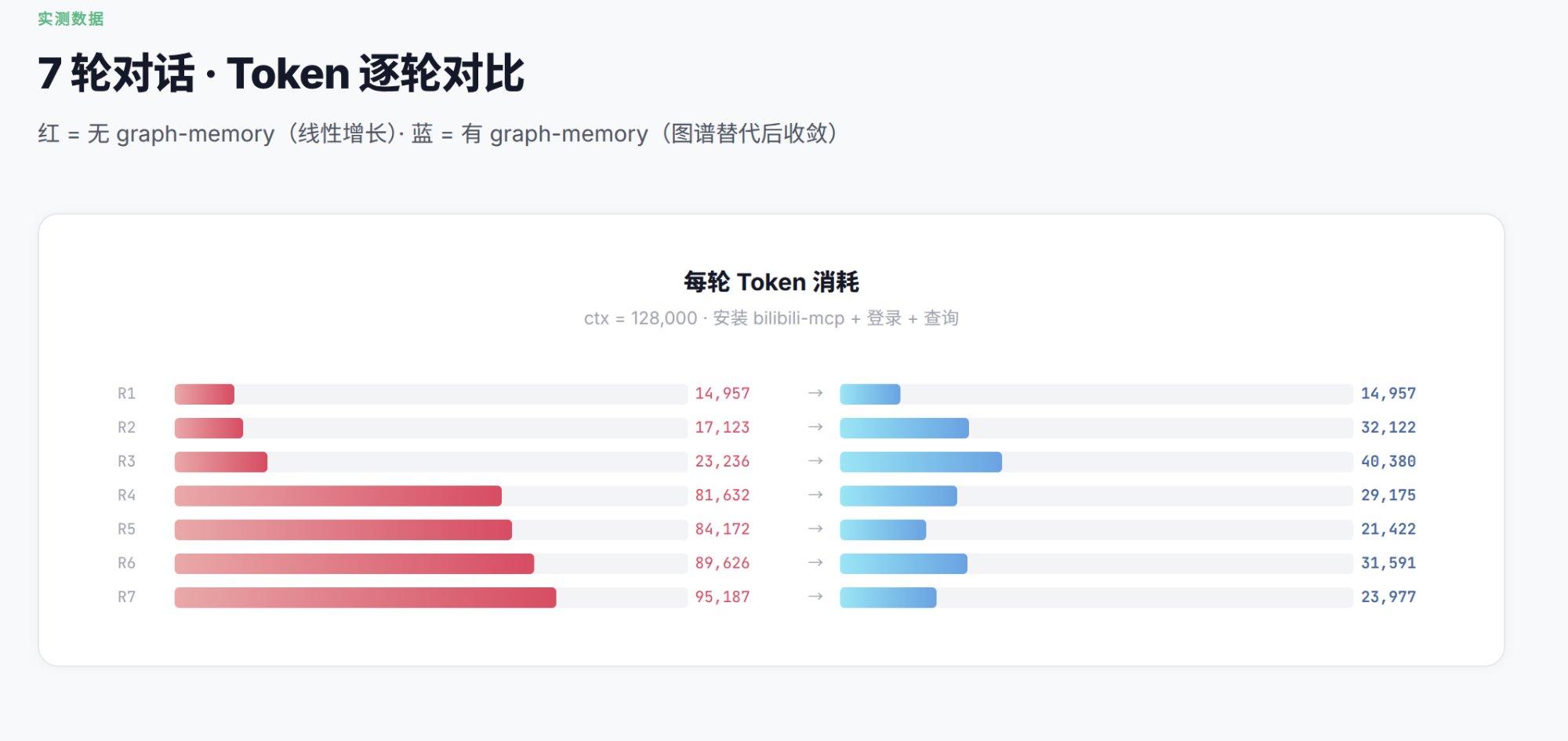
| Turn | Without Graph Memory | With Graph Memory |
|---|---|---|
| R1 | 14,957 | 14,957 |
| R4 | 81,632 | 29,175 |
| R7 | 95,187 | 23,977 |
The measured reduction at R7 was approximately 75% in that specific workflow. This is a scenario-level comparison, not a universal savings guarantee; the mechanism is replacing indiscriminate history replay with a relevant knowledge subgraph.
Project evolution
The DSH integration does not discard the original project. Graph Memory is evolving from an OpenClaw memory plugin into a graph-memory core that different agent harnesses can load natively.
| Stage | Deliverable | Status |
|---|---|---|
| OpenClaw origin | Context Engine, cross-session graph memory, dual-path recall | Maintained |
| Community graph engine | SQLite, FTS5, vectors, graph ranking, provenance | Available |
| DeepSeek Harness | Cordis adapter, native tools, auto-recall, Credentials | Implemented and tested |
| Graph Memory Pro | Visual graph workbench, controlled drag-and-drop, optional Neo4j | Architecture reviewed; DSH Host and Client Plugins not yet implemented |
On March 15, 2026, the project owner presented Graph Memory's architecture at the CLAW program event held in Tsinghua Science Park. The following owner-supplied materials and the Sina Finance event report document that development.


The image below is the existing OpenClaw / ClawX-era Pro graph prototype. It demonstrates a previously explored interaction direction; it is not a shipped DSH frontend.
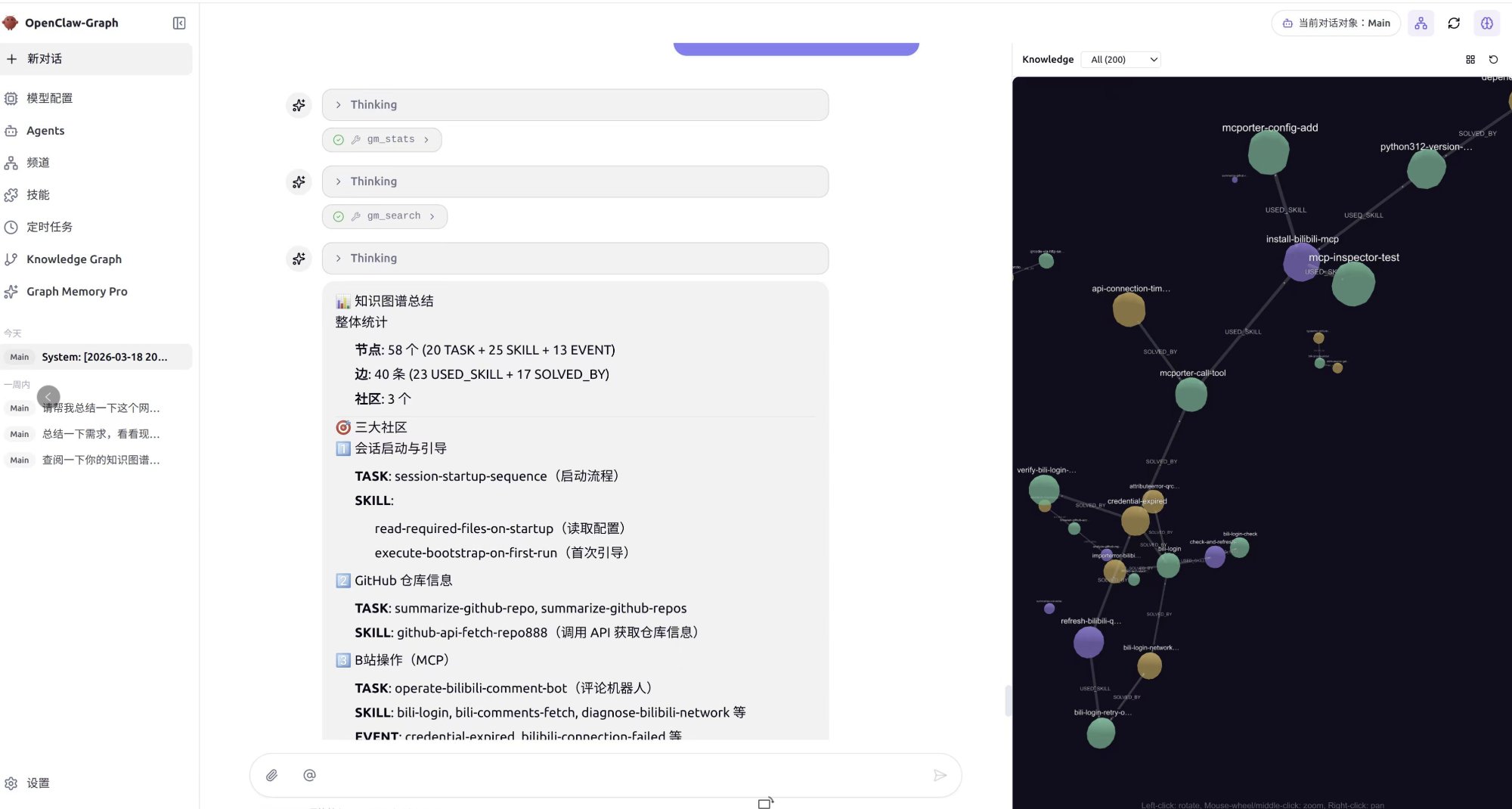
Names and venue information document project history only and do not imply endorsement by Tsinghua University, Sina Finance, DeepSeek, or OpenClaw.
Graph Memory architecture
Typed knowledge graph
TASK   ──USED_SKILL──▶ SKILL
TASK   ──SOLVED_BY───▶ EVENT
SKILL  ──REQUIRES────▶ SKILL
EVENT  ──PATCHES─────▶ SKILL
SKILL  ──CONFLICTS_WITH──▶ SKILL
Nodes retain episodic user/assistant provenance. This preserves the context in which knowledge was created, not only a lossy summary.
Dual-path recall
flowchart LR
  Q[Current query] --> EXACT[Exact path]
  Q --> GENERAL[Generalized path]
  EXACT --> SEARCH[Vector / FTS5]
  SEARCH --> EXPAND[Community expansion + traversal]
  GENERAL --> SUMMARY[Community-summary match]
  SUMMARY --> MEMBERS[Community members]
  EXPAND --> PPR[Personalized PageRank]
  MEMBERS --> PPR
  PPR --> CONTEXT[Deduplicated local context]
Host data flow
flowchart LR
  USER[User message] --> SESSION[DSH Session Events]
  SESSION --> ADAPTER[Graph Memory Cordis Adapter]
  ADAPTER --> EXTRACT[Structured Extraction]
  EXTRACT --> GRAPH[(SQLite / FTS5 / Vectors)]

  USER --> RECALL[Semantic + Lexical Recall]
  GRAPH --> RECALL
  RECALL --> RANK[Community Expansion + PPR]
  RANK --> PROMPT[Prompt Assembly]
  PROMPT --> LOOP[DSH Agent Loop]

  CREDS[DSH Credentials] --> ADAPTER
  TOOLS[gm_* Tools] --> ADAPTER
The code follows a host-neutral core plus host adapters:
graph-memory/
├── dsh.ts                 # DeepSeek Harness / Cordis adapter
├── index.ts               # OpenClaw adapter
├── cordis.patch.yml       # DSH bundle entry
└── src/
    ├── extractor/         # conversation → TASK / SKILL / EVENT
    ├── recaller/          # vector, FTS5, graph expansion and recall
    ├── graph/             # PageRank, communities and deduplication
    ├── store/             # SQLite schema and queries
    ├── format/            # safe context assembly
    └── engine/            # LLM and embedding providers
Native DeepSeek Harness status
| Capability | Status | Notes |
|---|---|---|
| Native Cordis loading | Done | No DSH fork required |
| Cross-session auto-recall | Done | Injected during Prompt Assembly |
| Explicit record and search | Done | gm_record, gm_search |
| Vector backfill and migration | Done | Model, dimension, and fingerprint tracked |
| Visible plugin state | Done | Active in Plugin Inventory |
| Pro visual workbench | Not shipped | Requires a DSH Client Plugin |
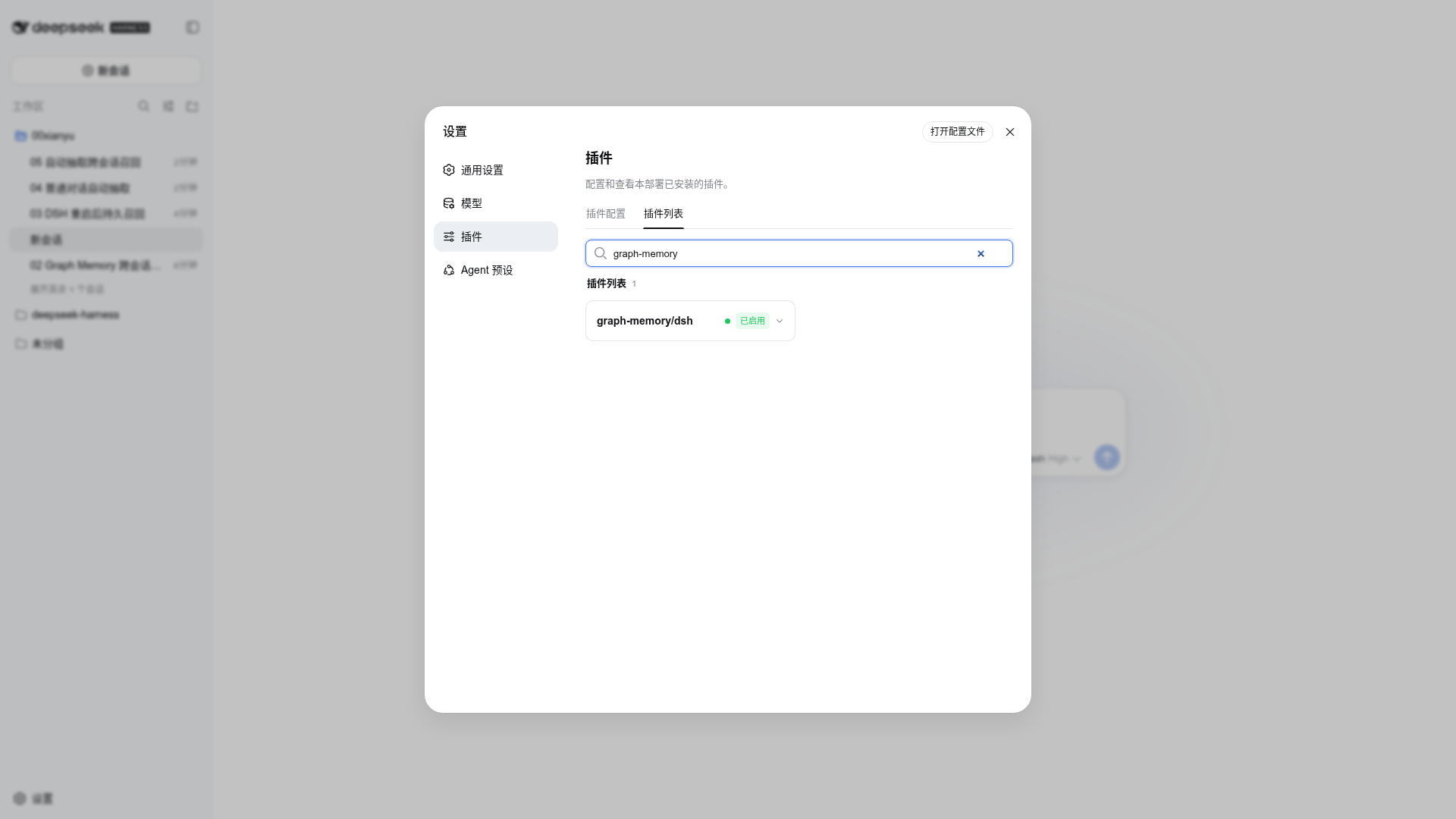
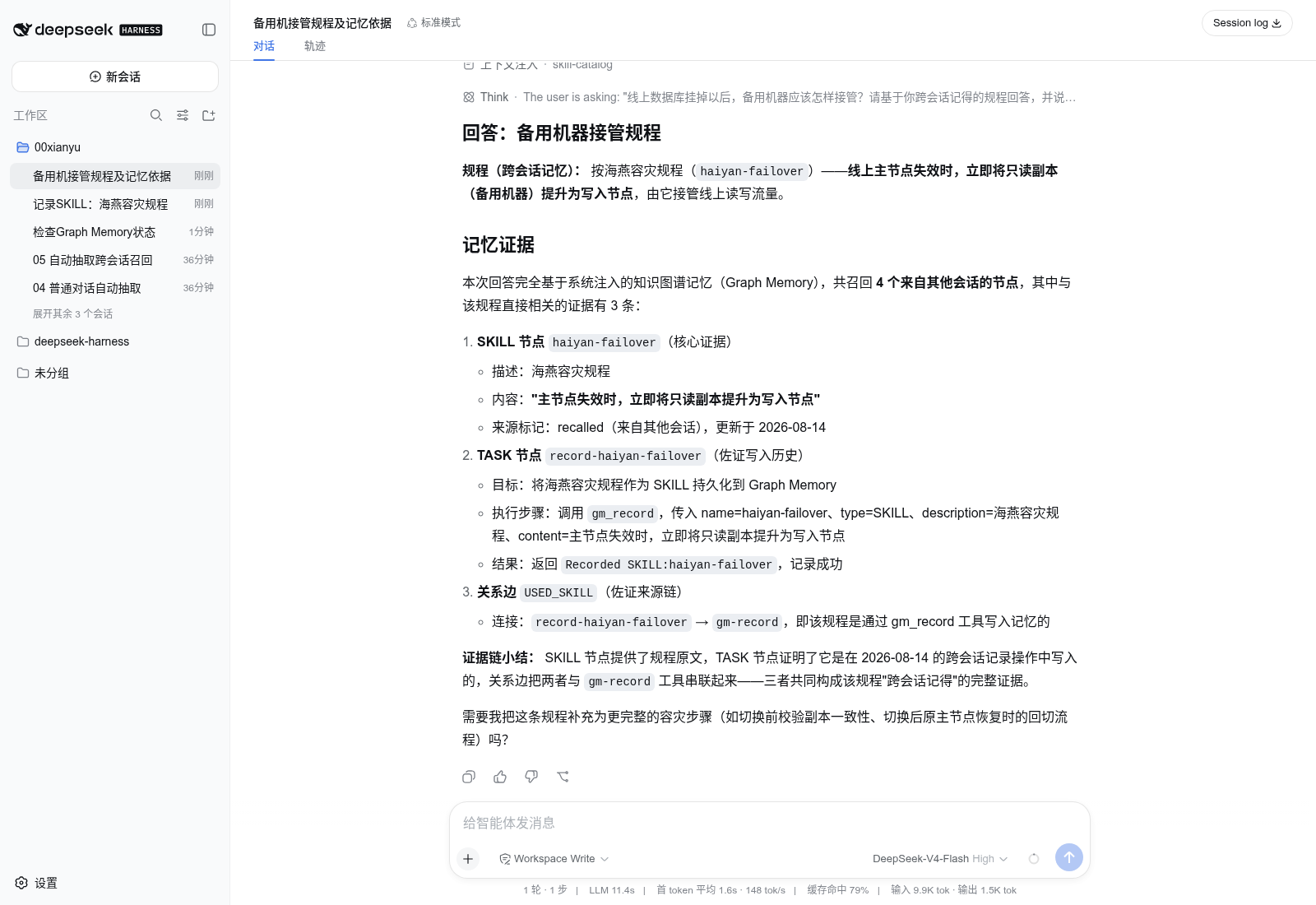
Current beta: 1.6.0-beta.1. Local acceptance used DeepSeek Harness 0.1.0-rc.5. DSH remains in Developer Preview and may introduce compatibility-breaking changes. Testing covered tarball installation, active plugin state, 1024-dimensional vector backfill, semantic recall across Sessions, persistence across restarts, and FTS5 fallback. All 107 automated tests passed.
Plugin enabled: graph-memory/dsh is active in the DSH plugin list
Cross-session semantic recall in a fresh Session
Install on DeepSeek Harness
Prerequisites: Node.js 22.19+ or 24+. The current beta is not yet published to npm, so build the tarball from source:
git clone https://github.com/123caiji/dsh-memory-toolkit.git
cd graph-memory
npm ci
npm test
npm run build
npm pack
Install the generated tarball into the DSH Web profile:
npx @deepseek-ai/dsh plugin --profile web add /absolute/path/to/graph-memory-1.6.0-beta.1.tgz
npx @deepseek-ai/dsh --profile web --dump-config
npx @deepseek-ai/dsh web

# From a deepseek-harness source checkout:
pnpm dsh plugin --profile web add /absolute/path/to/graph-memory-1.6.0-beta.1.tgz
pnpm dsh web
After installation, verify that graph-memory/dsh is enabled under Settings → Plugins → Plugin list.
Default store:
$DSH_HOME/graph-memory/graph-memory.db
Without DSH_HOME, this is normally ~/.dsh/graph-memory/graph-memory.db.
Optional vector retrieval
Do not send secrets in chat. Cordis stores only a credential reference; DSH credentials resolves the real value for each embedding operation.
DashScope example:
export GRAPH_MEMORY_EMBEDDING_API_KEY='replace-with-your-key'
export GRAPH_MEMORY_EMBEDDING_BASE_URL='https://dashscope.aliyuncs.com/compatible-mode/v1'
export GRAPH_MEMORY_EMBEDDING_MODEL='text-embedding-v4'
export GRAPH_MEMORY_EMBEDDING_DIMENSIONS='1024'
dsh web
Without embeddings, Graph Memory continues with FTS5 and does not block conversation.
DSH tools
| Tool | Purpose |
|---|---|
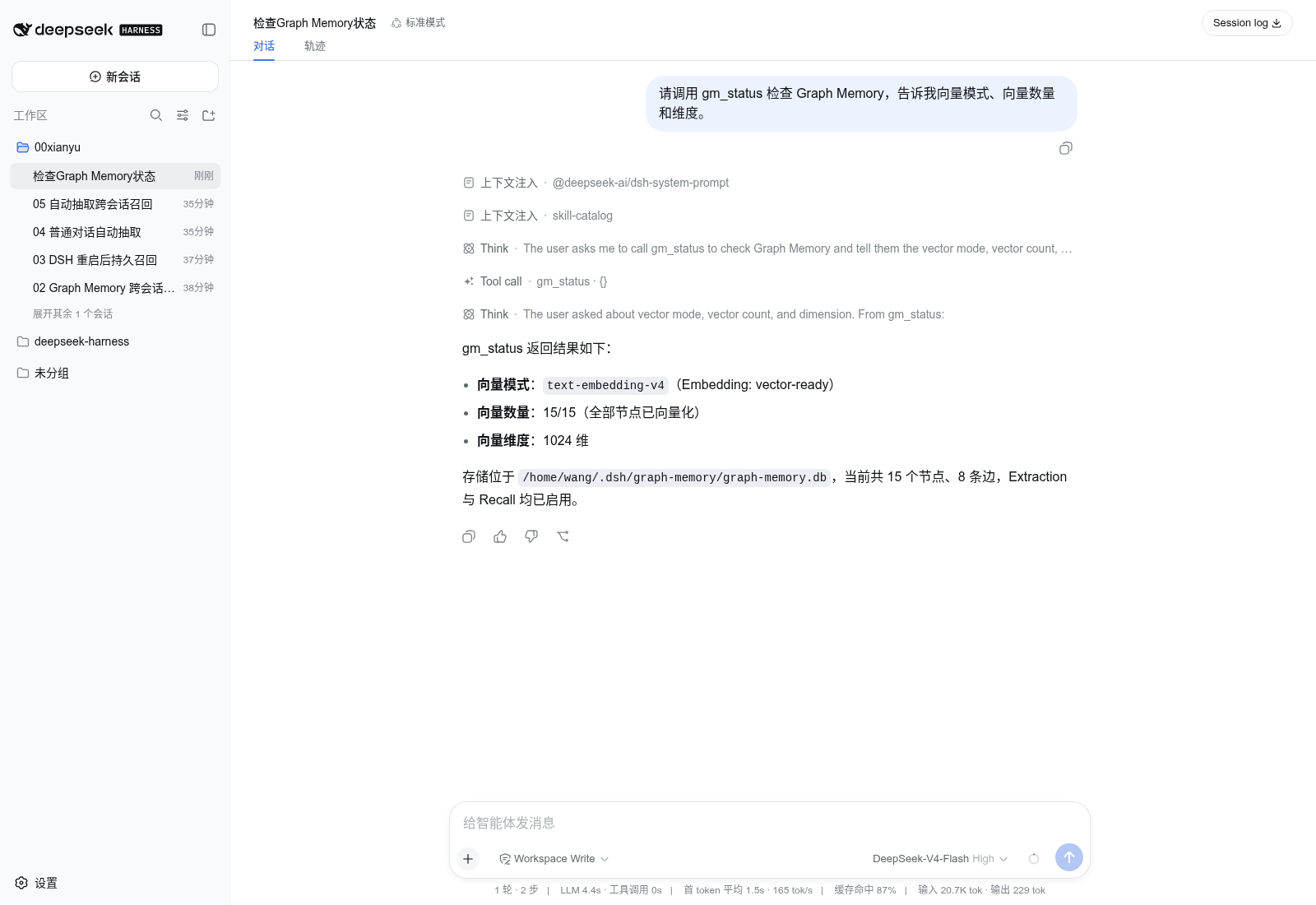
gm_status | Plugin, store, extraction, recall, and vector state |
gm_search | Explicit long-term graph search |
gm_record | Persist a TASK, SKILL, or EVENT |
gm_stats | Node, edge, type, and community statistics |
Automatic recall does not require an explicit gm_search tool call. The plugin retrieves relevant memory during Prompt Assembly.
Development
npm ci
npm test
npm run build
npm pack
Release checks:
- tests and TypeScript build pass;
- tarball contains
dist/dsh.jsandcordis.patch.yml; - no API keys, local databases, or environment files enter the repository;
- planned Pro features are never presented as shipped Community behavior.
Current limitations
- Automatic extraction depends on auxiliary-model output stability. Use
gm_recordfor critical beta knowledge. - DSH does not yet expose
gm_updateandgm_maintain; those remain OpenClaw-entry tools. - The Pro DSH visualization client plugin is not implemented.
- npm registry publication is pending; install the current beta from a GitHub-built tarball.
Privacy and security
- Memory remains in local SQLite by default.
- API keys come from host credentials or environment variables, not the database or Cordis patch.
- Recalled history is reference material; current user instructions always take precedence.
- Rotate any secret that has appeared in chat, logs, or screenshots.
License
MIT © 2026 adoresever, 123caiji
See docs/ATTRIBUTIONS.md for asset, logo, and trademark notes.