Morriaty-The-Murderer/dsh-plugin-abtest ↗★ 0
dsh-plugin-abtest
DSH 插件的配对实验与晋级门禁工具
AI 分析
核心用途是在隔离环境中并行运行当前插件与修改版插件,对比任务成功率和 Token 消耗。适合需要在发布前对 DSH 插件变更进行严谨 A/B 测试的开发者。
安装
npx -p @deepseek-ai/dsh dsh plugin --profile web add github:Morriaty-The-Murderer/dsh-plugin-abtest说明文档
阅读完整 README ↗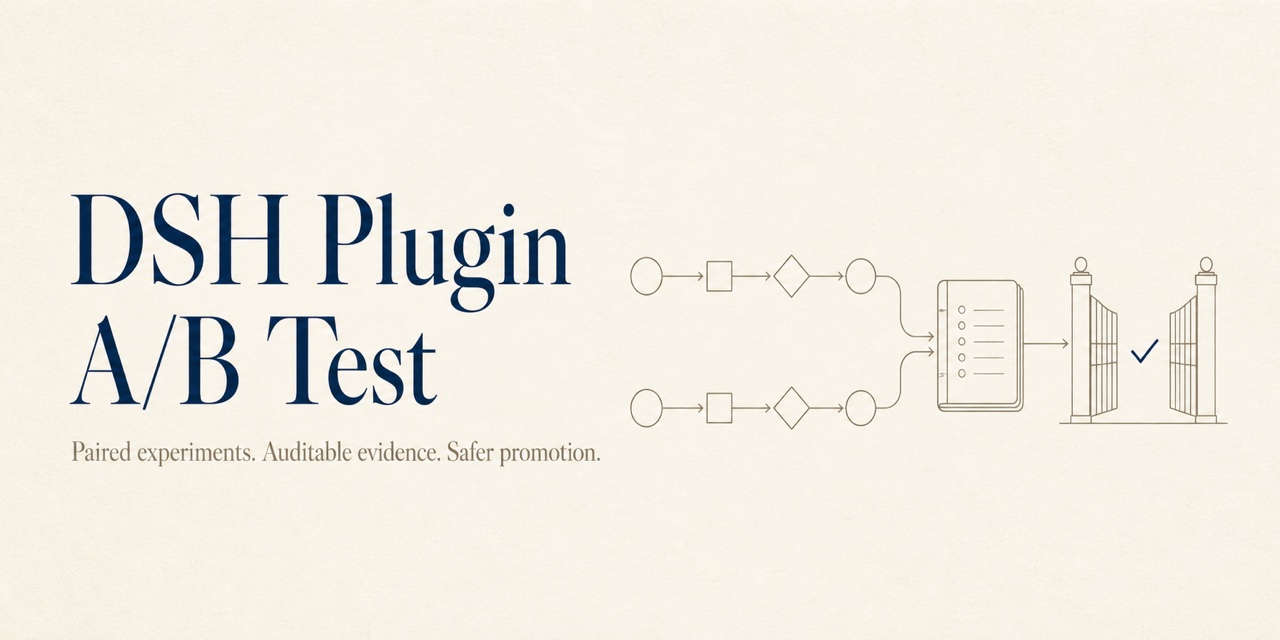
English · 简体中文
DSH Plugin A/B Test
Test a DSH plugin change on the same tasks before you ship it.
DSH Plugin A/B Test runs your current plugin (Control) and proposed change (Candidate) in isolated DSH environments, pairs their results case by case, and produces evidence you can review before release.
It helps answer three practical questions:
- Did the Candidate improve task success?
- Did that improvement come with a meaningful regression in tokens, latency, or tool errors?
- Can someone else reproduce the result from the same inputs?
Every experiment ends with one of four deterministic outcomes: PROMOTE, REVIEW, REJECT, or INCONCLUSIVE. Even PROMOTE is an offline recommendation only—this project never changes your real DSH profile or publishes a plugin for you.
See the decision first
This is a real result from the repository's offline example, with unrelated fields omitted:
{
  "outcome": "PROMOTE",
  "validPairCount": 2,
  "invalidPairCount": 0,
  "triggeredRules": ["primary.superiority"]
}
Alongside the decision, you get raw session evidence, assertion results, pair-level deltas, and reports in JSON, Markdown, and HTML. The model does not choose the outcome; deterministic rules from the experiment manifest do.
Quick start
The current MVP runs from source and requires Node.js ^22.19.0 || >=24.0.0 and pnpm 11.19.0. The starter experiment uses an offline scripted provider, so no model API key is required.
pnpm install --frozen-lockfile

node --import tsx src/cli/bin.ts init --output ./my-experiment --json
node --import tsx src/cli/bin.ts freeze --manifest ./my-experiment/experiment.yml --output ./evidence --json
node --import tsx src/cli/bin.ts run --manifest ./my-experiment/experiment.yml --output ./evidence --json
node --import tsx src/cli/bin.ts decision --manifest ./my-experiment/experiment.yml --output ./evidence --json
node --import tsx src/cli/bin.ts report --manifest ./my-experiment/experiment.yml --output ./evidence --json
Open ./evidence//report.html to view the static report. To test your own plugin, edit experiment.yml, evals/cases.yml, and the two variant configurations created by init.
Understand the outcome
| Outcome | What it means | Typical next step |
|---|---|---|
PROMOTE | Evidence is sufficient, quality meets the target, and guardrails pass | Continue through your human release process |
REVIEW | Results improved, but cost, latency, error rate, or variance needs judgment | Review the pair-level evidence |
REJECT | A hard gate failed, a critical case regressed, or the gain was too small | Fix the Candidate and rerun |
INCONCLUSIVE | There were too few valid pairs, exposure was not proven, or environments were not comparable | Complete the evidence instead of treating it as a failure |
Task success is the default primary metric. You can also guard token usage, P95 latency, and tool error rate. Thresholds, minimum valid pairs, repetitions, and concurrency all live in the manifest. See the manifest reference and decision rules for details.
Why the evidence is trustworthy
- Paired tasks: Control and Candidate receive the same case, workspace fixture, and model parameters.
- Balanced order: Pair order alternates to reduce fixed first-run bias.
- Isolated environments: Each arm gets its own
DSH_HOME, profile, workspace, session root, and frozen plugin artifact. - Traceable artifacts: Sources may be a local directory, tarball, exact npm version, or pinned GitHub commit; hashes are checked again before execution.
- Proven exposure: Session events, tool calls, or plugin receipts show whether the target plugin actually participated.
- Blind comparison: An optional comparator sees anonymous A/B outputs; identity is revealed only after comparison.
- Honest infrastructure failures: Provider outages, corrupted sessions, and environment mismatches become invalid evidence or
INCONCLUSIVE, not fake Candidate regressions.
Evidence is stored under one experiment directory:
//
├── manifest.lock.json
├── control-artifact.json
├── candidate-artifact.json
├── pairs/-/
│   ├── pair.json
│   ├── measurement.json
│   ├── control/
│   └── candidate/
├── comparison.json
├── decision.json
├── report.md
└── report.html
Completed pairs are reused by later run commands, and partial state is never silently overwritten. If inputs change or evidence is damaged, use a new output root.
Connect to real DSH
Non-mock providers invoke the exact pinned version @deepseek-ai/dsh@0.1.0-rc.7. Add model credentials and other environment variables by name to extensions.environment_allowlist. Fingerprints and artifact metadata store only the allowlist hash, never the original values.
Plugin and test-command stdout, stderr, and session logs are retained as raw evidence, so integrations must still avoid printing secrets.
The CLI is a trusted local automation boundary and may run commands explicitly declared in the manifest. Optional DSH/Cordis tool entry points are model-facing, so they reject experiments containing command_test rather than becoming arbitrary command-execution tools.
The complete CLI includes init, validate, freeze, run, status, compare, decision, and report. Stable exit codes and the live-model smoke procedure are documented in the verification record.
Development
pnpm identity:check
pnpm lint
pnpm typecheck
pnpm test
pnpm test:integration
pnpm test:rename
pnpm build
pnpm pack --dry-run
This project is currently an MVP and is not published as an npm package. See the architecture and upstream audit for implementation and security boundaries.
Public names, the npm package name, and the CLI name are managed from project.identity.json. A real rename test prevents stale public identity from surviving a rename; see the identity guide. Stable protocol identifiers do not change with the project brand.