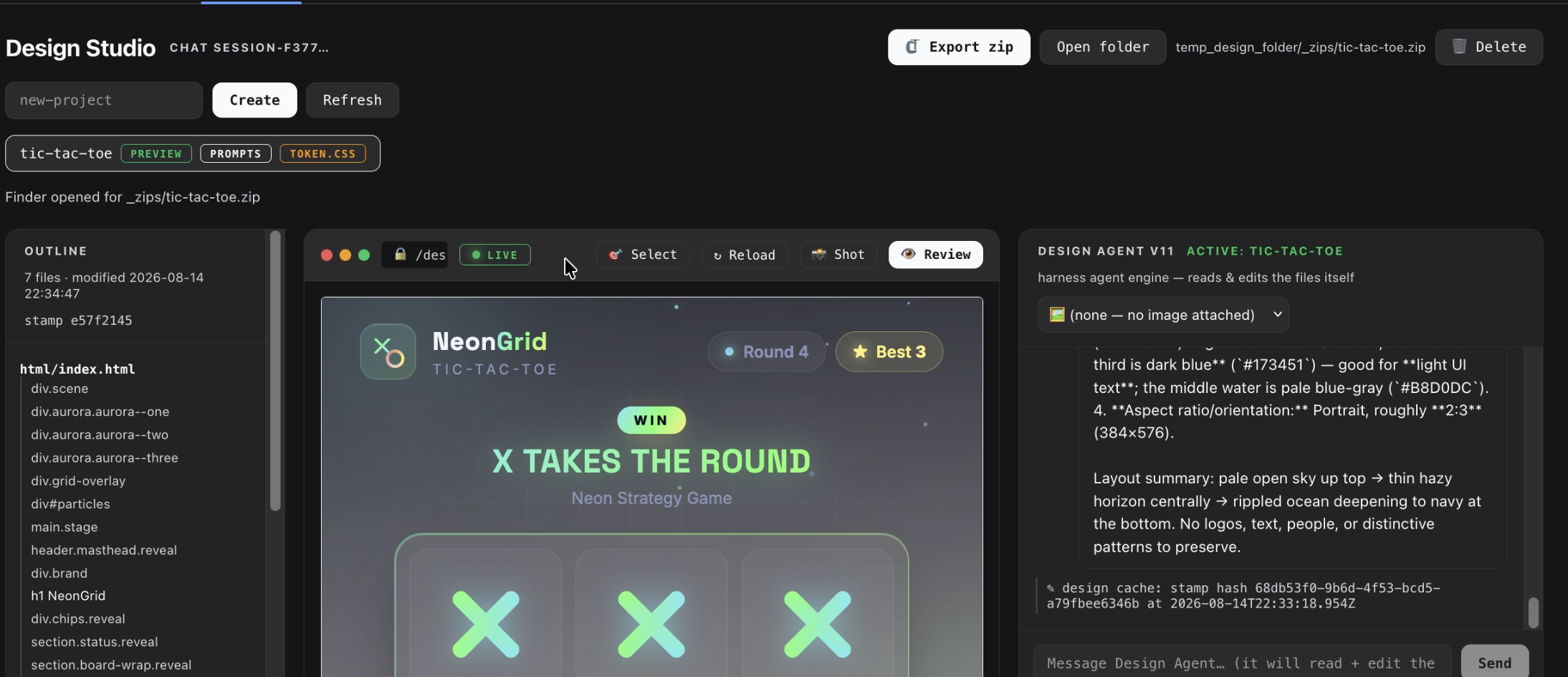
Persistent dual-face Design Studio plugin for the DSH harness: the design_studio agent tool (design systems under temp_design_folder/, identity presets, OpenRouter vision review, and a real harness-subagent design agent that lists, reads and edits the design files itself), the /design-studio live-preview route + JSON API, a design-brief prompt section, and the built-in Design Studio web UI (conversation tab, agent chat, settings pages). Install once — the tab appears on every launch. Zero runtime dependencies (plain JS).
A DeepSeek Harness plugin that turns design mockups into a first-class AI workflow.
Live previews, an element picker, a real design agent, vision review, screenshots,
identity presets — and a two-agent apply flow where DeepSeek edits and the design
agent verifies. Everything is backed by real files on disk under temp_design_folder/,
and everything is launch-persistent: install once, the Design Studio tab is there
on every launch.
Screenshots
@sal7one/dsh-design-studio · DSH Hub
Click any thumbnail for the full-size image.
dsh-design-studio/
├── package.json          # dual-face manifest: dsh.bundle (host) + dsh.client (web UI)
├── cordis.patch.yml      # the composition layer this bundle contributes
├── README.md             # this file
├── LICENSE               # MIT
├── repo-images/          # UI screenshots shown at the top of this README
├── lib/
│   ├── index.js          # HOST half: design_studio tool, /design-studio route + JSON API,
│   │                     #   design-agent engine, freshness stamps, auto-verification
│   └── client.js         # WEB UI half: conversation tab, element picker, agent chat, settings
├── examples/             # example design systems (html/css/js mockups + presets)
└── dynamic/              # legacy dynamic-plugin prototype (reference only — not needed)
✨ Features
Core platform
One command, persistent — a dual-face dsh.bundle + dsh.client package:
dsh plugin add once, and the tool, the preview route, the prompt section and the
Design Studio tab are all present on every launch. No build step, no TypeScript,
zero runtime dependencies (plain JavaScript).
design_studio agent tool — your assistant (and any subagent) can
list / all / create / read / write / zip / reveal / delete / sweep design systems,
manage identity presets, run vision reviews, chat with the design agent, read its
history, and configure the studio — all scoped to temp_design_folder/ design folders.
Live preview route — /design-studio//html/index.html, served by the
harness web server; the studio tab embeds it in an iframe with hot reload on save.
Design-brief routing — a system-prompt section turns operator screen briefs into
design systems automatically.
Design systems
Mockup-scoped files — every design system is html/index.html,
css/style.css, css/token.css, js/app.js (minimal presentation) plus
design_prompts_forcoders.md (the brief the coding agent follows) and
assets/images/ for uploads. Mock data stays honest — empty/loading states,
never fabricated live numbers.
Per-conversation ownership — each design system is bound to the conversation
that created it; the tab shows only your chat's designs (unbound legacy systems
are adopted on first list).
Drop zones — drop images or code files onto the tab; images land in
assets/images/ and auto-select in the agent chat picker.
Zip export + Finder reveal + delete — _zips/.zip (files only), open -R,
and shell-free recursive delete that works even on hosts with no POSIX shell.
Design agent (real harness subagent)
It does the work itself — the agent chat runs a harness subagent (spawn
engine, design-studio persona) that lists, reads and edits the design files across
multiple tool calls per message, then summarizes file-level changes.
Live activity — its reads/edits stream into the chat as they happen, with
inline errors, a persisted per-system history, and run timeouts.
Vision pre-pass — images explicitly selected in the picker (or mentioned by
filename) are pre-described by your configured vision model, so "the image"
always means the right one and the agent never guesses between assets.
Design-cache discipline — on every turn (even a bare "ok") the agent verifies
the freshness stamp, reports whether the design changed since its last turn,
adopts the latest files as truth, and asks what you want when the request is vague.
🎯 Element picker + two-agent apply flow
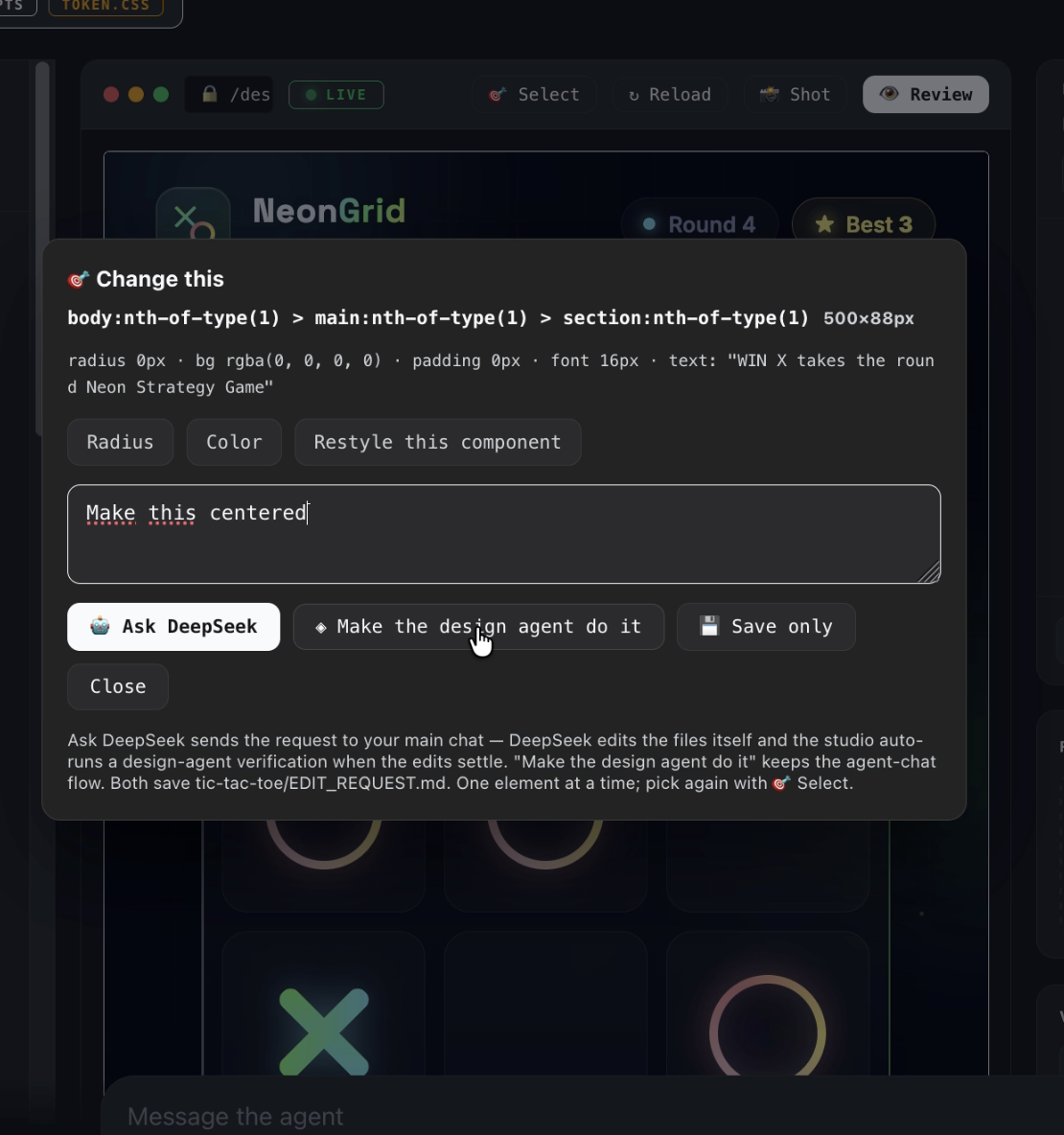
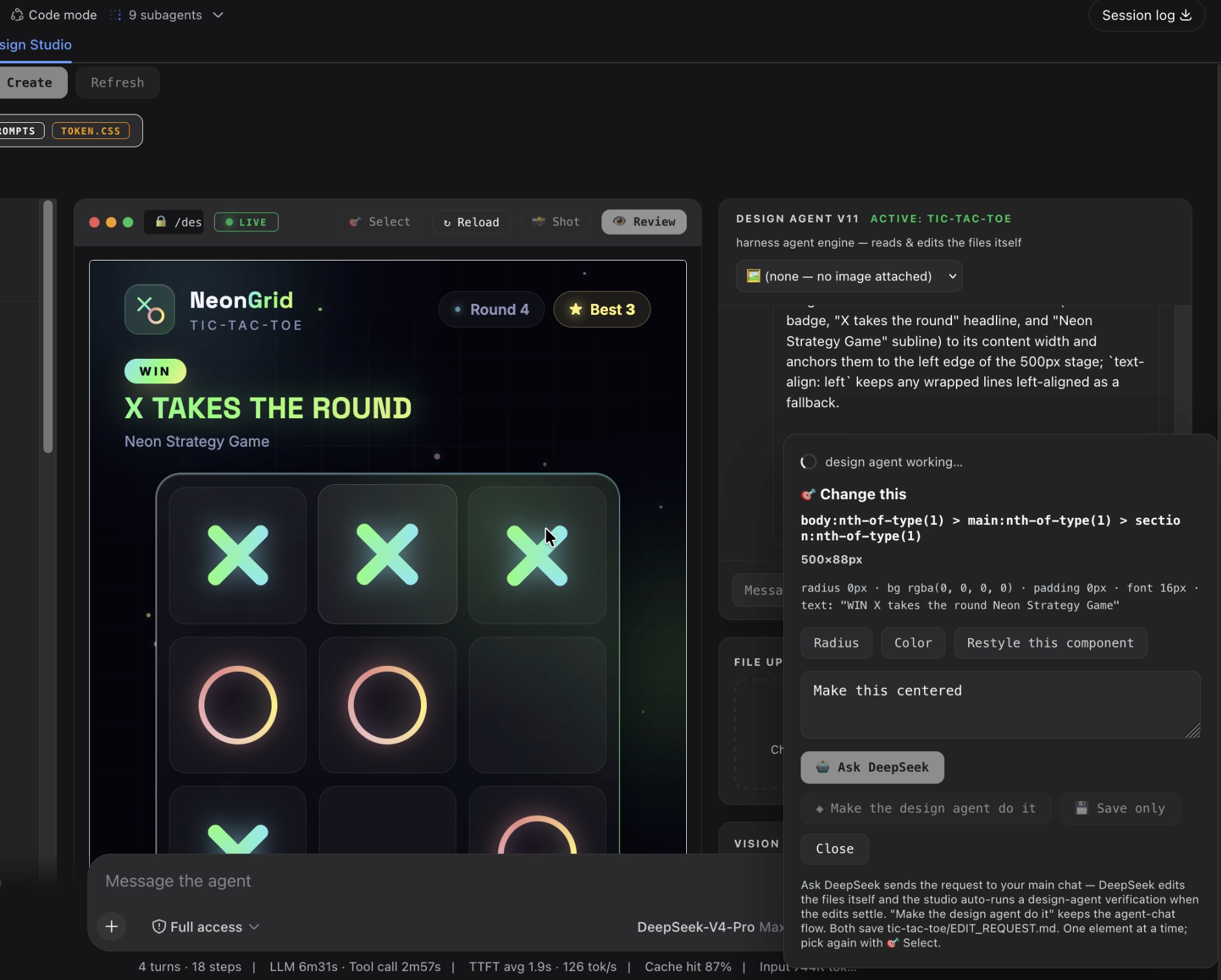
Click 🎯 Select, click any element in the live preview, describe the change:
Button
What happens
🤖 Ask DeepSeek(default)
Saves EDIT_REQUEST.md, injects the request into your main chat. DeepSeek edits the files itself and invokes the design agent only when it needs vision (the tool routes it explicitly). A live run banner tracks queued → working → finished in the tab, and the studio auto-runs a design-agent verification once the edits settle — guaranteed designer involvement, not a hope.
◈ Make the design agent do it
The classic flow: the design agent applies the change itself and replies in its chat.
💾 Save only
Just writes EDIT_REQUEST.md — apply later from either chat.
Freshness stamps (multi-agent safety)
Every design change bumps a stamp {hash, at} (fresh random hash + ISO time,
latest-status only) — the plugin detects changes from any editor via the
harness fs/observed stream, plus synchronous bumps on its own write paths.
Agents compare their remembered hash with the current one: drift ("changed since
your last turn") is surfaced in prompts and tool output, and the design agent
records a per-turn design cache so the next turn can prove UNCHANGED/CHANGED.
Vision, screenshots & presets
📸 Shot — capture a screen region (screencapture on macOS) straight into the
design system's assets/images/.
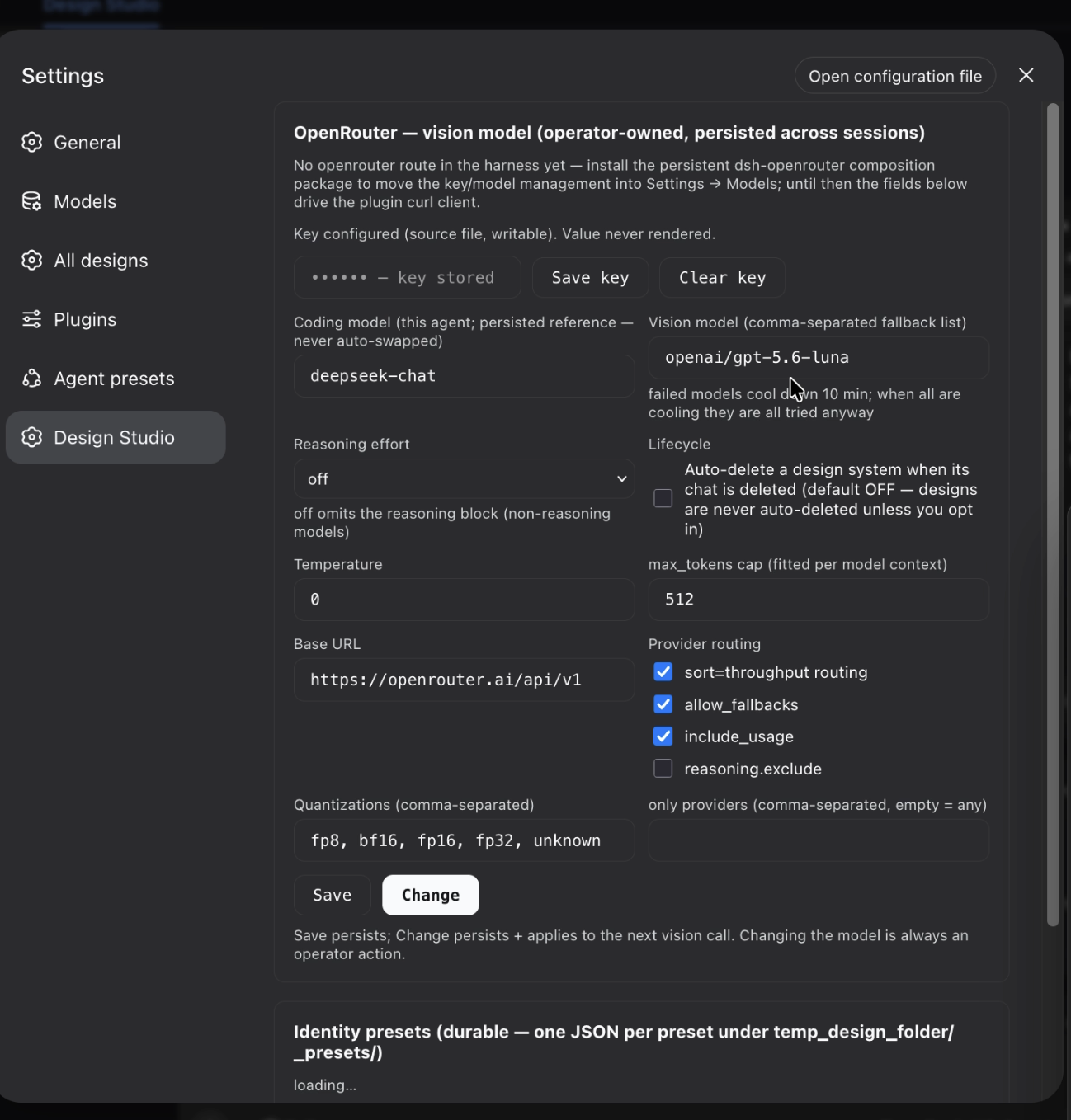
👁 Review — honest GOOD | POOR verdict + one-sentence notes from your
OpenRouter vision model against the brief (configurable models, effort, options).
Identity presets — save palettes/typography/logos as presets; preset_apply
writes css/token.css and copies logo assets. Credentials are handled through the
harness credential seam (OPENROUTER_API_KEY) — the key is never rendered or returned.
Settings & data
Settings → Design Studio / All designs pages: config, key status, system list,
zip/reveal/delete per design.
Everything survives restarts — designs, presets, config, reviews and agent
history live on disk under temp_design_folder/.
Quick start
Works with both harness distributions — the npm distribution
(npx @deepseek-ai/dsh web) and a source checkout (pnpm dsh web).
# 1. start the harness (if not running): npx @deepseek-ai/dsh web
# 2. install the plugin
dsh plugin --profile web add "github:sal7two/dsh-design-studio#main"
# 3. restart the harness so the new layers load
From a local checkout:
dsh plugin --profile web add -w /absolute/path/to/dsh-design-studio
-w is only needed when your profile directory is a pnpm workspace root
(pnpm-workspace.yaml with packages: [., packages/*]), and the path must be
absolute — a bare relative path is misread as a GitHub owner/repo shorthand.
Remove with the package name:
dsh plugin --profile web remove @sal7one/dsh-design-studio.
The bundle row is enabled by default. To keep it installed but off, override it in
your profile's own cordis.patch.yml (profile layers apply after bundle layers and win
per row):
- id: dsh-design-studio
  disabled: true
Optional: in the tab → Settings → Design Studio, paste an OpenRouter API key to enable
vision review and image description (stored via the credential seam; never shown again).
Everything else works without it.
Plain-English setup (non-power users)
Install Node.js (v22 or newer) from nodejs.org.
Start the harness:
npx @deepseek-ai/dsh web

I personally skipped npx, used npm, and installed this globally.
A browser window opens at http://127.0.0.1:3080 — that's the harness Web UI.
Install this plugin:
dsh plugin --profile web add "github:sal7two/dsh-design-studio#main"
Restart the harness (Ctrl+C, start again). The Design Studio tab now
appears in every conversation, plus Settings → Design Studio / All designs.
Design something. Create a design system, or just describe a screen to the
assistant — it routes briefs into the studio automatically. The live preview is
http://127.0.0.1:3080/design-studio//html/index.html.
Workflows
Iterate with the design agent. Open the Design Studio tab → select your design →
type a request in the agent chat ("make the status bar left-aligned", "use this image
as the background"). It reads, edits and summarizes; the preview reloads.
Pick an element and let DeepSeek change it. 🎯 Select → click the element → type
the change → 🤖 Ask DeepSeek. The request appears in your main chat, DeepSeek
edits, the tab banner tracks progress, and the design agent auto-verifies the result.
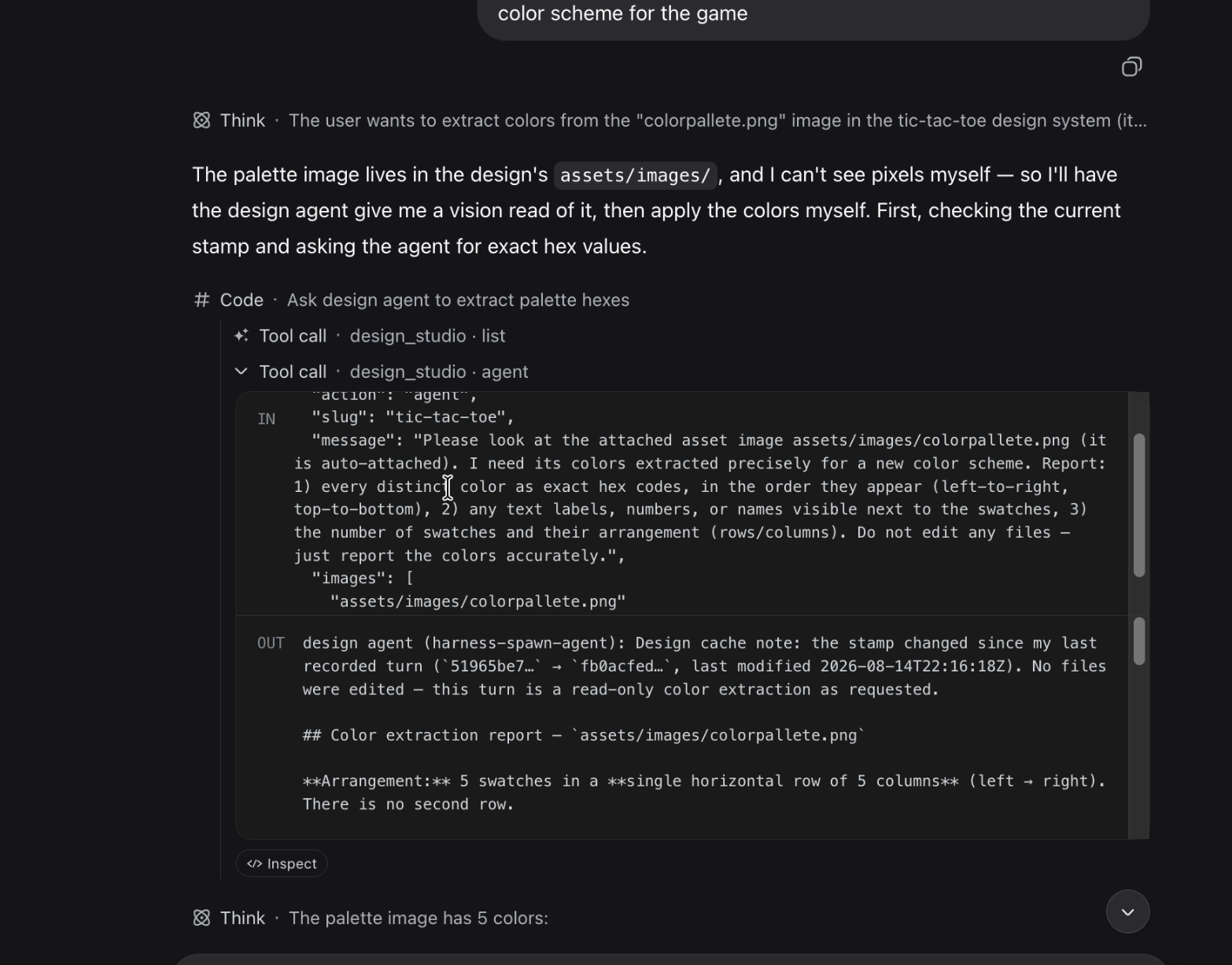
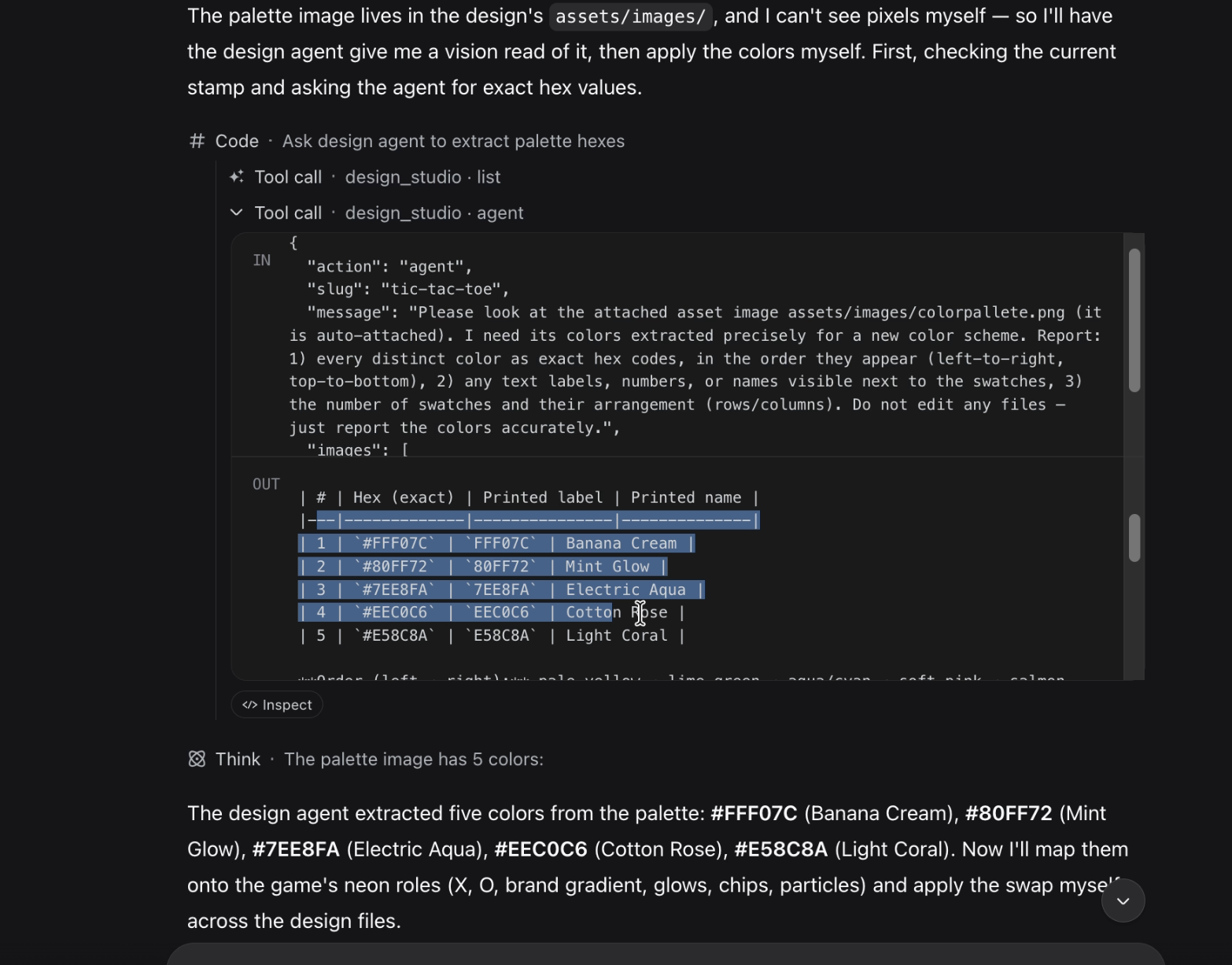
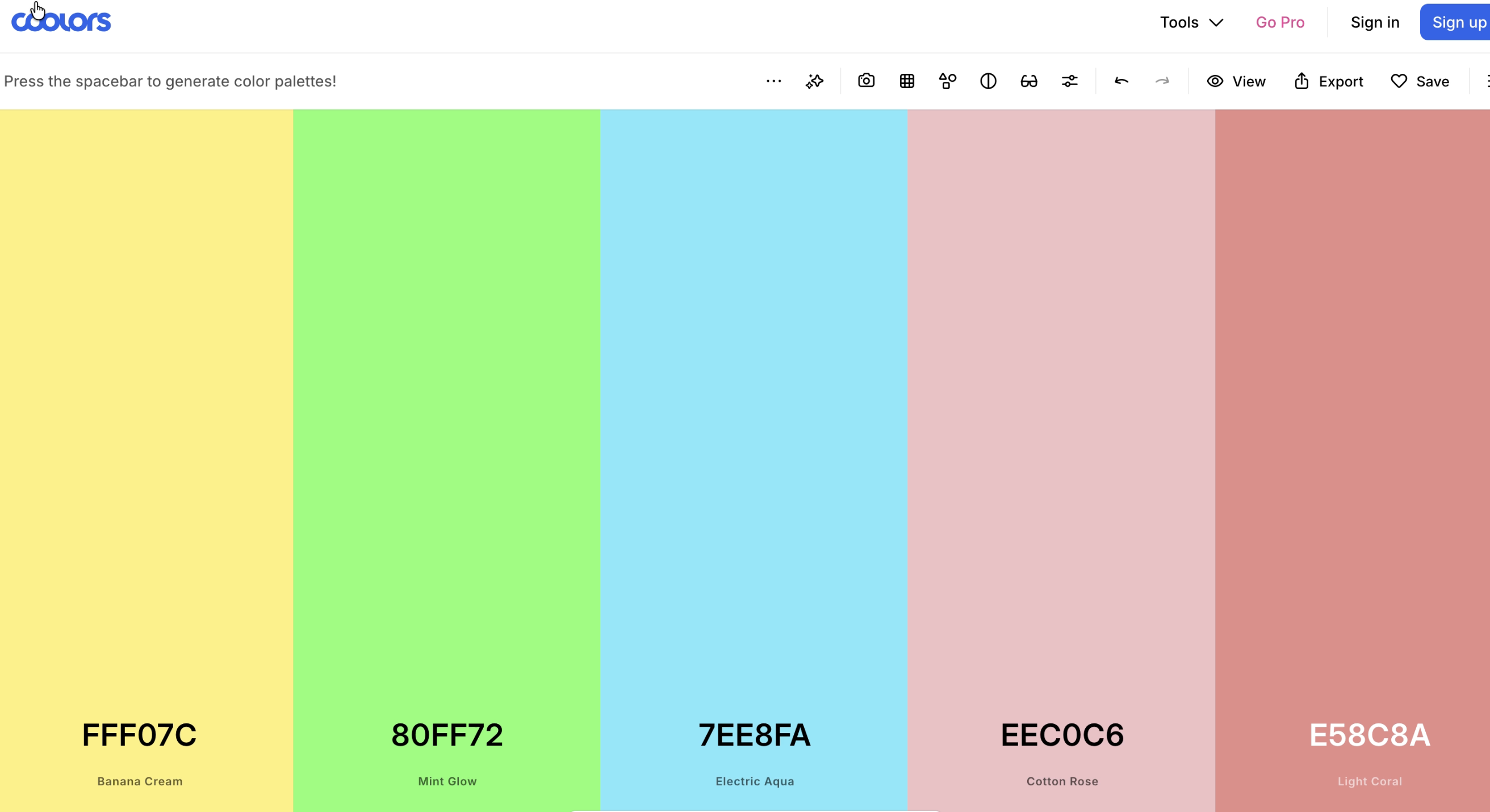
Give DeepSeek a visual job. Drop a palette image on the tab (it lands in
assets/images/), then in the main chat:
In the tic-tac-toe design, read the color palette from assets/images/palette.png
and apply it to css/token.css. Use the design agent for the visual read.
DeepSeek routes the vision work to the design agent (design_studio → agent), the
image is auto-attached and vision-described, and the result flows back into DeepSeek's
tool result.
Requirements
Node ≥ 22 and the harness (npm distribution ≥ 0.1.0-rc.5, or a source checkout of
the same generation) with the standard host services
(fs, subprocess, webServer, llm, credentials, attachments, systemPrompt, tools).
The design tree root must exist at the server process workspace root as
temp_design_folder/ (a symlink is fine).
For vision review: an OpenRouter key stored under credential reference
OPENROUTER_API_KEY, or a harness openrouter provider route.
⚠️ Compatibility notes — mistakes we already made so you don't have to
This plugin was built and broken against a moving harness base. The traps:
shell is gone at host level. The old shell executor (resolve/run) now lives
in session presets. A host row that injects shellwaits forever silently —
no boot error, no route, no tool. Inject subprocess and build shell semantics
yourself (see lib/index.js → sh()).
Hard-inject everything you register against.apply() runs as soon as its
injections resolve, which can be beforewebServer/tools/llm exist. A one-time
ctx.get() taken too early returns undefined and silently skips the route/tool/
section registration. Put integration points in inject so apply waits.
Provider keys collide with the built-in catalog. The base ships llm-pi-ai,
which natively declares openrouter (among others). Registering your own
openrouter configurable provider throws DUPLICATE_DIRECTORY and kills the whole
web boot. Check the target base's catalog before releasing a provider plugin.
Commit lib/. A harness checkout's .gitignore ignores lib/ — a plugin
committed inside one ships without its entry point. This repo lives at its own top
level and ships plain JS, so lib/index.js is committed.
Dynamic plugins die on restart. Everything in dynamic/ is in-memory by design.
The bundle is the restart-safe part. Don't promise users a persistent tab from a
dynamic package.
Client services are scope-addressed. The main chat is reachable from another
tab via sessions.scope(sessionId).get('conversation') — property access
(scoped.conversation) does not resolve the service. (This exact bug shipped
once; the fix is in lib/client.js → askDeepSeek.)