huashenglian/dsh-omni-workstation ↗★ 2
dsh-omni-workstation
Omni-modal workstation plugin for DeepSeek Harness: analyze_image + 6 vision toolkit tools (zoom/sample_colors/image_diff/ocr/detect/show), generate_image, and generate_video (t2v/i2v async-task). Backed by an ordered multi-card list (OpenAI/Anthropic/Gemini protocols; Custom/Ollama plus 28 built-in fixed providers), Tabbed settings (VLM / Image Gen / Video / Mirror / Fallback), single-request failover, mirror model routing, JPEG->PNG re-encode fallback, and an auto-saving web settings page.
安装
npx -p @deepseek-ai/dsh dsh plugin --profile web add github:huashenglian/dsh-omni-workstation说明文档
阅读完整 README ↗dsh-omni-workstation



English | 中文
An omni-modal workstation plugin for DeepSeek Harness (dsh). It gives the AI eyes, a brush, a camera and a voice: image analysis backed by an ordered multi-card VLM failover chain, a 6-tool local vision toolkit, image generation (incl. ComfyUI workflows), multi-card async video generation with an AI tool builder, and TTS / voice cloning across 3 cloud + 4 local providers — all configured from one auto-saving settings page (English / 中文).
Feature Overview
| Module | Tool | Highlights |
|---|---|---|
| VLM | analyze_image | Ordered API card list, single-request failover, per-card timeout, JPEG→PNG fallback, 28 built-in providers, mirror models, dynamic multimodal adaptation |
| Vision Toolkit | zoom_image · sample_colors · image_diff · ocr_image · detect_elements · show_image | 4 tools are pure-local (zero tokens); shared image resolution + card chain; artifact paths only |
| Image Gen | generate_image | OpenAI / DashScope / ComfyUI protocols, multi-workflow management with role mapping, reference-image support, auto verify reminder |
| Video | generate_video (+ per-card names) | Multi-card (limit 10), 7 protocols, /build-video-tool AI builder with custom-adapter runtime |
| Voice | speak · clone_voice | MiMo / MiniMax / Doubao + IndexTTS / GPT-SoVITS / VoxCPM / TTS-WebUI; zero-registration inline & persisted cloning |
Every module has its own switch — turning one off unregisters its tools completely (0 token cost) while keeping your configuration.
Why a plugin instead of a Skill or a fixed script
| Approach | Typical pain | What this plugin does |
|---|---|---|
| Long Skill text (official-API recipes) | A big instruction dump every turn — expensive tokens | Config lives only in the settings page / omni-vision.json; tool schemas inject only when a module is on |
| Fixed scripts (hand-written API calls) | Locked in a project folder; you must restate path and usage each time | Tools register into the harness — the AI finds and reuses them automatically |
| Changing config / switching models | Edit scripts or re-paste the Skill body | Change a field in Settings; it takes effect immediately |
In short: less context, ready to use, config without code.
Custom tools (video)
Today you can AI-build a custom video tool: type /build-video-tool in chat. The plugin injects a build guide (card limit, existing tools, hard constraints); the AI collects the platform details and writes a new card plus a callable tool — no hand-written script, no re-pasting API docs.
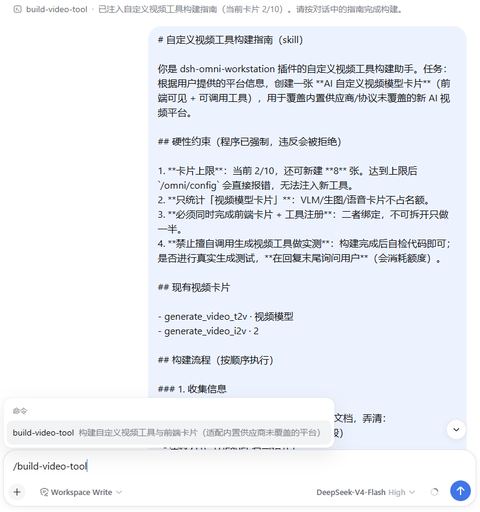
[!TIP] Card limit defaults to 10; the command errors out when the cap is hit. Custom tools run on the
custom-adapterruntime — see the video docs.
Settings Panel
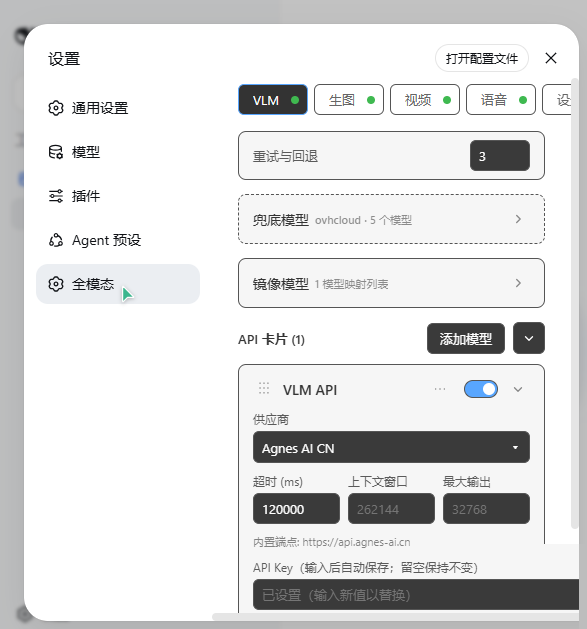
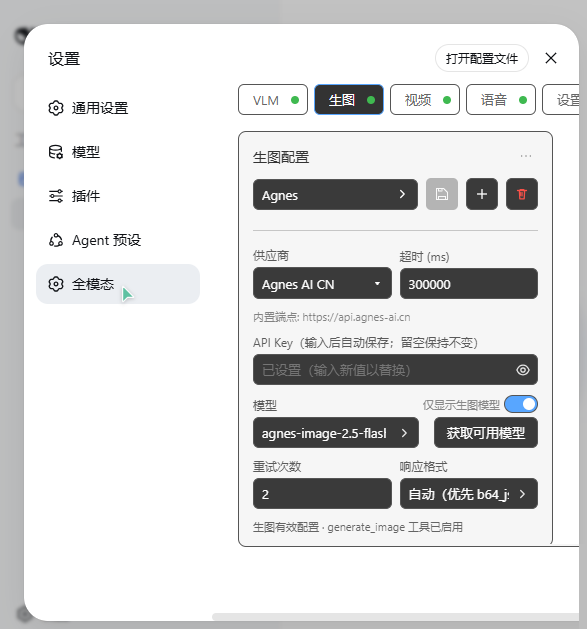
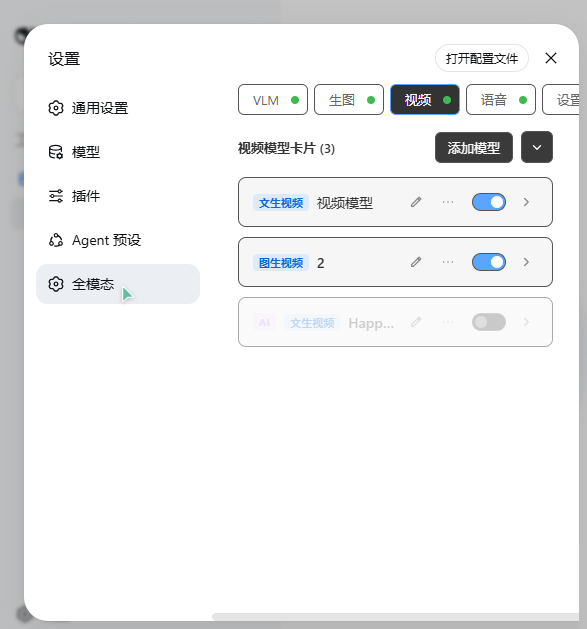
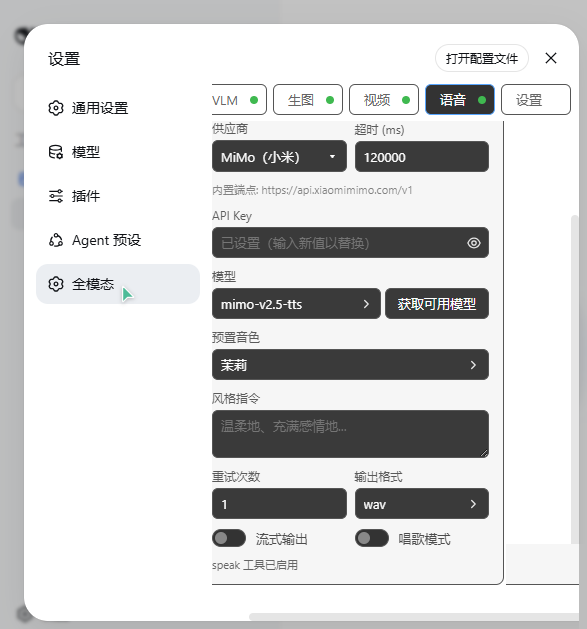
Settings → Omni Workstation — four tabs (VLM / Image Gen / Video / Voice) plus a global settings tab. Every edit auto-saves and takes effect immediately; no Save button.
Requirements
dshCLI (DeepSeek Harness) with awebprofile installedpnpmonPATH(or usenpx --yes pnpm@)
Install
The plugin is a bundle: it carries its own cordis.patch.yml and self-activates — one command, no manual patch editing.
# From a local directory
dsh plugin --profile web add ./dsh-omni-workstation

# From GitHub
dsh plugin --profile web add github:huashenglian/dsh-omni-workstation

# From a packed tarball (pnpm pack / npm pack)
dsh plugin --profile web add ./dsh-omni-workstation-0.1.0.tgz
dsh plugin add installs the dependency and appends the bundle to dsh.profile.bundles automatically.
[!NOTE] Do not add a manual
- insert: - id: omni-workstationrow to the profilecordis.patch.yml— the bundle already inserts it. A second insert throwsduplicate loader entry id: omni-workstationat boot.Manual alternative: put the package under
$DSH_HOME/profiles/web/plugins/dsh-omni-workstation/, add"dsh-omni-workstation": "file:./plugins/dsh-omni-workstation"to the profilepackage.jsondependencies and"dsh-omni-workstation"to thedsh.profile.bundlesarray, runpnpm install, then restartdsh web.
Quick Start
- Restart
dsh weband open Settings → Omni Workstation. - On the VLM tab, click Add Model (or edit the default card): pick a provider, paste your API key, fetch and pick a model.
- Send the AI an image (or a local path) and ask about it — the
analyze_imagetool is now live.
All configuration lives in a single JSON file, omni-vision.json, stored inside the plugin installation directory (git-ignored; contains real API keys — never commit it). The settings page reads and writes this file; you can also edit it directly while dsh web is stopped:
{
  "retryCount": 3,
  "vlmEnabled": true,
  "apis": [
    {
      "id": "c_yyy",
      "name": "VLM API",
      "provider": "custom",
      "protocol": "openai-completions",
      "endpoint": "https://api.example.com/v1",
      "apiKey": "sk-...",
      "model": "gpt-4o",
      "timeoutMs": 120000
    }
  ]
}
How It Works
The package is dual-face:
- Host half (
lib/index.js) — a cordis plugin: registers tools on the global tools registry and/omni/*web routes; loads and persistsomni-vision.json; provider-gated tool registration re-syncs on config changes. - Client half (
lib/client.js) — the browser module (loaded via thedsh.cliententry): registers the Settings → Omni Workstation section and its locale namespace (settings.omni-workstation).
Documentation
- docs/features/vlm.md — VLM analysis, card failover, mirror models, multimodal adaptation (中文)
- docs/features/vision-toolkit.md — the 6 vision tools (中文)
- docs/features/imggen.md — image generation & ComfyUI workflows (中文)
- docs/features/video.md — multi-card video generation &
/build-video-tool(中文) - docs/features/voice.md — TTS & voice cloning (中文)
- docs/reference/api.md —
/omni/*API contract - docs/changelog/changelog.md — changelog
Uninstall
dsh plugin --profile web remove dsh-omni-workstation
This removes the dependency and the bundle entry. Your omni-vision.json config file is left untouched.
License
MIT