keman-ai/dsh-skin-pack--packages-dsh-wukong-flame-mountain ↗★ 5
dsh-wukong-flame-mountain
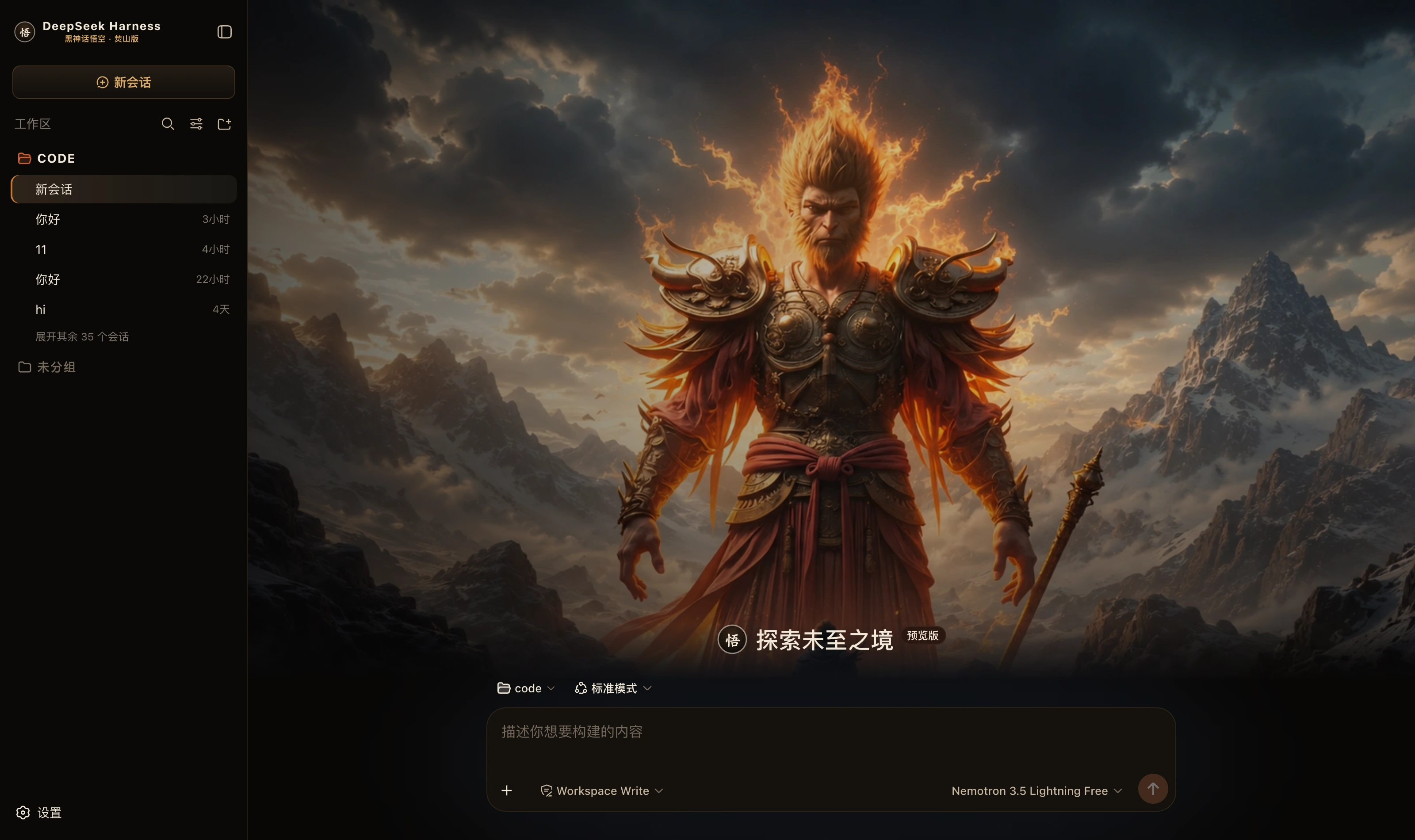
Black Myth Wukong · Flame Mountain — a dark skin for DeepSeek Harness: black ink, old gold and ember orange, with a full-bleed Flame Mountain visual on the new-session page
安装
npx -p @deepseek-ai/dsh dsh plugin --profile web add github:keman-ai/dsh-skin-pack#83e92004f8c3b52b9bf66d75aa96ddbc709bde13&path:packages/dsh-wukong-flame-mountain说明文档
阅读完整 README ↗dsh-wukong-flame-mountain · Black Myth Wukong · Flame Mountain
A dark skin for DeepSeek Harness (dsh): black ink, old gold and ember orange, with a full-bleed Flame Mountain visual on the new-session page.
What it changes
| Surface | Content |
|---|---|
| Palette | A full set of --dsw-alias-* / --dsw-specific-* semantic tokens on the dark base, plus a global 170px warp-and-weft texture |
| New session | A full landscape visual of the flame-haired Wukong with the composer at the bottom. Strong character visuals appear on the empty screen only — they collapse on entering a conversation |
| Brand slots | The sidebar and new-session marks become a gold seal bearing the character 悟, with the subtitle Black Myth Wukong · Flame Mountain |
| Status dock | Always present on the chat page: a reduced hero visual plus six kinds of real state, collapsible (the choice is remembered) |
| Identity copy | Thinking → "Thinking…", failure → "Execution failed, please retry." |
🔴 The ratios are fixed by the draft
72% black ink / 14% dark brown surface / 8% old gold / 3% bronze / 2% ember orange / 1% danger red
This is not a swatch but a usage constraint, held to line by line:
- Old gold goes to the primary action and the brand slots only, never across a surface;
- Ember orange goes only to the running semantic (
state-business-*) — the rarer it is, the more the running signal means; - even
+ New sessionis not solid gold (in the prototype it is gold text and border on a dark ground); solid gold belongs to Send alone; - the identity copy is deliberately restrained: the draft says twice to avoid over-stylised wording and to take over only the visual character and a little identity copy, with interaction, information architecture and permission logic still following DeepSeek Harness.
What the status dock shows
| Card | Fields | Source |
|---|---|---|
| Waiting on you | Tools awaiting approval, questions awaiting an answer | ConversationSnapshot.pending. Appears only when something is genuinely waiting |
| Current Session | State, elapsed turn time, current tool duration, inbox, model | running / turnTimings / runningCalls / queue; the model comes from the latest assistant message's provenance.model |
| Context | Occupancy %, token load, and the System / tool-schema / conversation composition bar | The contextPressure and contextBreakdown projections |
| Permission | The active permission and sandbox mode | The permissions projection |
| Usage | Input / output / cache hits / time spent / turns | The tokenUsage and sessionStats projections |
| Plan | Todo progress | The todos projection (the card is absent when there is no list) |
| Tool calls | Tool name · real duration · outcome | Trajectory tool-result nodes (duration = time - callTime) plus the snapshot's runningCalls. Appears only once a call has happened |
| Scroll injection | The source and form of each context injection | Trajectory context nodes (provenance.label / form) |
| Folded away | Compaction count, items and tokens folded | Trajectory compaction nodes. Absent when nothing was compacted |
⚠️ A tool duration may be absent: it can only be computed while the matching tool/call is still inside the session window. Older calls that scrolled past report only name and outcome — better blank than an invented figure.
⚠️ Composition is not a total: the three contextBreakdown figures use fixed-density estimates (systematically low for Chinese and JSON schema)
and do not add up to the token load, which is anchored to the provider's reported value. The UI says so too.
The prototype's Workspace context (which files are indexed) has no matching projection in the harness, and
Keyboard is a static cheat sheet — neither is built, and no fake data fills the space.
Install
Skin market (recommended): search for "Wukong" in dsh's skin market and install, then restart dsh.
Manual install (during development):
npm install && npm run build
DST=~/.dsh/profiles/web/node_modules/dsh-wukong-flame-mountain
mkdir -p "$DST" && cp -R lib cordis.patch.yml skin.json package.json README.md "$DST/"
# then add dsh-wukong-flame-mountain to ~/.dsh/profiles/web/package.json's dependencies and dsh.profile.bundles
After changing it you must restart dsh: the profile tree has to be recomposed, and without a restart the UI stays as it was.
🔴 The side effect of autoApply
Installing switches to this skin by default (autoApply, default true). The reason is that the harness does not persist third-party theme ids,
and the built-in Settings → Appearance has only three cells: light / dark / follow system, with no third-party themes —
switching manually requires the skin market's own panel (Settings → Skin Market).
The cost: it reapplies on every refresh, so switching away lasts only for that session. To change permanently, set autoApply to false
or uninstall the plugin. It is implemented as an 8-second window after startup (long enough to outlast the Host preference snapshot), after which it lets go entirely.
What cannot be done
- The hero's headline (the prototype sets it in a brush serif): the harness's empty-screen heading comes from the
built-in locale, and a third-party
locale.registerthrows on a duplicate name — addition only, never replacement. Forcing a pseudo-element over it would cover every other language too, so the host's own text stays. - The prototype's right-column cards (Workspace context / Keyboard): see above.
Version requirements
Requires dsh 0.1.1-rc.2 or newer. The brand-slot takeover relies on slot priority shadowing; on older versions
these three registrations throw and are swallowed, merely falling back to the official brand mark, while the palette and hero keep working.
Assets
The hero is a 1672×941 illustration compressed to webp (q92, 307 KB) and inlined into the bundle rather than linked from an image host —
from an image host — it has to work offline and on an intranet. How it is generated and its resolution ceiling are documented at the top of src/client/cover.generated.ts.
Development
npm run check   # tsc --noEmit
npm run build   # produces lib/index.js (host half) and lib/client.js (browser half)
lib/ must be committed: skins install via github:owner/repo, which installs the build output from the repository;
if the source moves and the output does not, people install the old version (and the market uninstalls the package outright over the missing entry file).
License
MIT © Science Roam Limited