dsh-stats-hud
Sci-fi HUD: turns the session stats line into game-style level bars, a speedometer and a rolling token counter.
安装
$
npx -p @deepseek-ai/dsh dsh plugin --profile web add github:lauytgary/dsh_hud_plugin说明文档
阅读完整 README ↗English · 简体中文
dsh-stats-hud
A sci-fi HUD for DeepSeek Harness: the session's stats become game-style level bars in a vertical column fixed to the far right edge of the web UI — without touching the original stats line.
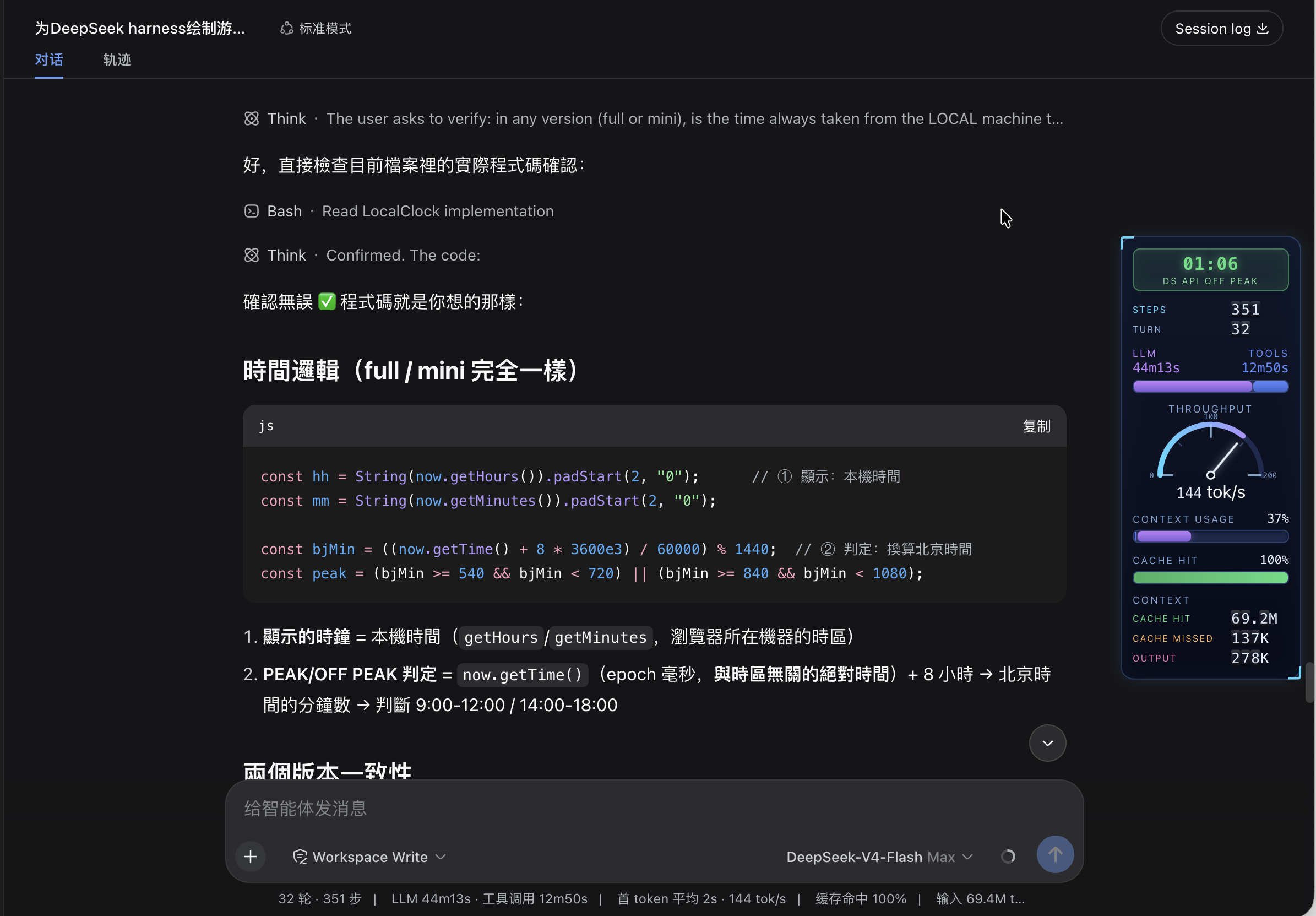
Instruments (all-English, LLM terminology)
| Instrument | Data | Full scale | Past full scale |
|---|---|---|---|
CLOCK badge | Local time (24h) + DS API PEAK / DS API OFF PEAK rate | Peak = Beijing 09:00-12:00 / 14:00-18:00 (auto-converted from local time) | PEAK orange tint, OFF-PEAK green tint |
STEPS / TURN rolling rows | Steps / turns as odometer drums (like the CONTEXT rows) | — | Drums spin up on mount, roll on change |
LLM / TOOLS dual bar | Two columns (labels over values), bar segments = raw LLM:TOOLS time ratio | No cap — 2:1 time means 2:1 bar | — |
THROUGHPUT gauge | tokens/s (throughput), centered title, combined centered readout (146 tok/s) | Redline auto-scales 200→300→400… (arc ticks follow) | — |
CONTEXT USAGE bar | Context-window usage % with 3 segments: Sys Prompt (gray) / Tools (blue) / Messages (purple) by token ratio | 0-100% | ≥80% whole bar turns solid red; hover shows the three token counts |
CACHE HIT bar | Cache-hit % | 0-100% | = 540 && bjMin = 840 && redline) redline += 100` auto-scales) |
ContextUsageBar: segment colors and the ≥80% solid-red threshold; the hover tooltip readssystemTokens/toolsTokens/messageTokensfrom thecontextBreakdownprojection- Rolling counter:
DRUM(3× 0-9),DRUM_H = 15(px per digit),RollingValue's carry/borrow formula and mount spin-up - CSS:
position:fixed; right:12px; tiers intierOf(space)(≥200full /≥90mini / else hidden) and the.gsh-root.gsh-*rules
Publishing to npm (optional)
# remove "private": true from package.json, then
npm publish
# users install with:
dsh plugin --profile web add dsh-stats-hud
License
MIT