LeemanCheung/dsh-image-gen ↗★ 3
dsh-image-gen
GPT Image 2.5 generation through Codex subscriptions or API keys, with progressive previews for DeepSeek Harness 适合需要在DSH中调用GPT Image 2.5生成图片的用户。
Other repositories with this package name
Install
npx -p @deepseek-ai/dsh dsh plugin --profile web add github:LeemanCheung/dsh-image-genREADME
Read the full README ↗dsh-image-gen




Generate images in DeepSeek Harness with OpenAI gpt-image-2.5-flare (or gpt-image-2.5-sunburst and gpt-image-2), using a signed-in Codex subscription by default or an API key when explicitly configured.
Linked development installs also resolve Codex Connect from the active DSH Profile. This uses the connector's public store, including its selected account in the current multi-account format, instead of mistaking an inaccessible optional dependency for a signed-out account. The same path has been verified against the installed Profile without displaying credential values.
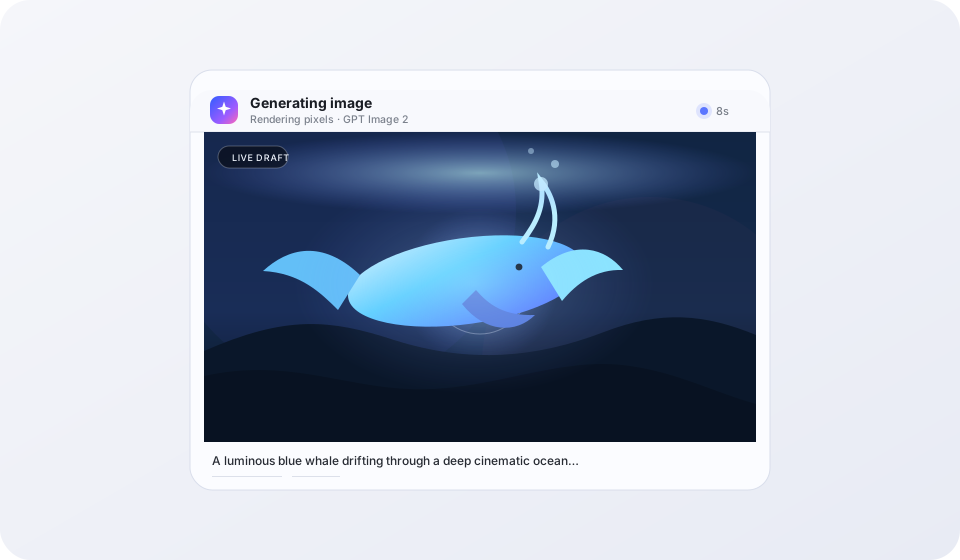
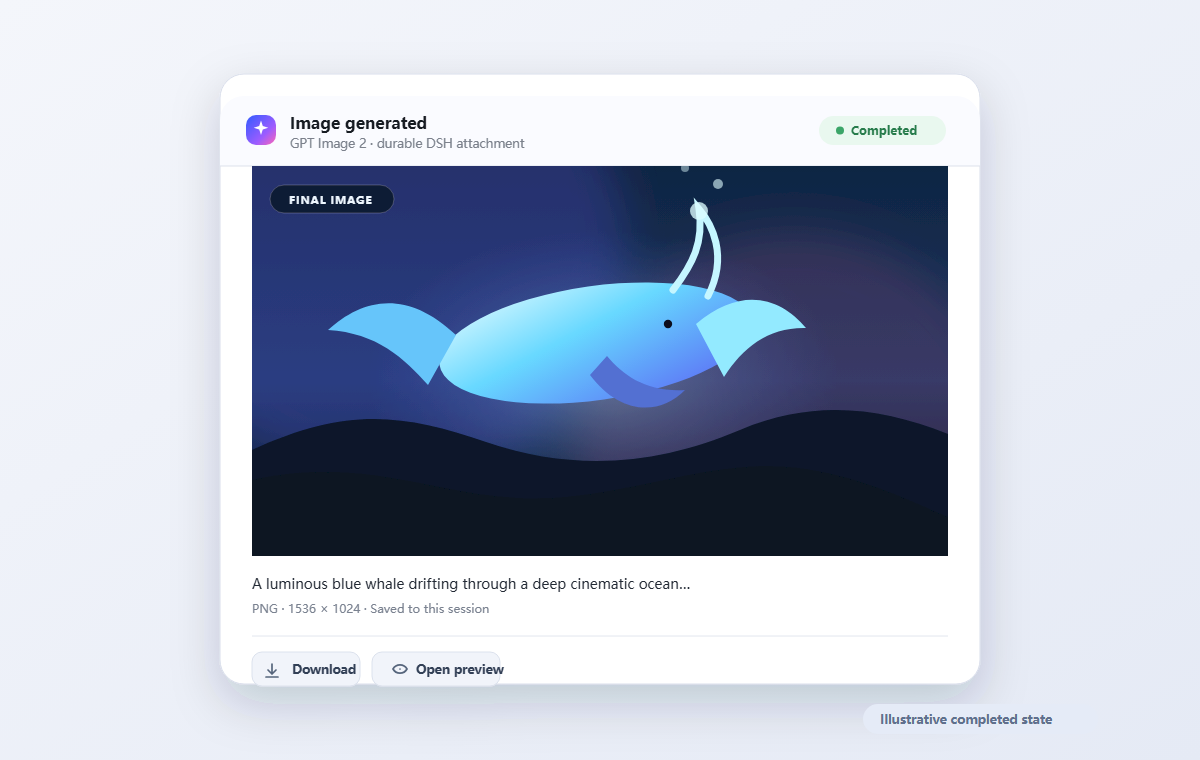
These illustrations mirror the shipped developing and completed card states. API-key mode can replace the light field with real streamed drafts; Codex subscription mode animates until its non-streaming response arrives. The completed state remains available as a durable DSH attachment with preview and download controls.
Capability map
| Area | Delivered behavior |
|---|---|
| Tool and access paths | Exposes the Codex-compatible image_gen tool for gpt-image-2.5-flare, gpt-image-2.5-sunburst, and gpt-image-2; defaults to refreshable dsh-codex-connect subscription OAuth and can explicitly use a DSH API-key credential. |
| Progressive experience | Subscription requests show a developing animation until their non-streaming result; API-key requests can show up to three provider-sent partial images, cross-faded in place. |
| Durable results | Saves only the completed image as a DSH immutable attachment, so the same card can replay, preview in a lightbox, and download after a session reload. |
| Conversation compatibility | Returns text-only tool output to the model while retaining the image reference in UI metadata, including for nested Code Mode calls. |
| Safety boundaries | Resolves credentials per request, pins the subscription endpoint, rejects redirects, bounds response sizes and concurrency, validates image bytes through DSH, and retries only transient failures. |
Highlights
- Registers the Codex-compatible model tool name
image_gen. - Selects a provider image model per call or per deployment on both access paths: GPT Image 2.5 Flare and Sunburst, plus the older
gpt-image-2. - Accepts the GPT Image 2.5 quality ladder (
auto,low,medium,high,xhigh,max); both access paths accept the aliases, and the subscription endpoint budgets its own output from the requested tier. - Reuses the refreshable OAuth login owned by
dsh-codex-connect; noOPENAI_API_KEYis required for Codex subscription mode. - Streams up to three real provider partial images when the API-key Images endpoint is selected; Codex subscription mode keeps the developing animation active until its non-streaming response arrives.
- Cross-fades each partial over one animated developing plate, then sharpens into the final image.
- Stores the final image in DSH's immutable attachment store and supports replay, lightbox preview, and download.
- Keeps model-facing tool output text-only, so image generation does not make a text-only model route reject conversation history.
- Supports native tool calls and nested Code Mode calls with the same durable card.
- Resolves credentials per operation, rejects redirects, limits response sizes, validates image bytes through DSH, and retries only transient failures.
- Includes Chinese and English UI copy plus
prefers-reduced-motionsupport.
Codex parity and improvements
OpenAI Codex's built-in image_gen tool hardcodes gpt-image-2, calls the ChatGPT Codex Images endpoint with subscription OAuth, records one working state, and saves the completed image under Codex's generated-images directory. Its public backend currently requests a non-streaming JSON response and its UI does not expose a distinctive diffusion animation.
dsh-image-gen keeps the compatible image_gen name and improves the visible process:
| Experience | Codex | dsh-image-gen |
|---|---|---|
| GPT Image 2 (subscription endpoint) | Yes | Yes |
| GPT Image 2.5 Flare / Sunburst | No | Selectable per call or per deployment on both access paths |
GPT Image 2.5 xhigh / max quality | No | Accepted and forwarded; the subscription endpoint still serves its own quality |
| Progressive provider frames | Subscription path is currently non-streaming | Subscription animation; API-key mode supports up to 3 live frames |
| Before first frame | Generic working state | Animated developing plate, scan, and light field |
| Frame transition | Generic activity | In-place cross-fade and focus development |
| Final result | Saved image | Durable DSH attachment, replay, lightbox, download |
| Text-only model compatibility | Not applicable to DSH history | Model receives text; image reference stays in UI metadata |
| Reduced motion | Platform dependent | Explicitly supported |
Primary references:
- Codex image-generation tool
- OpenAI image-generation skill
- GPT Image 2.5 Flare model
- GPT Image 2.5 Sunburst model
- GPT Image 2 model
- Image generation guide
Compatibility
Verified environment:
- DeepSeek Harness
0.1.5-rc.1(real Web host boot from this repository, plugin-tree load,image_genregistration, served client module, plus typecheck, deterministic build, tests, and package smoke) - DeepSeek Harness
0.1.2-rc.1(QA Web Profile load, plugin enablement, Hostimage_genregistration, Client tool-view load, and historical generated-card replay) dsh-codex-connect0.1.0-alpha.4.34for the live subscription runs (0.1.0-alpha.4.4was the version verified for the0.3.xreleases)- Node.js
24.15.0(package support:^22.19.0or>=24.0.0) - DSH Web profile on Windows 11
- Real Codex subscription generation, durable replay, Blob preview, and download controls
Version 0.3.2 targets 0.1.2-rc.1 and no longer claims compatibility with the alpha builds. The earlier 0.1.2-alpha.5 lifecycle result belonged to dsh-image-gen 0.3.1; it is retained as history but does not transfer to this release. The compatible rc.1 manifest entry records the verified DSH Host/Client/tool-view integration above. A fresh subscription generation on rc.1 had reached the provider but returned HTTP 403, so that specific rc.1 claim is superseded: on DSH 0.1.5-rc.1 the same subscription path now returns HTTP 200 for gpt-image-2.5-flare and gpt-image-2.5-sunburst (2026-09-11).
Version 0.4.0 adds GPT Image 2.5 support (gpt-image-2.5-flare / gpt-image-2.5-sunburst, a per-call model, and the xhigh / max quality tiers). The keyless suite verifies the request shaping; live Codex subscription requests then confirmed the private endpoint accepts both 2.5 aliases, so the subscription path defaults to gpt-image-2.5-flare too. The real subscription runs used the signed-in ChatGPT quota, not a billed API account, so no API billing was incurred.
The same release fixes a real DSH mount failure that mocked tests could not see. connection.rpc.handle() registers the plugin's loopback route through webServer.register(), and on DSH 0.1.5-rc.1 the connection loader entry carries webRuntime but not webServer, so the whole plugin tree failed at boot with cannot get property "webServer" without inject. Because a loader entry — not a module's exported inject array — owns the runtime capability boundary, cordis.patch.yml now grants webServer to the connection entry and declares the plugin's own services. Verified by booting a real DSH Web host from this repository with an empty profile patch: the plugin tree loads, the server answers HTTP 200, and the served client module is this build.
Install
Review third-party source before installation and pin release tags or commits. For the default keyless subscription path, install Codex Connect, sign in once, then install this plugin:
dsh plugin --profile web add dsh-codex-connect
dsh openai-codex login
dsh plugin --profile web add github:LeemanCheung/dsh-image-gen#v0.4.1
v0.4.1 is the current release (GPT Image 2.5 support plus the image-read recovery fix). For production, pin the exact commit you reviewed (.../dsh-image-gen#) rather than a moving branch; main carries unreleased work between tags.
This repository does not publish to npm. The npm package named dsh-image-gen belongs to a different project by another author, so npm install dsh-image-gen or a bare dsh plugin add dsh-image-gen will not install this plugin. Install from this GitHub repository.
For local development:
git clone https://github.com/LeemanCheung/dsh-image-gen.git
cd dsh-image-gen
npm install
npm run check
dsh plugin --profile web add .
The repository commits lib/index.js and lib/client.js, so a pinned Git install does not need to run a dependency build script. Restart the DSH Host after installation and refresh the Web page.
Authentication
authMode: auto is the default. It first asks the installed dsh-codex-connect package for its DSH-owned, refreshable ChatGPT OAuth credential and sends it only to the fixed first-party endpoint https://chatgpt.com/backend-api/codex/images/generations. If Codex credential resolution, compatibility checking, or refresh fails for any non-cancelled reason, it then tries the DSH credential reference named by apiKeyEnv (default OPENAI_API_KEY); if neither works, it returns the combined failure. codex-subscription never falls back.
Use authMode: codex-subscription to forbid API-key fallback, or authMode: api-key to use only the configured Images API account. Never put an OAuth token or API key in cordis.patch.yml, chat messages, Git, or screenshots. The plugin resolves authentication for every generation and does not retain it after the request.
Use
Ask naturally in a DSH conversation, for example:
Generate a cinematic 16:9 product photograph of a translucent mechanical keyboard on a dark glass desk, violet rim light, no text.
The model calls image_gen. While it runs, the card shows the developing animation. API-key mode replaces the light field with each real streamed partial; Codex subscription mode reveals the final image when its JSON response arrives. DSH's existing interrupt control cancels the request. The settled card supports preview and download.
Tool options:
prompt: detailed generation instructions, 1–32,000 characters and at most 64,000 UTF-8 bytes.model: optional provider image model for this call, such asgpt-image-2.5-flare,gpt-image-2.5-sunburst, orgpt-image-2. Omit it to use the deploymentmodel, or the subscription default when the subscription path is active. It accepts letters, digits, and. _ : -up to 128 characters. Both access paths accept the GPT Image 2.5 aliases.reference_image_path: optional PNG, JPEG, or WebP path. DSH asks for one-time approval naming the file and upload origin before reading it. The bytes are validated without storage, sent only to the API-key/images/editsendpoint, and committed as a durable audit attachment only after the Provider succeeds. This mode needsauthMode: api-key, orautowith an API-key fallback; the private Codex subscription endpoint is not treated as an edit API.size:autoor arbitraryWIDTHxHEIGHTaccepted by GPT Image 2.x: each edge divisible by 16, no edge above 3840, aspect ratio 1:3–3:1, and 655,360–8,294,400 total pixels.quality:auto,low,medium,high,xhigh, ormax. GPT Image 2 accepts the first four;xhighandmaxare GPT Image 2.5 tiers and are rejected by the provider on older image models.output_format:png,jpeg, orwebpin API-key mode. Codex subscription mode currently returns PNG.output_compression: 0–100 for API-key JPEG/WebP only.background:auto,opaque, ortransparent. Transparent output is a preview feature of the public Image API, requires API-key mode, and supports PNG/WebP but not JPEG.
Completed results keep the request and result distinct. size is derived from the validated final image bytes; requestedSize / requestedQuality preserve the call settings. qualitySource says whether the displayed quality came from Provider metadata or is only the requested fallback. model reports the model that actually served the request.
Configure
The bundle inserts the image-gen row with safe defaults. Override it in the selected profile's cordis.patch.yml:
- id: image-gen
  name: dsh-image-gen
  config:
    authMode: auto # auto | codex-subscription | api-key
    apiKeyEnv: OPENAI_API_KEY
    baseUrl: https://api.openai.com/v1
    model: gpt-image-2.5-flare
    defaultSize: auto
    defaultQuality: auto
    defaultOutputFormat: png
    defaultOutputCompression: 90
    defaultBackground: auto
    moderation: auto
    partialImages: 3
    requestTimeoutMs: 120000
    maxRetries: 2
    retryBaseMs: 1000
    maxConcurrent: 2
baseUrl, model, moderation, partialImages, output compression, and API pricing apply only to API-key mode. The default model is gpt-image-2.5-flare; set it to gpt-image-2.5-sunburst for edit-heavy work or to gpt-image-2 to stay on the older model. Codex subscription mode serves gpt-image-2.5-flare by default, accepts a per-call model, uses the fixed first-party Codex endpoint, returns PNG, and never sends OAuth to baseUrl. Configuration fails at load for an invalid provider URL, model, or default image size. Plain HTTP is accepted only for loopback development endpoints. Every credential-bearing request uses redirect: "error".
A live subscription request on DSH 0.1.5-rc.1 (2026-09-11) confirmed that the private Codex endpoint accepts gpt-image-2.5-flare and gpt-image-2.5-sunburst; every probe returned HTTP 200 and echoed the requested model back. The endpoint does not honor the requested size and quality literally. It picks the delivered size and quality itself, and its own quality budget follows the requested tier: high returned 1774x887 with 1030 image-output tokens, while max returned 1536x1024 with 1372 tokens. The same tier therefore costs and returns more than the API-key path's documented per-tier counts, and results always describe the returned facts while requestedSize / requestedQuality keep the call's request.
API-key contract and operation bounds
Create a DSH credential named by apiKeyEnv (default OPENAI_API_KEY) or export that environment variable before starting the DSH Host, then set authMode: api-key. Never put the secret in the profile patch.
A custom baseUrl must expose /images/generations and, when reference_image_path is used, /images/edits. Both endpoints return an OpenAI-compatible data[0].b64_json response; generations may instead stream SSE image_generation.partial_image / image_generation.completed events carrying b64_json