anonamerjaxon-dev/dsh-preset-inspector ↗★ 0
dsh-preset-inspector
Live, read-only inventory of every agent preset: the tools, conditional tools, MCP servers, skills and plugin rows each preset actually composes, as a panel inside the Web GUI. 适合需要清晰了解每个预设到底启用了哪些工具、技能和 MCP 的用户。
Other repositories with this package name
Install
npx -p @deepseek-ai/dsh dsh plugin --profile web add github:anonamerjaxon-dev/dsh-preset-inspectorREADME
Read the full README ↗dsh-preset-inspector
A read-only panel in the DeepSeek Harness Web GUI that answers "what is actually inside preset X?" — and a pair of CLIs that answer the same question from a terminal, plus one that moves a plugin between presets.
Why
A DSH profile runs several agent presets (Standard, Web, Media, Creative, …). Each preset declares a complete child plugin list, and those rows decide the tools, skills and MCP servers a session gets. Three things make that hard to see:
- The GUI picker shows preset names, not contents.
- A request header lists tool names, not which preset granted them.
- A plugin installed as a bundle mounts at host level, so its tools appear in every preset — silently, and at token cost in every session.
This plugin makes all of it visible, and gives you one command to change it.
What it shows
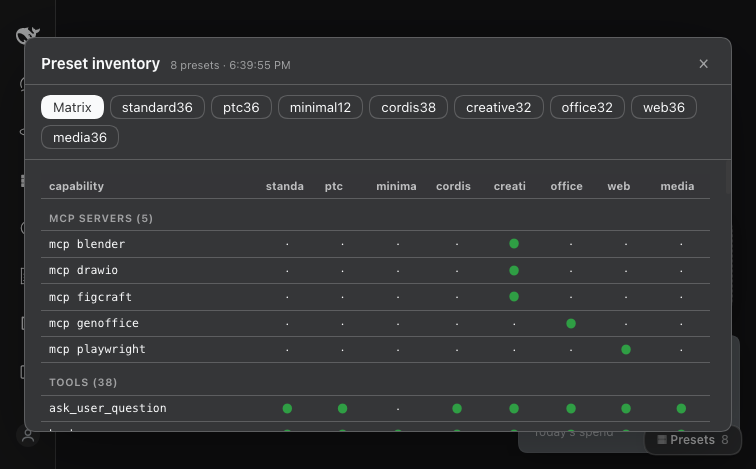
- Matrix — every capability (tool, conditional tool, MCP server, skill) against every preset.
- Per preset — tools grouped by the plugin that registers them, conditional tools with the reason each is not guaranteed, MCP servers and their endpoints, skill roots with counts and names, and every composition row with its state.
- Live — the data comes from the running preset registry, so a preset that failed to mount shows up with its diagnostic instead of hiding.
How it works
The host half reads ctx.agentPresets — the same registry the GUI picker uses —
flattens each preset's config.plugins, resolves every module to its package
directory and attributes the tool names that package registers. Host rows that
register tools are added to every preset, because ToolRuntime.view(scope)
inherits ancestor layers.
The browser half is a client module (exports["./client"]): the host ships the
snapshot as globalThis.__dshPresets through a global index-injection row, and
the client module renders it. No bundler, no route, no auth work.
Install
dsh plugin --profile web add github:anonamerjaxon-dev/dsh-preset-inspector
Or from a checkout:
dsh plugin --profile web add /path/to/dsh-preset-inspector
Then add dsh-preset-inspector to dsh.profile.bundles in
~/.dsh/profiles/web/package.json and restart dsh web. A ▦ Presets button
appears at the bottom-right of the GUI.
It registers no tools of its own, so it costs a session nothing in tool schemas.
CLIs (optional, no install required)
bin/ carries the terminal side of the same idea. node bin/dsh-presets and
node bin/dsh-preset-plugin, or symlink them onto your PATH.
dsh-presets list                 # presets with tool / skill / MCP counts
dsh-presets show creative        # everything in one preset
dsh-presets matrix               # capability × preset grid
dsh-presets diff standard web    # what differs between two presets
dsh-presets json                 # machine-readable snapshot

dsh-preset-plugin list           # every plugin and where it is mounted
dsh-preset-plugin where
 # one plugin, with its row ids
dsh-preset-plugin move
 creative,web   # these presets only
dsh-preset-plugin everywhere
          # back to every session (default)
dsh-preset-plugin off
                 # mounted in no preset
Both read dsh --profile --dump-config, which composes the profile and
exits without binding a port — so they work while a server is running, and they
never touch one.
dsh-preset-plugin writes with a backup, recomposes to verify, and rolls back if
the composition fails. A move followed by everywhere leaves the file
byte-identical.
Requirements
- DeepSeek Harness
0.2.1-rc.2(the preset registry API it reads). - Node
>= 22.
No runtime dependencies.
Licence
MIT.