dsh-digipet
Hatch a digital creature in your DeepSeek Harness. It feeds on your real work — turns, tool calls, even your errors — and evolves along branching lines shaped by how you actually work. Zero tokens, zero tools, the model never knows.
AI 分析
核心用途是将日常开发/对话工作趣味游戏化。适合想要在 DSH 中养电子宠物、且不希望宠物占用上下文 Token 或干扰 Agent 正常工作的用户。完全在本地运行。
インストール
npx -p @deepseek-ai/dsh dsh plugin --profile web add github:swaylq/dsh-digipetドキュメント
README 全文を読む ↗dsh-digipet
English | 中文
Hatch a digital creature in your DeepSeek Harness. It feeds on your real work — turns, tool calls, even your errors — and evolves along branching lines shaped by how you actually work.
Zero tokens, zero tools, zero context injection: the model never learns it exists. It's not a skin — it's a save file that grows.
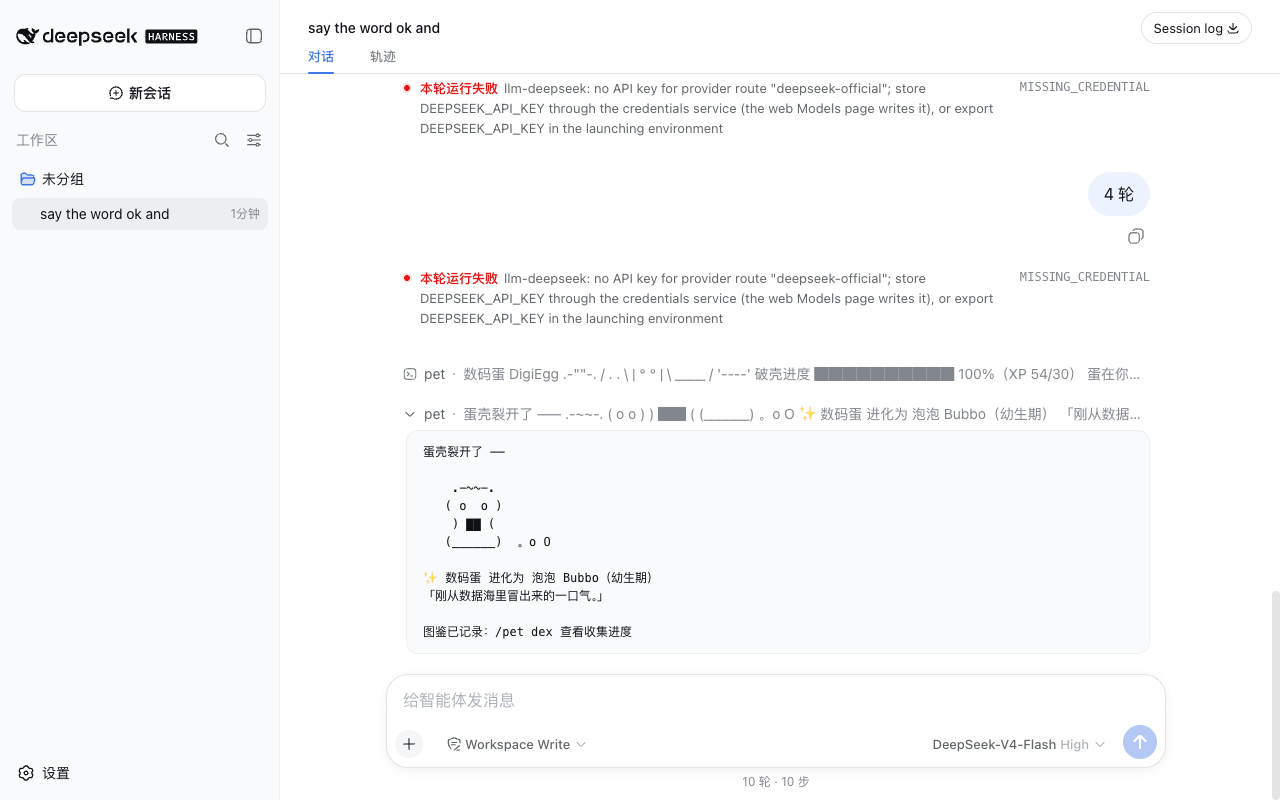
The shell cracks open —

    .-~~-.
   ( o  o )
    ) ██ (
   (______)  。o O

✨ DigiEgg evolved into Bubbo (Fry)
"A single breath, freshly surfaced from the data sea."
Why
The DSH ecosystem already has twenty-plus desktop pets (whale-girl, assorted whales, a revived Clippy, Live2D companions…). Nearly all of them are state mirrors: agent thinks, pet thinks; task done, pet cheers. The deepest one, whale-girl, has XP levels and titles — but its body never changes, and it lives only in the Web GUI.
None of them is a raising game: no hatching, no evolution stages, no "how you work decides what it becomes." dsh-digipet fills that square — a tamagotchi/Digimon-style growth loop hosted in your harness and fed by your actual work.
How it plays
/pet hatch— lay a DigiEgg.- Just work. Every completed turn, every message you send, every tool call, even every error becomes XP.
/petshows the status card; a ⚡ appears when it's ready./pet evolve— witness the ceremony. Each evolution re-reads your work profile for that stage and picks a line:
| Line | What feeds it | Ultra form |
|---|---|---|
| Forge | writing files, running commands | Leviathwright |
| Scholar | reading code, searching docs | Omniscient Kun |
| Bond | plain conversation | Aurorasong |
| Glitch | errors and mishaps survived | Coredump Wyrm |
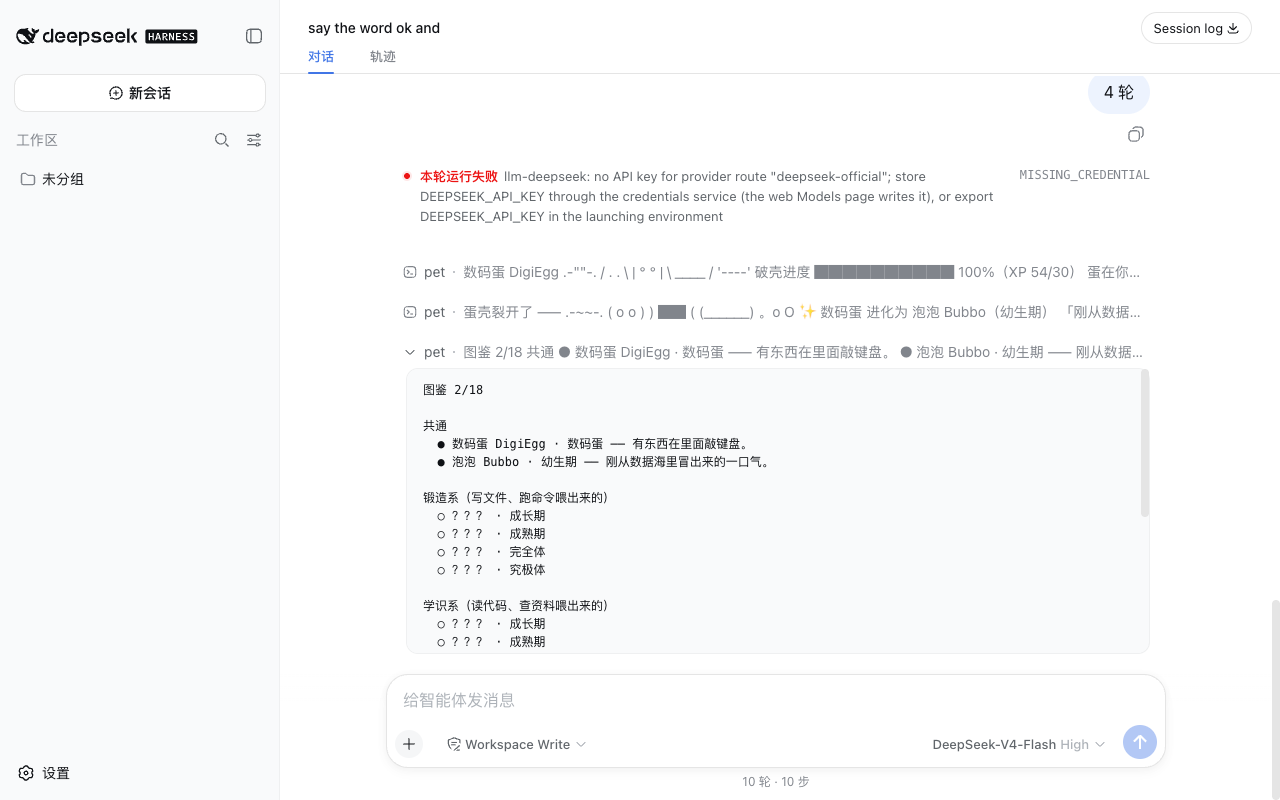
Six stages (Egg → Fry → Junior → Adult → Prime → Ultra), 2 + 4×4 = 18 forms. /pet dex tracks your collection, /pet story replays its life. Lines are never locked in — a Forge-line pet that spends a stage drowning in stack traces respecs into the Glitch line. What it finally becomes is a mirror of how you actually worked.
Overfeeding makes it drowsy (above 90% fullness, XP gain drops to 15%) — a thematically honest anti-grind valve.
Install
dsh plugin --profile web add github:swaylq/dsh-digipet
# or a local directory
dsh plugin --profile web add /path/to/dsh-digipet
Restart dsh. Pure JavaScript, zero dependencies, no prepare script — installing from git needs no build authorization.
Commands
| Command | Does |
|---|---|
/pet | status card: art, XP, fullness, mood, four stats, lifetime counters |
/pet hatch | lay the egg (one pet per DSH home; also triggers a ready egg's ceremony) |
/pet evolve | the evolution ceremony |
/pet name | name it (≤16 chars) |
/pet dex | the collection (unseen forms show as ???) |
/pet story | its life journal |
/pet about | mechanics and trust stance |
How it works
The whole plugin is four event taps and one slash command:
| Hook | Feeds |
|---|---|
agent/turn-stopping | +5 XP per completed turn |
agent/inbox/claimed | +2 XP per user message (feeds Bond) |
tools/result | +3 XP per tool call, classified by tool name into Forge or Scholar; failures feed Grit |
agent/error | +4 XP per error (feeds Grit) |
Evolution takes the dominant stat of the window since the last evolution; the window then resets. The save lives at $DSH_HOME/digipet/state.json, written the same way the official JSON storage backend persists (temp file + fsync + atomic rename), throttled to one write per 1.5 s no matter how busy the agent gets.
DSH's core invariant is "model-visible means logged" — this plugin's answer is to show the model nothing at all. No registered tool (tool schemas are a per-request token tax), no agent.inject(), no session events. The pet exists only in command result cards and contributes zero bytes to every model request.
Trust stance
- Reads: only its own save file. It never reads your code or your conversation — the event taps use only what kind of thing happened; message and tool contents never touch the save.
- Writes: only
$DSH_HOME/digipet/state.json. - Network: none.
- Model surface: none. Zero token overhead; provider KV caches are untouched.
- Blast radius: every listener body is wrapped in try/catch and the command handler has its own error floor — a stumbling pet cannot veto, rewrite, or delay real work. All hooked events are notification-mode (
emit/serial).
Known limitations
- One pet per DSH home; every profile, session, and subagent on the machine shares and feeds it (feature and limitation).
- Concurrent dsh processes race the save last-writer-wins — the same single-process stance as the official JSON backend.
- Tool classification is a name heuristic (
write/edit/shell→ Forge;read/grep/search→ Scholar); oddly named third-party tools count as neutral chow. - The collapsed conversation row flattens the art to one line — click the card for the full monospace version (same interaction as DSH's tool rows).
- Thresholds and the diet are deliberately not configurable: changed numbers would leave the dex and old saves speaking different languages (the same closed-semantics stance whale-girl takes).
Verification record
Verified on dsh 0.1.0-rc.6 (macOS, web profile):
- Installed via
dsh plugin --profile web add; the digipet layer appears in--dump-config; dsh webboots clean; a registration probe confirmed the command landed;/pet hatchin a real browser renders the egg card (monospace, newlines preserved);- With no API key, a plain message still produces real events — the model request fails, but
agent/inbox/claimed(+2 Bond) andagent/error(+4 Grit) fire, and the save matches the diet line by line; - At 30 XP,
/pet evolverenders the hatch ceremony; the dex reads 2/18; - 35 unit/integration tests (
node --test) cover the pure logic core and a faked Cordis context.
License
MIT