windwhiterain/dsh-compaction-threshold ↗★ 1
dsh-compaction-threshold
Per-session automatic compaction threshold for DeepSeek Harness: a compaction backend whose trigger percentage is stored per session and adjustable from the Web composer while the session runs. 适合需要根据不同会话任务灵活控制上下文压缩时机的DSH用户。
インストール
検証済み bundle がないか、互換性チェックに失敗しています。先にリポジトリの説明を読んでください。 README 全文を読む ↗
ドキュメント
README 全文を読む ↗dsh-compaction-threshold
Per-session automatic compaction threshold for DeepSeek Harness, adjustable from the Web composer while a session runs.
The shipped backend (@deepseek-ai/dsh-compaction-basic) fixes the trigger
percentage in the agent preset: one number for every session that preset serves,
changeable only by editing YAML and reloading the host. That is the wrong
granularity for real work — a long refactor wants to compact late and keep its
history verbatim, a scratch session wants to compact early and stay cheap, and
neither should require a host restart.
This plugin keeps the same compaction transaction and makes the percentage per
session: a chip beside the permission and model chips shows the value, a menu
changes it in one click, /compaction-threshold does the same from the keyboard,
and the value is stored durably beside the session log so it survives a restart.
A forked session and a delegated subagent inherit their parent's value.
The package is third-party, and it is honest about its coupling: a compaction
backend must be a subclass of the shipped engine, so unlike a plugin that only
talks to the Cordis context, this one imports
@deepseek-ai/dsh-compaction-basic and copies its trigger policy. Read
Known limitations before upgrading the harness.
- What it looks like
- Quick start
- Use
- Inheritance
- How it works
- Model experience
- Verification
- Developing against a dev host
- Known limitations
What it looks like
The chip sits with the permission and model chips in the composer, and shows the session's current percentage:

The menu offers the preset default and 30 %–100 %. Here the session is a fork that inherited its parent's 70 %, so the menu also states where the value came from:
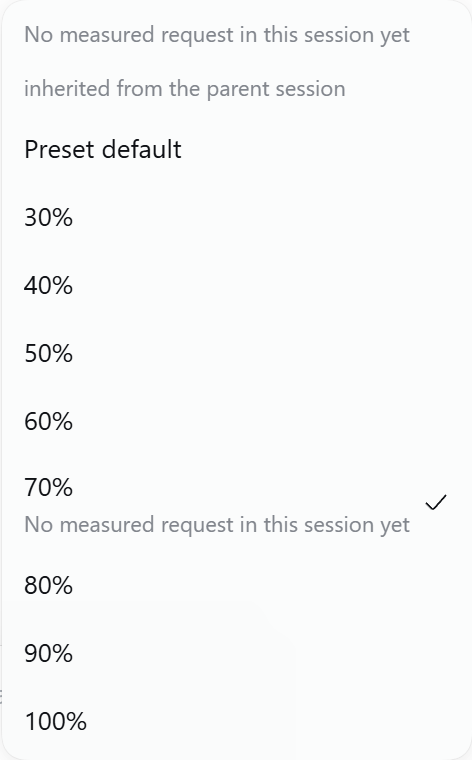
Once a request has been measured, the chip's tooltip and the menu heading report the token count the trigger resolved to, so the percentage in force is visible rather than implied.
Quick start
dsh plugin --profile web add github:windwhiterain/dsh-compaction-threshold
Then wire two rows into ~/.dsh/profiles/web/cordis.patch.yml — one on the host
plane, one inside each agent preset that should become adjustable:
# host plane: the durable store, the Session projection, and the command
- insert:
    - id: compaction-threshold
      name: 'dsh-compaction-threshold'

# agent plane: replace the shipped backend inside the preset's compaction group
#   - id: compaction-basic
#     name: '@deepseek-ai/dsh-compaction-basic'          # remove this row
#   ...and add:
#   - id: compaction-threshold-engine
#     name: 'dsh-compaction-threshold/engine'
Keep command-compact and tool-result-pruner exactly as they were. Omit
thresholdRatio on the engine row to follow the backend default (0.8); state it
to give that preset a different starting point.
Restart the host afterwards. A new dependency is read at startup, so the row
cannot resolve in the running process, and applying the preset swap before that
restart leaves new sessions mounting an unresolved row. deploy/ holds the same
instructions as a checklist and a script that applies them structurally:
node deploy/apply-web-wiring.mjs ~/.dsh/profiles/web/cordis.patch.yml [--write]
Use
The chip opens a menu of Preset default plus 30 %–100 %. The same change can be
typed:
| Input | Effect |
|---|---|
/compaction-threshold | Report the current value, its origin, and the resolved trigger |
/compaction-threshold 60 or 60% | Compact this session once pressure reaches 60 % of its window |
/compaction-threshold 0.6 | The same, written as a ratio (bare values ≤ 1 are ratios) |
/compaction-threshold default | Drop the value and follow the preset again |
The change applies from the next step, is enforced against a turn already in flight (the value is read at every step boundary), and survives a restart.
Inheritance
A forked session and a delegated subagent both record their direct parent in
SessionHeader.parentSession, so both inherit. A child receives a snapshot of
the nearest ancestor that owns a value, up to 16 generations, and owns it from
then on:
| Situation | Result |
|---|---|
| Child's parent has 70 %, preset default 10 % | Child shows 70 %, marked inherited from the parent session |
| The parent had no value, its own parent had 25 % | Child inherits 25 % (nearest ancestor with a value) |
| The parent changes 70 % → 50 % after the child exists | Child keeps 70 %: the snapshot was taken once |
Child's /compaction-threshold default | Child returns to the preset default and does not re-inherit |
| No ancestor owns a value | Child follows the preset default |
The record that carries a snapshot is also the marker that the inheritance was
spent, which is what keeps default meaningful in a child. The value is written
durably, and the chip keeps the origin visible until the child's own value
differs from the inherited one.
How it works
Two rows, because a compaction backend and the interface that configures it live on different planes:
| Row | Plane | Owns |
|---|---|---|
dsh-compaction-threshold | Host | The storage domain keyed by Session id, the compactionThreshold Session projection, and the /compaction-threshold command |
dsh-compaction-threshold/engine | Agent preset, inside its compaction group | The ctx.compaction service: the shipped engine with a per-session pressure ratio |
The engine reads the value synchronously from the host service and falls back to
its own configured thresholdRatio when the host row is absent, so a miswired
composition degrades to the shipped behaviour instead of disabling compaction.
Context-overflow recovery, retention, pruning, retries, and summarization are
inherited unchanged.
The threshold formula
thresholdTokens = floor(contextWindow × ratio)
A percentage here is the share of the declared context window the session may fill before it compacts, and nothing else scales it down.
That is the plugin's one deliberate divergence from
@deepseek-ai/dsh-compaction-basic, which also caps the threshold at
contextWindow − outputReservation − headroomTokens. That cap makes a large
output reservation shrink every percentage at once: on a 262 144-token window
with maxTokens: 131072 and the default 65 536 headroom, the cap is 65 536
tokens, so every setting from 25 % to 100 % behaves identically and the knob
stops meaning what it says. Removing the cap restores the full range: 100 % now
means "compact only when the window is essentially full".
The consequence is worth stating plainly: the prompt plus its reserved completion still has to fit the provider's real window, so a high percentage can reach a provider overflow. The upstream recovery path handles that case and bypasses the ratio by design — it is the provider telling the session it is out of room, not the threshold policy firing.
headroomTokens is still accepted because the inherited schema carries it, and
it still supplies the default summary budget, but it no longer shifts the
trigger. retainRatio/retainTokens are window-relative for the same reason.
Why the override lives in a storage domain, not the session log
The Session persistence reader refuses an event type outside the generated
known-type catalog unless the record carries ignorable: true
(packages/session/session-persistence/src/storage-contract.ts), and
Session.append() cannot set that marker. A plugin outside the harness
repository therefore cannot add a Session event: its own logs would stop loading.
The override is non-session application data, so it belongs in
ctx.storageDomain, and the client is notified through a Session projection —
which is key-addressed and needs no client code per domain.
Model experience
Per-session compaction threshold
What the model sees
Nothing directly: the plugin adds no tool and no prompt text. Indirectly it changes when a `` checkpoint replaces older history and how much recent history stays verbatim, exactly as the shipped backend does.
Token effect
Lowering a session's ratio compacts earlier and therefore spends fewer prompt tokens per request at the cost of more summaries; raising it compacts later, up to the point where the provider itself reports the request as too long. The summarization request itself is the same one the shipped backend issues.
KV-cache effect
The summarization call reuses the conversation's own prefix, as the shipped backend does. Changing the ratio never rewrites a request prefix, so it invalidates no provider cache; it only changes which requests still carry the un-compacted prefix.
Verification
node probe/probe.mjs
The probe drives the pure policy module without a host: the window fraction and its retention, the command grammar, range selection, the inheritance walk (direct parent, ancestor skipping, unusable values, cycle safety, depth cap), and the engine brand's survival across module generations. 21 probes pass.
Further probes need no browser. probe/session-tools.mjs decodes the zstd-framed
session logs and reports each stored session's preset, tool catalog, and
delegation depth. probe/session-detail.mjs reports one session's selected
presets, routes, token counts, and compaction events, and
probe/surface-tokens.mjs prices its surface with the harness's own estimator —
the pair behind a "compaction did not trigger" report. probe/tsx-identity.mjs
proves that a plugin outside the checkout shares the host's
BasicCompactionEngine and Service objects under a source-launched host.
The browser probes drive the installed Edge through playwright-core and verify
against a dev host that the chip renders, the menu writes through the command,
the value is per session, default clears it, clearing does not re-inherit, a
fork inherits, and a delegated child inherits:
node probe/dev-ui.mjs http://127.0.0.1:3081/?token=…
node probe/dev-fork.mjs http://127.0.0.1:3081/?token=… 70
node probe/dev-subagent.mjs http://127.0.0.1:3081/?token=… 80
node probe/dev-chip.mjs http://127.0.0.1:3081/?token=… 4
Developing against a dev host
A dev host is required to verify anything the client half renders, and it must never share the primary host's port. A second host that inherits the default port tries to bind the same address, and on Windows that second bind can take the listener away from the running host — the running host then dies. Check the port first, then boot with an explicit one:
Get-NetTCPConnection -State Listen -LocalPort 3081 -ErrorAction SilentlyContinue   # expect nothing
./scripts/dev-host.ps1                      # DSH_HOME + profile + 127.0.0.1:3081 + --no-open
./scripts/dev-host.ps1 -Checkout C:/path/to/deepseek-harness   # boot from source through tsx
scripts/dev-host.ps1 refuses the primary port, refuses a port that is already
listening, refuses ~/.dsh as DSH_HOME, and binds loopback only. The three
isolations it guarantees:
| Resource | Primary host | Dev host |
|---|---|---|
| Port | the deployment's own port | explicit free port, 127.0.0.1 |
DSH_HOME | ~/.dsh | a separate directory |
| Browser | opened by the harness | --no-open, so no window steals focus |
Other rules that matter here:
--port 0lets the OS assign a free port, which cannot collide at all.--from-default-profile webboots the profile it initializes; it is not an init-only switch. Pass the port flags in that same command.- A profile's
cordis.patch.ymlis live-reloaded, but a new dependency is read at startup, so the dev host needs one restart after installing the plugin. - Credentials live per home: copy
.credentials.yamlinto the dev home, or export the provider key in the environment before booting. - File-level
hmrroots reload the host half without a restart; after adding a root, touch the file once, because the watcher reacts to a change. A root list added to a live patch while the host runs is not a reliable signal either — restart once after wiring, and the roots are active from then on. - The watch reloads host-plane rows only.
dsh-compaction-threshold(the store, the projection, the command) reloads on a file change; the engine row is mounted inside an agent preset's realm, and the reload does not re-import it, so an engine change needs the preset remounted — a host restart, or a preset edit that rebinds its sessions. Reach for a restart when a change touchesengine.jsorlib/policy.js.
Known limitations
- One divergence from the shipped backend, by design. The threshold is a
plain window fraction; the shipped backend would cap it at
window − outputReservation − headroomTokens, which can compress the whole 25 %–100 % range of the knob onto one value. Span selection, the summarization transaction, retention, pruning, and retries are still transcribed from@deepseek-ai/dsh-compaction-basic0.1.7-rc.1 (src/region.tsselectCompactableRangeand the engine's transaction). Those internals are not exported, so an upstream change must be mirrored here by hand, and theConfigschema is inherited from the installed package rather than owned. The probe pins the arithmetic, not upstream file contents. - A high percentage can still hit a provider overflow. The request must fit the provider's window with its reserved completion, and the upstream recovery path compacts on a provider-confirmed overflow without consulting the ratio. A percentage controls the threshold; the provider controls its own limit.
- A threshold cannot fix pressure that lives in the tool schemas. Compaction
is only attempted when the budget is crossed, and the transaction refuses a
summary that is not smaller than the span it replaces. In a deployment whose
declared window is barely larger than its own tool catalog, the engine prunes,
tries a summary, and honestly reports
summary is not smaller than the shadowed content. A ratio changes when the engine tries; it cannot create headroom the surface does not hold. - A snapshot is taken at the child's first observation, not at the fork.
The Session store emits no creation or fork event, so lineage is read from
SessionHeader.parentSessionand the copy happens the first time the child is read (the engine's pressure check or the projection). An ancestor that changes its value between the fork and that first observation is what the child inherits, and a child that owns no record yet still inherits a value its ancestor sets later; owning any record spends the inheritance for good. - A child inherits only where the engine is mounted. A child keeps its parent's agent preset, so this holds for a preset that carries the engine row; a child of a preset still running the shipped backend has no chip and no inheritance.
- The package declares no dependencies on purpose.
@deepseek-ai/cordis,@deepseek-ai/dsh-compaction, and@deepseek-ai/dsh-compaction-basicmust resolve from the host, exactly like the shipped rows do; alink:or git install inside a DSH profile resolves them through that profile, so the plugin shares the host's module instances instead of loading a second copy of the engine and ofService. Runningimport('dsh-compaction-threshold')outside a host therefore fails on those specifiers, which is expected. - Records are never garbage-collected when a session is deleted.
/compaction-threshold defaultclears one session's value, and the w