SAOS-3624/dsh-video-storyboard ↗★ 9
dsh-video-storyboard
Scene-aware storyboard for DeepSeek Harness: one addressable grid per video (numbered cells, timestamps, transcript, audio envelope) so a text-only agent can look at the video itself instead of being told a summary.
설치
npx -p @deepseek-ai/dsh dsh plugin --profile web add dsh-video-storyboarddsh-video-storyboard

A scene-aware storyboard for text-only agents. Feed a video in, get one addressable grid out: numbered cells, a timestamp per cell, and the transcript line that falls inside it — so the model can look, cite a cell, and ask for a close-up instead of being told a summary.
The effect, in numbers. A 5-minute clip becomes one image — 9–16 frames for 384 tokens, where a frame-per-image tool spends 3,072–6,144 for the same coverage. A 90-second PV scans in 9 s and returns 12 cells whose shot boundaries match 41 detected cuts. Second call on the same file: 3.6 s (cached). No model weights, no image library, no font config.
Community project. Not affiliated with DeepSeek.
中文说明:README.zh.md — 创新点、实现原理、实测基线、路线图。
Requires: Node ≥ 20,
ffmpeg/ffprobeonPATH. No other runtime dependencies.
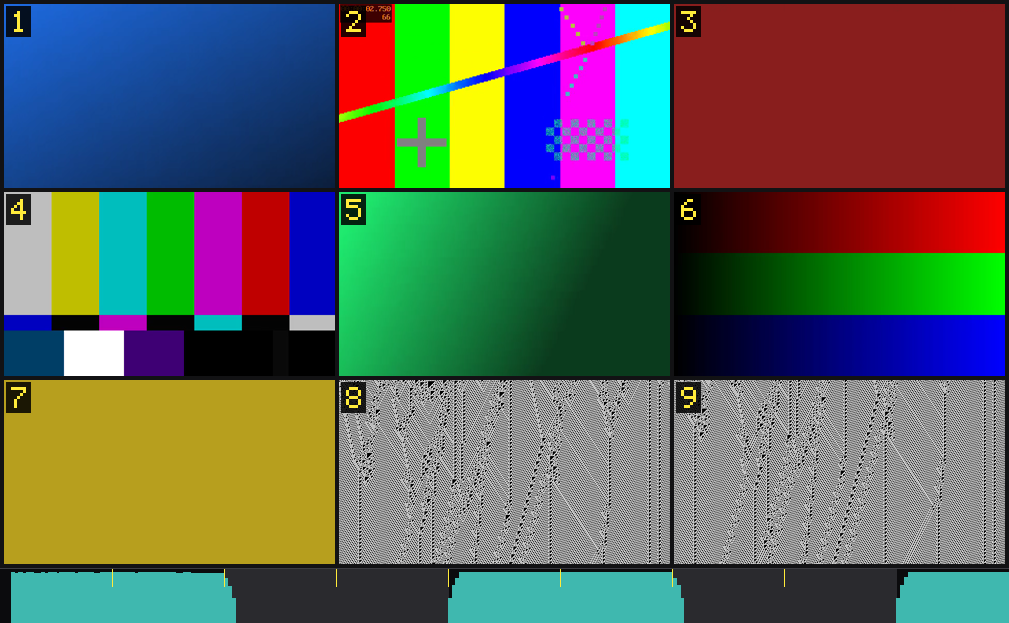
A 27-second synthetic clip (9 shots, loud/quiet/loud audio) turned into one image: 9 numbered cells,
one timestamp range each, and a footer strip showing loudness, silence and cut points on the same time
axis. The clip is generated by ffmpeg — no third-party footage is used anywhere in this repo.
What the algorithm actually does
Eight decisions, each made because the obvious alternative failed on real footage:
| # | Decision | Why not the obvious thing | Code |
|---|---|---|---|
| 1 | Scene-change detection on HSV at 64×36, three-channel mean of |ΔH|+|ΔS|+|ΔV| | Luma-only difference misses cuts that swap hue at equal brightness (2 of 9 cuts in our fixture; ffmpeg scdet finds 4/9, we find 9/9) | src/scan.js |
| 2 | Threshold chosen by rate, not by a score multiple — target ≈1 cut per 1.5 s, floor at score 12 | 3×p95 scored 38 on B-roll (fine) but 130 on fast-cut anime → zero cuts, on exactly the content that needs the most cells | src/scan.js |
| 3 | Cell placement = equal increments of the local cut-rate integral, snapped to real cuts (≤30 % of an ideal cell) | Uniform splitting gives a 6 s burst of 20 shots the same space as a 20 s static shot; snapping without a limit silently distorts the weights | src/density.js |
| 4 | Grid size from motion p90, not from duration | 16 cells over a static single take = 16 identical frames; 4 cells over a PV = nothing | src/plan.js |
| 5 | Minimum gap capped by the material's own granularity (min(minGap, medianShot×0.9)) | A fixed 1.2 s merged six 1 s shots into three, and then could not reach the requested cell count at all | src/segments.js |
| 6 | Sharpest frame wins — 3 candidates per segment, highest Laplacian variance | thumbnail=n= picks by histogram; blur does not change a histogram, so it happily returns a Gaussian-smeared credit card | src/sheet.js |
| 7 | Audio envelope on the same axis, inside the same image | A separate audio image costs another 384 tokens and loses the alignment, which is the entire point | src/audio.js, src/sheet.js |
| 8 | ASR chunked to ≤45 s at silence midpoints, non-speech segments filtered and reported | One 299 s request shifted every timestamp 13 s early; a music-only PV produced a fake 29 s line that landed in 5 cells | src/asr.js, src/pipeline.js |
The two-stage read, and what a long film actually costs
A 2 h 35 m film is not 24 images up front (9,216 tokens). The cheap path is:
| stage | cost | what you learn |
|---|---|---|
video_probe | 0 | length, audio/subtitle tracks, how to read it |
| one overview (16 cells over the whole file) | 384 | structure — which 7.5-minute stretch is worth opening |
| open the 2–3 suspicious stretches | 3 × 384 | 16 cells of detail each |
| total | 1,536 | same price as four images, but the first 384 already tells you whether to continue |
The saving is not in shrinking any single image — it is in letting the model stop early. That is why
video_probe returns a plan rather than a picture, and why textOnly paging exists.
Prior art, accuracy ceilings we do not try to beat, and the things we deliberately left out: docs/REFERENCES.md.
Long films: the text index has a budget
One image is 384 tokens, but the text index is unbounded — a 2 h 35 min film produced 64 cells and a 75 KB index, which exceeded the host's tool-result limit. The excess was folded into a file on disk and never read, so 44 minutes of dialogue were silently missing. Three things prevent that now:
- Per-cell cap (180 chars by default). An overview needs "what is this stretch about", not the full line.
- Cell-aligned truncation with an explicit continuation hint:
[text stopped at cell 13 of 64 — call again with cellRange: [14, 64] and textOnly: true to read the rest] cellRange+textOnly— page through the index without re-rendering images or re-decoding frames.
video_storyboard({ input, cells: 16, sheets: 4 })                     // 4 images + first page of text
video_storyboard({ input, cells: 16, sheets: 4, cellRange: [14, 42], textOnly: true })
video_storyboard({ input, cells: 16, sheets: 4, cellRange: [43, 64], textOnly: true })
textOnly returns no image, so paging costs nothing in tokens; with the scan and ASR results cached it
takes ~0.8 s per page after the first call.
CLI batch mode for a whole film, where 24 separate calls is not a workflow:
node bin/storyboard.mjs film.mp4 --batch 300 --out film.png
# → film-w01.png … film-w24.png  +  film-timeline.md (window | cells | cuts | chars | image)
A tail window under 30 s is merged into the previous one instead of spending 384 tokens on a 2-second
window that holds a single cell. Window boundaries are snapped to real cuts (one full scan up front,
--no-snap to disable), so a window never ends in the middle of a sentence.
Quick start
git clone https://github.com/SAOS-3624/dsh-video-storyboard.git
cd dsh-video-storyboard

node --test                                          # 154 tests (needs ffmpeg)
node bin/storyboard.mjs your-video.mp4 --cells 9 --text   # see exactly what the model would get
node bin/storyboard.mjs film.mp4 --batch 300              # long film: one png per 5-min window + a timeline.md
node scripts/install-dev.mjs                         # mount into DSH, then restart DSH
Installing into DSH. For a normal profile:
dsh plugin --profile web add dsh-video-storyboard
The desktop profile is managed exclusively by the Electron app, so dsh plugin refuses it —
use node scripts/install-dev.mjs instead (it copies the package into the profile and registers the
bundle). Either way, restart DSH afterwards: the plugin tree is composed at process start.
How sampling actually works (and what it is not)
Worth stating plainly, because it is easy to misread:
- Tokens are billed per image, not per frame. Everything here exists to put many frames into one image. 9–16 frames = 384 tokens.
- All cells are the same size. This tool does not shrink resolution in fast-cut sections.
What it varies is how many seconds each cell covers — dense regions get short cells, calm
regions get long ones (
density(t) = clamp(localCutRate / meanCutRate, 1, 2.5)). Why not variable resolution: at 350×194 a halved cell is mush, and the token cost is flat anyway. - The timeline is fully covered; individual shots are not guaranteed. 300 shots in 5 minutes across
16 cells cannot all be seen. That is what
video_zoomis for. - Continuous motion is not a cut. Any frame-difference scorer (this one,
scdet, TransNetV2) gives high scores to a fast pan or a zoom. That is why peaks are suppressed within 0.35 s and why short segments get merged instead of each taking a cell.
Status (v0.1)
| Piece | State |
|---|---|
src/plan.js — layout / coverage / grouping / guardrails (pure functions) | ✅ implemented |
src/scan.js — HSV-weighted shot boundary detection | ✅ implemented — 9/9 cuts, 0 false positives on the fixture, 47× realtime |
src/segments.js — cuts → segments → fit to N cells | ✅ implemented |
src/probe.js — ffprobe + rotation / end-edge handling | ✅ implemented |
src/sheet.js — extract + cover-crop + burn index + tile, zero image library | ✅ implemented |
| adaptive threshold + min-gap + density-driven grid sizing | ✅ validated on 6 real clips |
src/pipeline.js — orchestration shared by CLI and tool | ✅ implemented |
src/index.js — registers video_storyboard + video_zoom | ✅ implemented, host contract verified |
src/audio.js — loudness (EBU R128) + silence, no model | ✅ implemented |
src/asr.js — subtitle track + OpenAI-compatible ASR + cell alignment | ✅ implemented (client verified against a local fake server) |
src/cache.js — scan-result cache keyed by file+window+threshold | ✅ implemented (2nd call on a 5-min clip: 13.4 s → 3.6 s) |
npm test                                                  # 154 passing (unit + ffmpeg e2e + host contract)
node bin/scan-video.mjs video.mp4 9                       # 调阈值:切点 / 分数 / 段长 / top peaks
node bin/storyboard.mjs video.mp4 --cells 9               # 端到端出一张图 + manifest
node bin/storyboard.mjs film.mp4 --from 600 --to 780      # 只看某一段(不扫全片)
node bin/storyboard.mjs film.mp4 --plan 300               # 先出分段计划(不渲染)
Against ffmpeg -vf scdet on the same clip: scdet's default threshold finds 4 of 9 hard cuts; this scanner finds 9 of 9 with a 2× score margin to the strongest non-cut frame. Reason: scdet scores mean absolute frame difference (luma-ish), so a cut that swaps hue at equal brightness is invisible to it. Measured on the two such cuts in the fixture: brightness delta 0.6–0.8 %, hue delta 24/255 and 151/255.
Real-world check (6 clips of 1080p footage: B-roll, anime, PVs, a single take)
| clip | len | p90 | auto th | cuts | gap | grid |
|---|---|---|---|---|---|---|
| B-roll (50 mm lens) | 299 s | 7.9 | 16 | 141 | 2.1 s | 16 ×1 |
| anime feature | 1090 s | 15.0 | 43 | 408 | 2.7 s | 16 ×2 |
| special ED | 80 s | 11.6 | 21 | 42 | 1.9 s | 4 ×1 |
| PV (official) | 92 s | 17.0 | 54 | 44 | 2.1 s | 9 ×1 |
| PV (concept) | 90 s | 26.1 | 58 | 41 | 2.2 s | 9 ×1 |
| party singing (single take) | 251 s | 2.2 | 12 | 1 | — | 4 ×1 |
The threshold is chosen by rate, not by a score multiple. My first attempt was 3 × p95, which looked fine on the B-roll clip (38 → 88 cuts) and then died on fast-cut anime: the concept PV's p95 is 43, so ×3 = 130 → zero cuts, on the exact content that needs the most cells. Targeting ≈1 cut per 1.5 s (auto-tightened to 0.5 s on short clips, floored at score 12 so static footage stays a single shot) works across all six.
Grid size follows content density (p90), not duration alone: ≥15 → 12 s/cell, 5–15 → 20 s/cell, −18 && charsPerSec < 1`
marks a music-driven clip, which keeps the cell floor at 9 instead of letting the "dialogue carries the
info" rule shrink it. See docs/BASELINE.md.
Term dictionary. ASR w