dsh-custom-theme
Paste a tweakcn theme CSS into DeepSeek Harness and get light + dark palettes, with optional wallpaper and a liquid-glass composer
같은 패키지 이름의 다른 저장소
설치
npx -p @deepseek-ai/dsh dsh plugin --profile web add github:cndoin/dsh-custom-themedsh-custom-theme
Bring tweakcn themes into DeepSeek Harness. Paste a theme's CSS, get both a light and a dark palette applied across the whole UI. Ships with optional custom wallpaper (image / video, blur, dim, tint) and an Apple-style liquid-glass composer with a pointer-following specular highlight.
中文说明 · Install with an AI agent
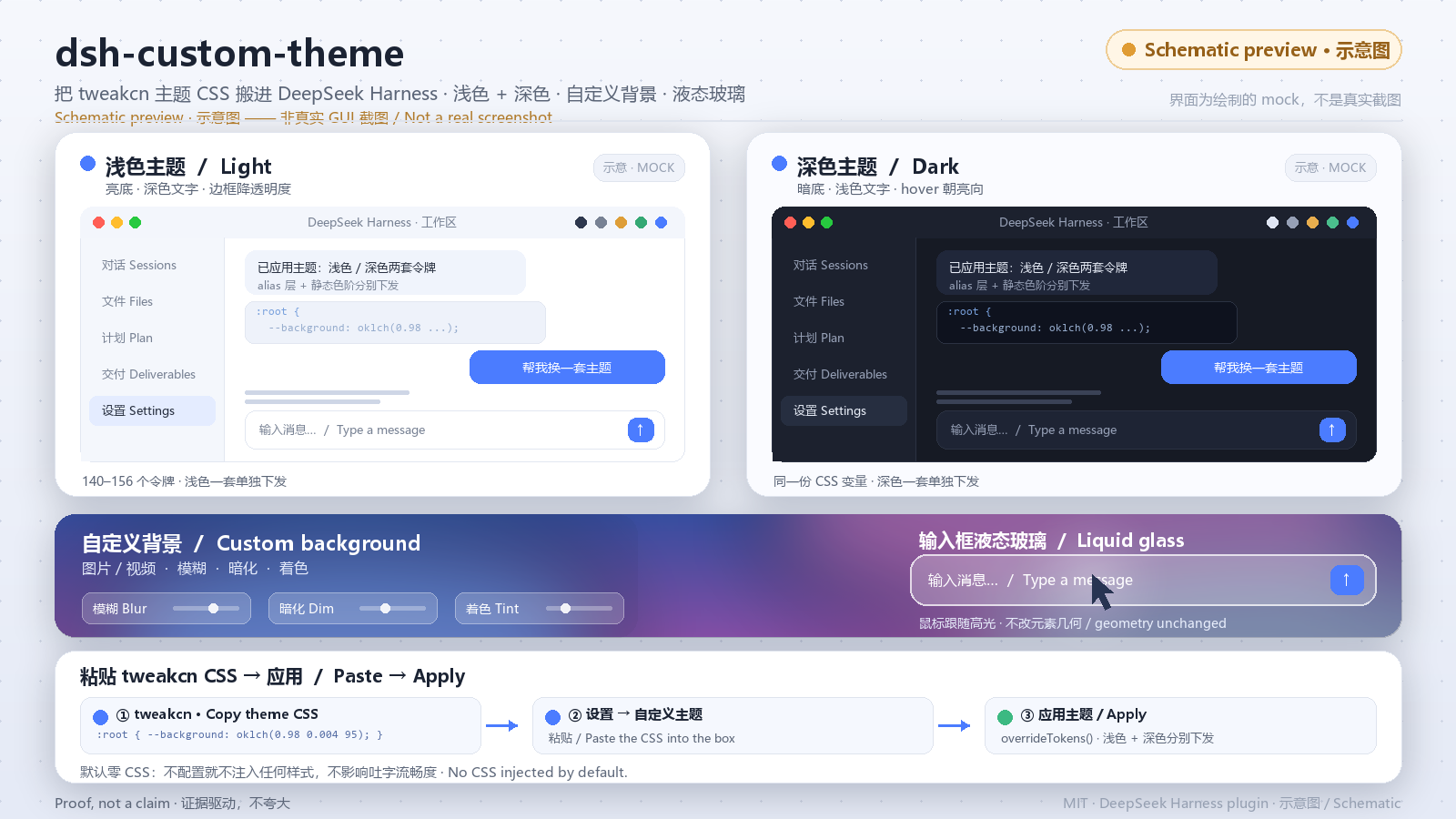
The image above is a schematic illustration, not a screenshot of the running app.
What you get
| Two palettes from one paste | :root { … } → light, :root.dark { … } → dark. A single-palette theme gains a legible companion automatically. |
| Whole-UI coverage | 140–156 design tokens: alias layer, specific surfaces, focus rings, radii, fonts, and 38 static colour ramps. Light and dark are delivered separately. |
| Paste-safety | Only CSS custom-property declarations are read. Pasted content is never inserted as a stylesheet. url(), @import, expression(), javascript:, braces and semicolons are rejected. |
| Custom wallpaper | Image or video, blur / dim / tint sliders, optional local file (downscaled to 1920 px and re-encoded as JPEG before storage). |
| Liquid glass | Frosted composer with a white specular highlight that follows the pointer. The element itself never scales or transforms. |
| Offline, no telemetry | Everything runs in the renderer. No network requests, no analytics, no account. |
A deliberate non-feature
The plugin does not try to change how fast the model's text appears. DSH assembles
assistant/live-chunk deltas into a string and hands the whole block to MarkdownText;
the only pacing in the client is a triple requestAnimationFrame flush. A client plugin
has no per-chunk event, and a MutationObserver only sees text after React commits it.
Rewriting the conversation renderer would drop the official Markdown, tool cards and
citation interactions, and break copy/paste.
What the plugin does guarantee is that it does not make it worse: with everything off it injects zero CSS, zero SVG filters and zero token overrides. Glass and wallpaper are strictly opt-in, so a fresh install adds no per-frame compositing work to a live stream. An earlier revision enabled an SVG displacement filter by default; that was the most likely cause of janky output in small text areas and has been removed.
Install
Requirements
- DeepSeek Harness with a CLI-managed profile (
webby default). The desktop profile is owned by the Electron app and refuses CLI installs — see the note below. - Node.js ≥ 22 for development / rebuilding
client.js. Running the plugin needs no build step: the generatedclient.jsis committed.
Three commands
git clone https://github.com/cndoin/dsh-custom-theme.git "$HOME/.dsh/plugins/dsh-custom-theme"
dsh plugin --profile web add link:"$HOME/.dsh/plugins/dsh-custom-theme"
dsh plugin --profile web install
Then restart the host (dsh web) — the host half mounts only at process start.
Verify:
grep -A6 '"dsh"' "$HOME/.dsh/profiles/web/package.json"
# dsh-custom-theme must appear in dsh.profile.bundles
declares no dsh.bundle? pnpm does not always create a root link forlink:dependencies. Create it yourself — a junction on Windows (New-Item -ItemType Junction -Path "$HOME\.dsh\profiles\web\node_modules\dsh-custom-theme" -Target), a symlink elsewhere — and declare"dsh-custom-theme": "link:"underdependenciesin the profile'spackage.json. Then re-rundsh plugin --profile web install.
Desktop profile
The desktop profile is managed by the Electron application, not the CLI. If you installed
through the app's plugin manager, the plugin is already active and the client.js change
is visible after a reload (Ctrl+R) or a Harness restart. State lives in the browser's
localStorage under dsh-custom-theme/v1, so it persists across reloads but is not synced
between machines.
Uninstall
dsh plugin --profile web remove dsh-custom-theme
Use
Settings → Custom theme (registered into settings.section with order: 32).
- Pick a theme at tweakcn.com (or build your own), click Copy theme.
- Paste it into the box and click Apply theme.
- Restore default puts everything back.
Three built-in presets (Claude / Amethyst Haze / T3 Chat) fill the paste box so you can see the format first; they are not applied until you click Apply.
The wallpaper and glass card is independent of the theme paste; changes are instant and do not require Apply. Both are off by default — enable them only if you want them.
Nothing shows up? The bottom of the card has a Run status JSON block. It reports the switch states, URL validation result, CSS length, whether the DOM layer was created, token count, and whether the browser supports
backdrop-filter. Copy it into an issue.
Compatibility
The parser is exercised against a matrix of real generator outputs, not just the happy path.
| Input | Example |
|---|---|
tweakcn v4 :root / .dark | --background: oklch(1 0 0); |
| tweakcn v3 / legacy HSL triplets | --primary: 221 83% 53%; → wrapped as hsl(...) |
oklch() / hsl() / rgb() / 3-, 4-, 6-, 8-digit hex | including negative hue and alpha |
:root, :host, html, body, [data-theme="dark"], .dark, :is(.dark), grouped :root, .dark | plus :not(.dark) / :root:not(.dark) negation |
@theme inline font stacks (v0 exports) | real font lists preserved |
shadcn registry item JSON, registry index JSON, bare { light, dark } / cssVars | fenced JSON, BOM, prose-wrapped JSON, top-level arrays |
| Markdown fences, surrounding prose, BOM, CRLF | stripped before parsing |
| Single-palette community exports | companion dark/light scheme derived from luminance |
npm test runs 97 unit tests plus six compatibility scripts:
ALL FORMATS PASS                 0 case(s) need attention
ALL 10 GENERATOR OUTPUTS PASS   PLACEHOLDER FORMAT PASSES
AUDIT FINDINGS PASS             ALL 42 PRESETS PASS
The method behind each claim — which shipped DSH bundles were read, which selectors are stable, what the headless checks actually prove — is in docs/evidence.md.
How it works
One override layer
ctx.theme.overrideTokens('dsh-custom-theme', tokens) is called with a fixed source id,
so re-applying replaces the layer instead of stacking. ThemePresenter writes each token
with body.style.setProperty(name, value). The plugin therefore never emits a token whose
value is var() — that would be a self-referencing invalid value.
Wallpaper isolation
Only two shell tokens may become translucent: --dsw-alias-bg-base and
--dsw-specific-sidebar-fill. --dsw-alias-bg-layer-1 / -2, --dsw-alias-bg-overlay
and --dsw-specific-input-major are used by code blocks, trajectory tables, message cards
and popovers (ui-trajectory alone references layer-1 28 times); they are never touched.
When no custom theme is applied, no shell token is overridden at all — hardcoded
fallbacks would otherwise clobber DSH's currently active built-in theme.
Glass without breaking the composer
The glass rule targets the stable [data-composer-card] attribute only. It contains:
- no
transform/scale(an earlier revision squeezed the page — the element's geometry is now untouched), - no SVG
filter: url(...)on the composer (a filter creates a new containing block and would misplace@-mention / attachment / emoji popovers, and clip overflow), - no
isolation, no child selectors, no pseudo-elements, - no
!importantonbackground-color/border-radius/border(DSH's focus-visible and error states stay intact); specificity comes from:not(:focus-within):not([data-error])instead.
Pointer tracking is deliberately quiet: a resident low-frequency pointerover /
pointerout pair, with pointermove attached only while the pointer is over the card;
one requestAnimationFrame with latest-wins coalescing; values are compared before being
written; all listeners are passive; nothing calls preventDefault / stopPropagation.
(hover: hover) and (pointer: fine), prefers-reduced-motion and pointer: coarse gate it.
Degradation
@supports not (backdrop-filter) → solid colour; prefers-reduced-transparency → fully
opaque; prefers-reduced-motion → static highlight and paused video (also paused when the
page is hidden); forced-colors → system colours; performance mode caps blur at 8 px.
Video is always autoplay muted loop playsinline.
Windows caption strip stays draggable
On Windows DSH uses titleBarStyle: "hidden" and paints its draggable caption strip as
[data-windows-titlebar] .frame:before — a 40 px element with
-webkit-app-region: drag whose background is var(--dsw-specific-sidebar-fill). That
strip is what makes the top bar draggable and gives double-click maximize/restore.
Enabling a wallpaper makes that token translucent so the image shows through, which also makes the caption strip transparent. On an acrylic / transparent Electron window the hit test then stops treating the strip as part of the window: dragging the top bar and double-clicking to maximize both stop working (observed on DSH 0.2.2-rc.1, Windows).
The fix repaints only that pseudo-element with the theme's original opaque colour
(html[data-windows-titlebar] [class*="frame"]:before), using a stable attribute + class
substring so a hashed-class rename does not break it. Every other surface keeps its
translucent wallpaper look, and the rule is emitted only while a wallpaper is actually
enabled — so the zero-CSS-by-default guarantee is untouched. Regression test:
tests/backdrop.test.mjs.
Architecture
src/core.js             Pure theme parsing / mapping. No DOM, no imports. Inlined.
src/backdrop.js         Pure wallpaper + glass CSS generation. Inlined.
src/client.template.js  Settings page, controller, pointer tracking. Inlined.
src/dictionaries.js     zh / en locale strings. Inlined.
src/presets.json        Three built-in theme examples. Inlined.
scripts/build.mjs       Concatenates the above into client.js (no bundler, no deps).
client.js               Generated browser half — committed, no build step at install time.
index.js                Host half: a no-op entry (state lives in the browser).
cordis.patch.yml        Inserts only this plugin's own entry.
tests/                  97 unit tests, including a VM end-to-end DOM injection check.
tests/fixtures/         Self-contained fact snapshots: 8 theme exports, the 42
                        tweakcn presets, the DSH token-name / declaration sheets.
scripts/                Compatibility / adversarial / generator-parity probes.
docs/                   AI install runbook and the evidence/method notes.
assets/                 Schematic preview image.
Everything the test suite needs is committed: a plain git clone can run npm test
with no network access and no extra research checkout. The fixture snapshots are
fact data (raw CSS variable values and token names), not bundled upstream source
code — see tests/fixtures/README.md.
client.js is generated. Do not edit it by hand — tests/core.test.mjs re-builds it
read-only, in memory and compares byte-for-byte with the sources, so a hand edit fails
the suite without touching the working tree.
The browser half is a window.__ModuleLoader__.load({ id, factory }) closure factory;
React is injected by the factory parameter, and the theme service comes from Cordis
dependency injection (inject: ['slots', 'locale', 'theme']).
Development
node scripts/build.mjs     # regenerate client.js
npm test                   # 97 unit tests + 6 compatibility scripts
npm run check              # build + node --check + full test
Adding a theme format? Add a case to scripts/format-matrix.mjs and a regression test in
tests/core.test.mjs. Adding a token? Update buildOverrides() in src/core.js and re-run
scripts/dump-mapping.mjs to inspect the generated light/dark values.
Known limitations
- Text arrival rate is owned by the model response and DSH's renderer; the plugin cannot smooth it (see A deliberate non-feature above).
- The wallpaper uses two translucent shell tokens. A few DSH components paint directly from static colour ramps; those stay opaque by design to keep code and tables readable.
- With glass enabled and no
!important, a future DSH release could introduce a higher-specificity composer background rule that wins over the frosted layer. If that happens, the fix is a more specific selector, not an!important. - The bundled
client.jsis verified by headless-Chrome CSS-rule checks and a VM DOM harness, not by a full visual pass over the live GUI.
License
MIT. The three bundled presets come from tweakcn (Apache-2.0); raw CSS variable values are not a creative work and are included as format examples only.