dsh-kanban
A Kanban board for the DSH Web GUI: one SQLite task board with drag-and-drop, views and templates in its own sidebar panel, plus host tools, a skill and a CLI so agents and the human work the same cards. 适合需要与AI协同管理任务、在侧边栏直观跟踪待办事项的用户
같은 패키지 이름의 다른 저장소
설치
npx -p @deepseek-ai/dsh dsh plugin --profile web add github:mrdhira/dsh-kanbandsh-kanban
One task board for the whole home directory, shared by Dhira and by every agent session: the panel is
the human's view, the kanban_* tools are the agents', and bin/kanban.mjs is the scripted one — all
over one SQLite store, through one policy engine, so the gate that refuses an agent is the gate that
refuses the human.
| surface | who uses it | what it does |
|---|---|---|
Kanban panel (sidebar.panellist → main) | the human | every state as a lane (dropped last), drag-and-drop with a keyboard path, a search box, a New card button that opens a minimal create dialog, the card drawer with both checklists, the flow metrics and a collapsible history |
kanban_* tools (9) and the kanban skill | agents | list, read, create, update/fill, move, drop, sprint, board, metrics — including the card's write scope |
bin/kanban.mjs | the human, scripts, checks | the same verbs from a shell, with distinct exit codes |
Why
Task state used to live in a hand-authored $DSH_HOME/tasks/todo.md and in whatever each session
remembered, and no surface could be trusted to agree with another: nothing enforced a gate, and
nothing recorded that a move had happened. The figures were the giveaway. An import stamped
started_at = finished_at = now on eleven migrated cards, and the generated view advertised
Throughput 11 in 7 days · Cycle time median 0d · SLE … (history, from 11 finished)
while the event log held two moves. A board that asserts history it does not have is worse than no board, because the number is read as evidence.
dsh-kanban replaces that with one SQLite store below all three surfaces and one policy engine above
it. The gates — Definition of Ready, Definition of Done, WIP limits, priority and class of service —
live in the store; every mutation appends an event; and tasks/todo.md became a generated view,
rewritten by every writer and checked for drift by check-board.mjs. The four flow metrics are
recomputed from what happened rather than read off a column.
Agent Skills
The host half registers the kanban skill at runtime, so an agent session can work a card without
reading this source: list and read the board, create a card, refine it until the Definition of Ready
is ticked, move it through the gates, comment, block and unblock — and be refused with the names of
the items that are missing. The skill carries the DoR/DoD item names and the rule that a write scope
is data the agent must pass.
Quick Start
The plugin lives inside the profile it serves, so "install" means register it and restart the app.
Either route ends the same way: a link: dependency, a bundle row, and a restart.
Option A — the script
cd ~/.dsh/profiles/desktop/plugins/dsh-kanban
./install.sh            # registers the bundle in the profile and links it
./install.sh --check    # what would change
./install.sh --remove   # unregister
Option B — by hand
- Clone it to a stable path — the path becomes the install path.
git clone https://github.com/mrdhira/dsh-kanban.git ~/.dsh/profiles/desktop/plugins/dsh-kanban pnpm install— this plugin's own toolchain, not the profile's. Itspnpm-workspace.yamlallows esbuild's build script, which pnpm 11 blocks by default. Thepreparescript runsnode build.mjs, which writeslib/**(the host half, the store and the client half) andbin/kanban.mjs— whatmainand the bundle point at.- Register the dependency and the bundle name in the profile's
package.json(~/.dsh/profiles/desktop/package.json):{ "dependencies": { "dsh-kanban": "link:/absolute/path/to/dsh-kanban" }, "dsh": { "profile": { "bundles": ["dsh-kanban"] } } } - Install the profile link, then restart DSH —
pnpm installin the profile directory createsnode_modules/dsh-kanban, the symlink the Loader resolves the package name through. A new bundle row is a composition change, so a host-half change needs an app restart. A client-half change needs only a page reload: the Loader picks up a new bundle row by itself, but a module inside a row that is already loaded does not reload (T-008).
Configure
A fresh install needs nothing: the board defaults to $DSH_HOME/tasks/board.db, the generated
view to $DSH_HOME/tasks/todo.md, and the Definition of Workflow ships with the guide's limits. The
bundle row is created with an empty config on purpose — Cordis validates a row's config before the
plugin activates, and the host half exports no schema to validate against, so it reads every field
defensively and applies its own defaults.
| setting | default | effect |
|---|---|---|
dbPath | $DSH_HOME/tasks/board.db | where the board's SQLite file lives |
mirror | true | rewrite tasks/todo.md on every mutation |
pollMs | 5000 | the panel's refresh interval while it is visible |
- insert:
    - id: kanban
      name: dsh-kanban
      config:
        dbPath: /absolute/path/board.db
        mirror: true
        pollMs: 5000
A field the patch does not mention keeps the default above, so declare only what you mean to change.
How it Works
Three surfaces read and write one store through one policy engine: a rule enforced in the
panel is enforced in the tools and the CLI, because there is only one implementation of it. The board
is $DSH_HOME/tasks/board.db (SQLite), and its history is the append-only events table — one row
per mutation. $DSH_HOME/tasks/todo.md is a generated view of that store; never hand-edit it.
A profile plugin cannot import anything but Node builtins (@deepseek-ai/* does not resolve from
a profile directory). That is why the DSH contracts are vendored in src/types/dsh.ts, the store is
our own SQLite, and the browser half talks to the host over this plugin's own HTTP route rather than a
typed Remote. DESIGN.md is the full design record and PRODUCT.md the product brief.
/api/kanban serves health, board (with ?since= → 304), task/:id, export, and
POST mutate with an op. The route is registered as a prefix on the app's own web server, so it wins
the longest-prefix match over the app's /api bridge and therefore does not carry that bridge's
browser-session fence: a request from this machine is believed, including an
x-kanban-actor: human. The server binds loopback only.
That is a deliberate, recorded trade for a single-user local tool. The boundary that matters — an
agent may not set a priority — is enforced at the tool boundary, where an agent's identity is its
session and not a header it can choose. A per-launch token is the obvious hardening and is deferred
until the index-injection question for a file://-loaded window is answered.
What it looks like
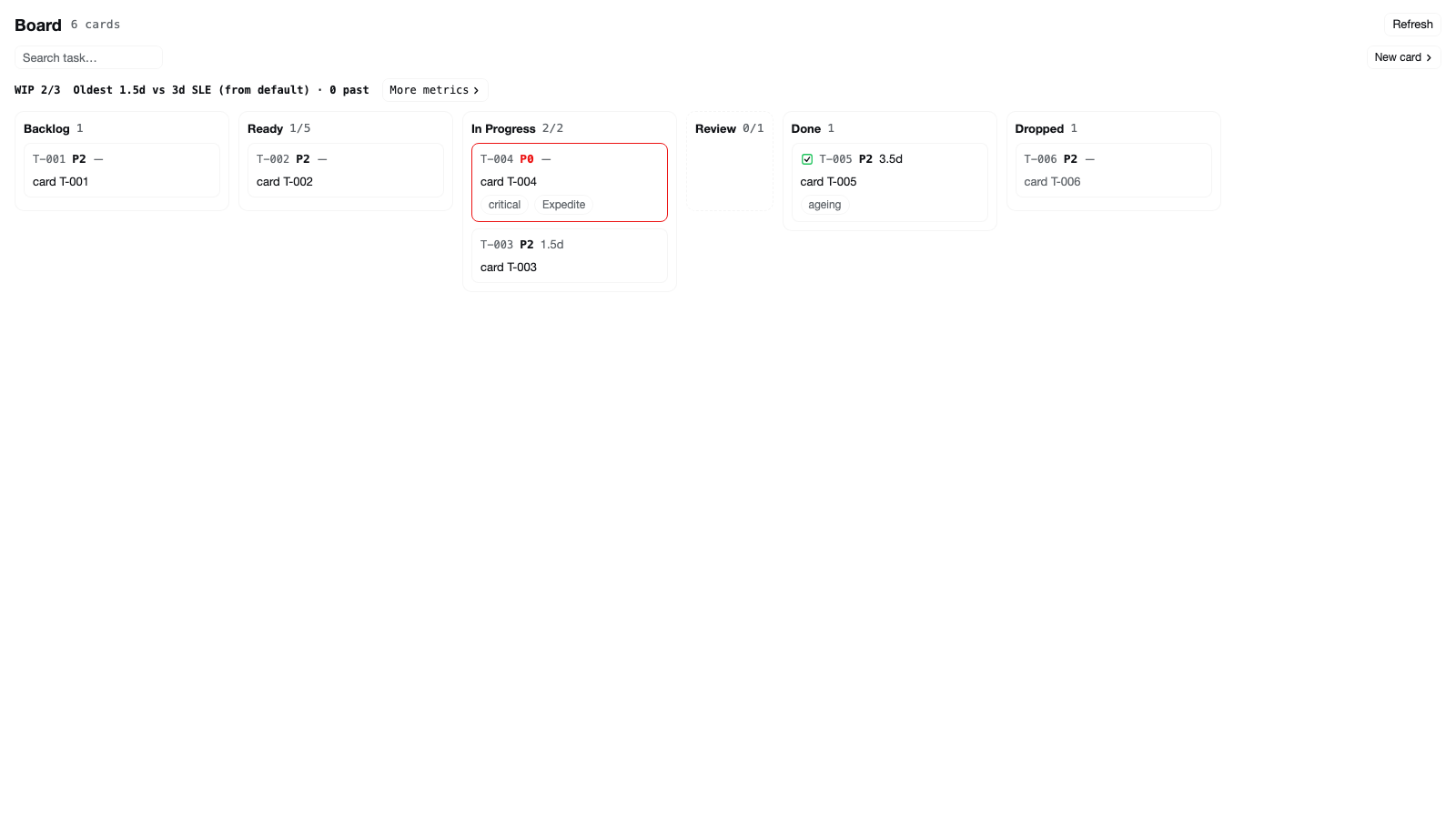
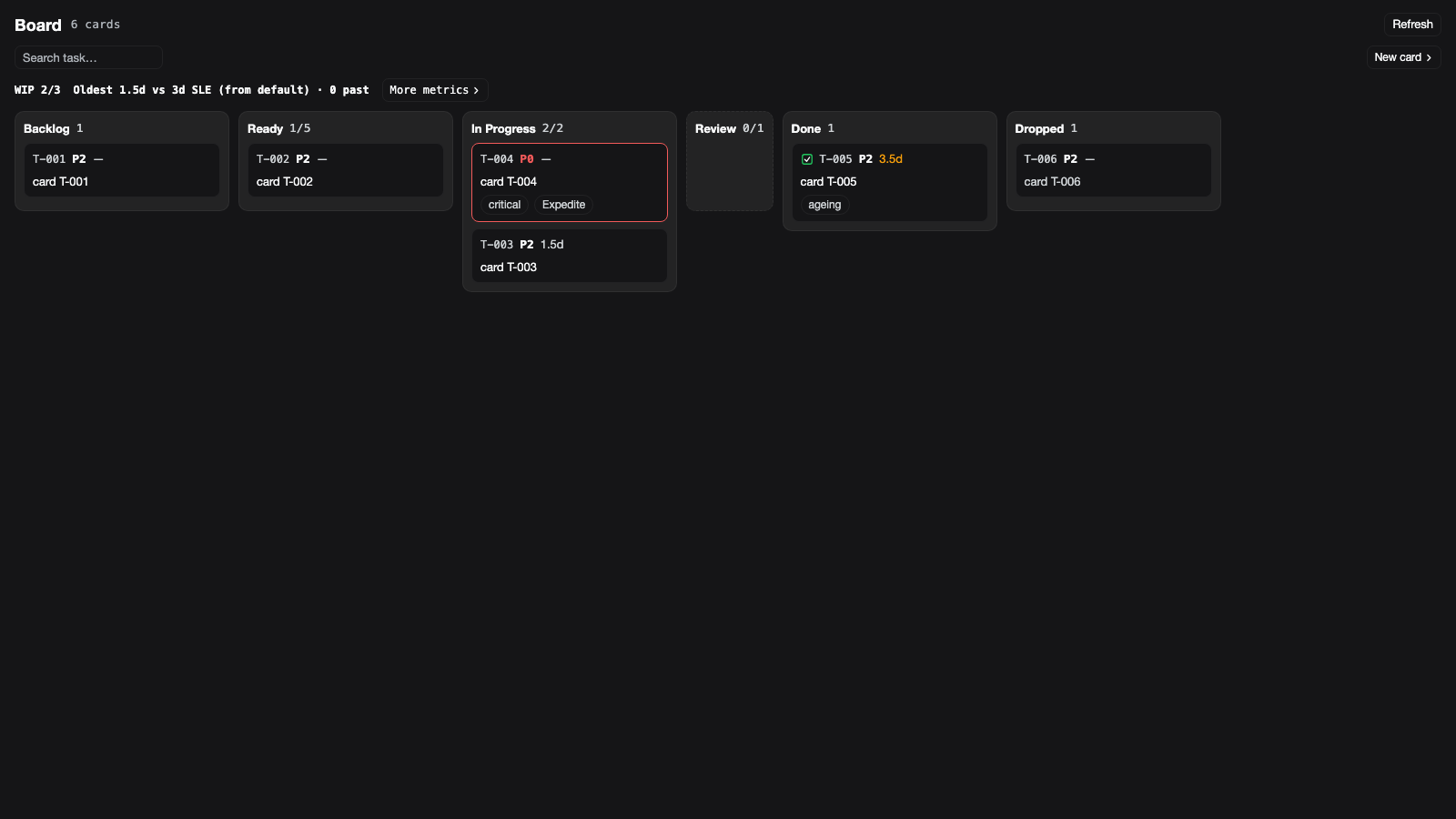
The board, six lanes and every state reachable, in the app's own two themes. Nothing is styled against the app: every colour is one of its theme tokens with a literal fallback.
| light | dark |
|---|---|
 |  |
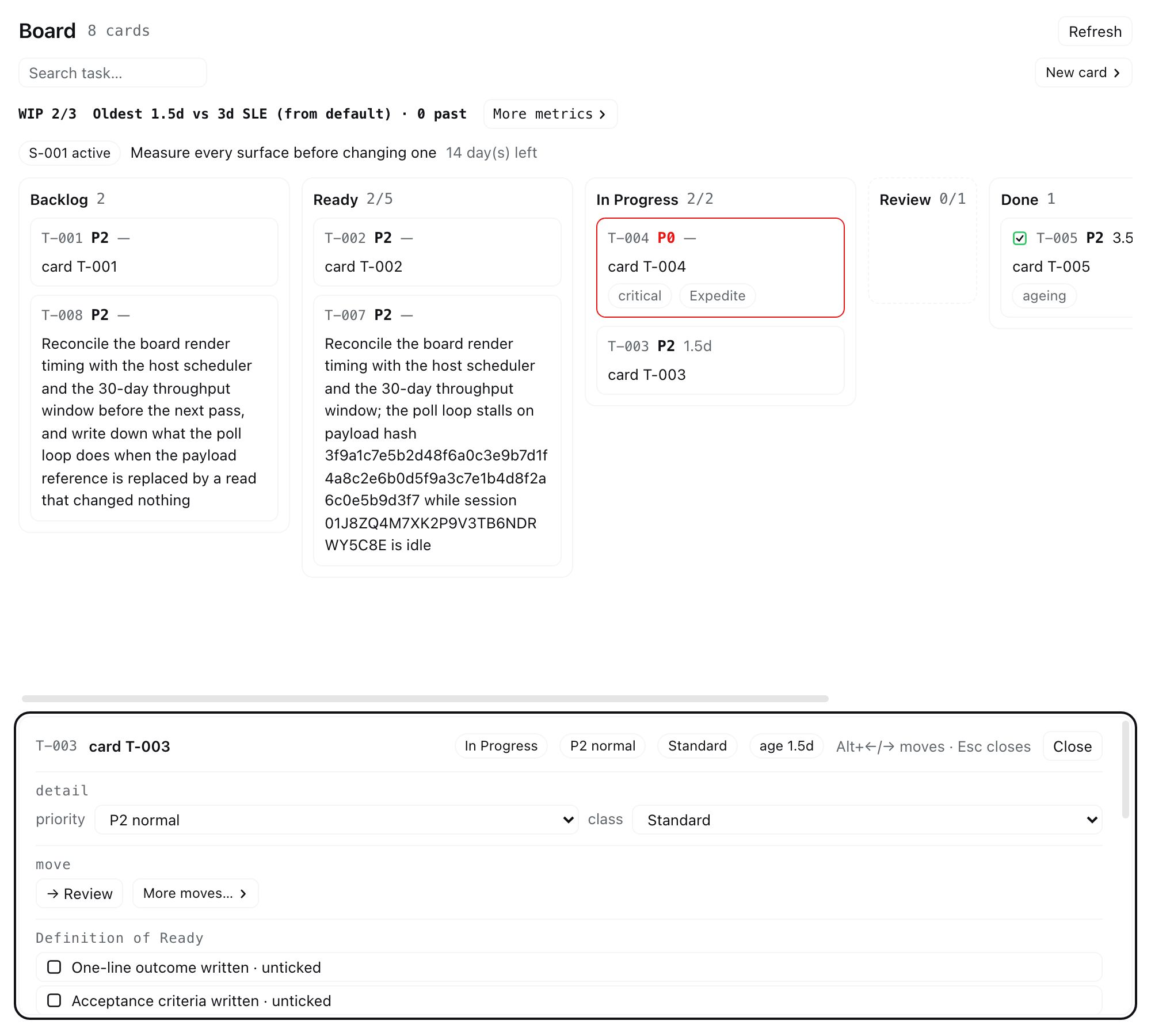
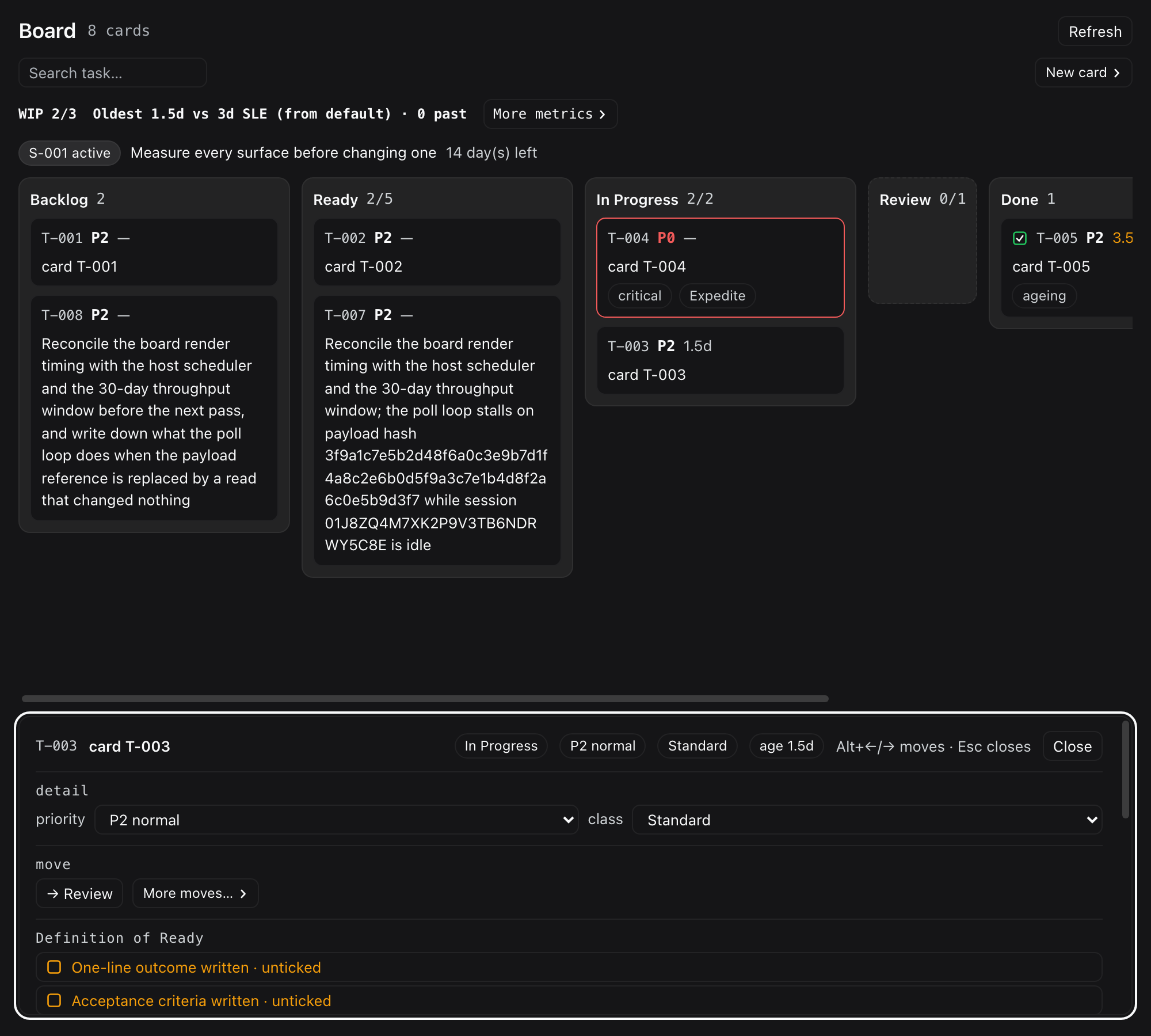
A card's drawer: one primary move, the rest behind a disclosure, the Definition of Ready as checkable rows, and the history collapsed until asked for.
| light | dark |
|---|---|
 |  |
The flow
A card moves through five states, and two gates decide whether it may. dropped is off the workflow —
it is where a card goes when it leaves, and the way back is the drawer's own primary move.
flowchart LR
  B[backlog] -->|"DoR complete"| R[ready]
  R --> I[in-progress]
  I --> V[review]
  V -->|"DoD complete"| D[done]
  B -.->|"dropped, with a reason"| X[dropped]
  R -.-> X
  I -.-> X
  V -.-> X
  X -->|"the drawer's move"| B
- Definition of Ready — outcome, acceptance, write scope, estimate. A card in
backlogcannot be pulled intoreadyuntil every item is ticked, and the refusal names the ones that are missing. - Definition of Done — evidence, tests, docs, links, and no unverified claims, checked when a card
enters
done. - Work in progress —
in-progressandreviewcarry their own limits. Only a human may set the limits, the priority or the class of service, and onlyexpeditepasses a limit that is otherwise full. - Dropping a card needs a written reason. Dragging one onto
droppedrefuses the gesture and hands the move to the drawer, because that is the only place the reason can be typed. - Every move is an event, so the flow metrics (cycle time, throughput, the service-level expectation) are computed from what happened rather than from what a column says.
The rules the board enforces
They come from The Kanban Guide (May 2025) for flow and
the 2020 Scrum Guide for the optional timebox. Kanban has
no sprints, so this is Scrumban and the sprint layer is optional data. The full rationale is in
~/.dsh/docs/kanban.md.
backlog → ready → in-progress → review → done, plusdropped;blockedis a flag, so blocked work still counts as WIP.- Definition of Ready gates every exit from
backlogexcept dropping. - A write scope is data, and agents should pass one.
kanban_createandkanban_updatetakewriteScope— a workspace-relative file or directory prefix, or a list of them (the same shape the Agent Teams board'swrite_scopescarries). A recorded scope is the DoR'swrite-scopeitem, so the row reads as named and the card may leavebacklog; a card with none is refused by name, because a gate that demands a fact no caller can supply is not a gate. The CLI takes the same fact as a repeatable--write-scopeprefix, so a card created or edited from a shell is not gated on a field the shell cannot set;--write-scope=(an empty value) clears it onupdate, the same way an empty--tagsclears the tags. A human may still tick the item for a scope recorded elsewhere (the pre-Kanban board, a task folder). - Definition of Done gates
done; work that does not meet it returns to the backlog. - WIP control:
in-progress2,review1, ready queue 5.expediteis the only exception. - Only the human sets a priority or a class of service, and only the human may except a gate — and an exception must carry a written reason, which is recorded on the card.
- The four flow metrics (WIP, throughput, work item age, cycle time) and a Service Level
Expectation derived from cycle time; the SLE says
guessuntil ten items have finished.
Trust and concurrency, stated precisely
Three claims are spelled out here rather than implied:
- Optimistic concurrency is opt-in. Every mutation accepts an
expectedRevand refuses a write that carries a stale one;bin/kanban.mjs, the tools and the route only send it when the caller does, and the panel always does. A caller that omits it is choosing last-writer-wins. The mechanism is "a rev you supply is checked", not "no write can clobber another". - The CLI is the human's tool and trusts its shell.
bin/kanban.mjsdefaults to--actor human, so an agent that shells out without--actor agent:is recorded as Dhira and could set a priority or except a gate. There is no way to enforce otherwise from inside the process — an agent with a shell can lie. The gate that is enforced is on the agent's proper surface: a tool call carries its session and cannot claim to be the human. set-dowis human-only and validated. The Definition of Workflow is the control itself, so a malformed one is refused at the store rather than stored: a non-numeric WIP limit used to disable WIP control silently, and adorthat was not an array made every move throw. Fields the payload does not mention keep their stored value; a field that is present and wrong refuses the whole write.
Requirements
Build-time: Node 22 or newer (the host half is emitted for node22, and the suite uses
--test-isolation=none), plus pnpm and the devDependencies — esbuild, TypeScript, React, jsdom. A
clone needs nothing but pnpm install.
Run-time: the DSH desktop app. The built lib/** needs no install step of its own and no
devDependencies; the store uses node:sqlite, which ships with the app's Node. bin/kanban.mjs is a
bundled ESM executable that imports nothing but Node builtins, so it runs from a clean checkout with
no node_modules.
Development
pnpm install                      # one workspace, one lockfile; `prepare` builds lib/**
node scripts/gate.mjs             # build + typecheck + tests + freshness, ending in GATE PASS
node build.mjs                    # host + browser halves, the CLI, and the declarations
node scripts/typecheck.mjs        # three projects: host, browser, tests
npm test                          # builds first, then runs the suite under the guard
Run the gate rather than composing the steps by hand: it judges every step by process exit code and
prints one verdict, because twice this project read a broken build's tail -1 as green — the guard
prints its own memory line last — and the suite then passed against a stale bundle. A build
failure invalidates every test result after it, so the gate builds first and checks freshness last.
Build before you test. The suite imports the generated lib/**, not src/**; lib/ is
gitignored, so a fresh clone has none, and a test run against a stale build is green and wrong.
| source | built | what it is |
|---|---|---|
src/store/ | lib/v1/store/** | the board: schema, policy, metrics, the generated view, the import (no DSH import) |
src/host/ | lib/v1/host/** | the route, the nine tools, the skill, the probe record |
src/client/ | lib/v1/client.js | the panel: model, drag logic, transport, store, components, styles |
src/cli/ | bin/kanban.mjs | the CLI, bundled to a single executable |
types/ | — | the ambient build facts for each half |
test/ | — | table-driven suites against lib/** |
Testing and Validations
Ten test/*.test.ts files, all against the built artifacts: the store and schema, the policy engine,
the four flow metrics, the generated view, the import of the pre-Kanban board, the CLI as a black box
(including its exit codes), the browser model and drag arithmetic, and the panel under jsdom against a
fake HTTP layer.
- The freshness gate.
scripts/gate.mjsends withcheck-build-freshness.mjs: artifacts must exist and must not predate their source. A stalelib/**invalidates every result above it. - Non-vacuity. A new test is proven by mutation probe — break the code it names and watch it fail — not by passing. A test that cannot fail is not evidence.
- Memory discipline. Every
noderun goes through the vendoredscripts/guard.mjs, which caps it (1 GB for the DOM suite, 512 MB for pure logic). Exit 124 means the cap was hit: bisect the run, never raise the cap. Two defects once took a machine to ~170 GB RSS. - Never assert on a DOM node. Compare primitives —
assert.ok(node === null), not the node — because walking a failing React/jsdom node's fibers allocated gigabytes. - No test is skipped, and a skipped one would have to say the exact condition that unskips it.
(
test/migrate.test.ts'sskippedlist is data about the import, not a disabled case.)
Contributing
One author: every commit here is authored and committed by **Dhira Wigata **, set repo-locally.
git config --local user.name  "Dhira Wigata"
git config --local user.email "dwigata.putra@gmail.com"
No `Co-auth