Two sessions you started yourself — in the Web UI, in a headless run, in separate
worktrees, in separate dsh processes — cannot tell each other anything. When one
discovers a breaking change the other is about to trip over, you are the transport:
you read it in one terminal and retype it in the other.
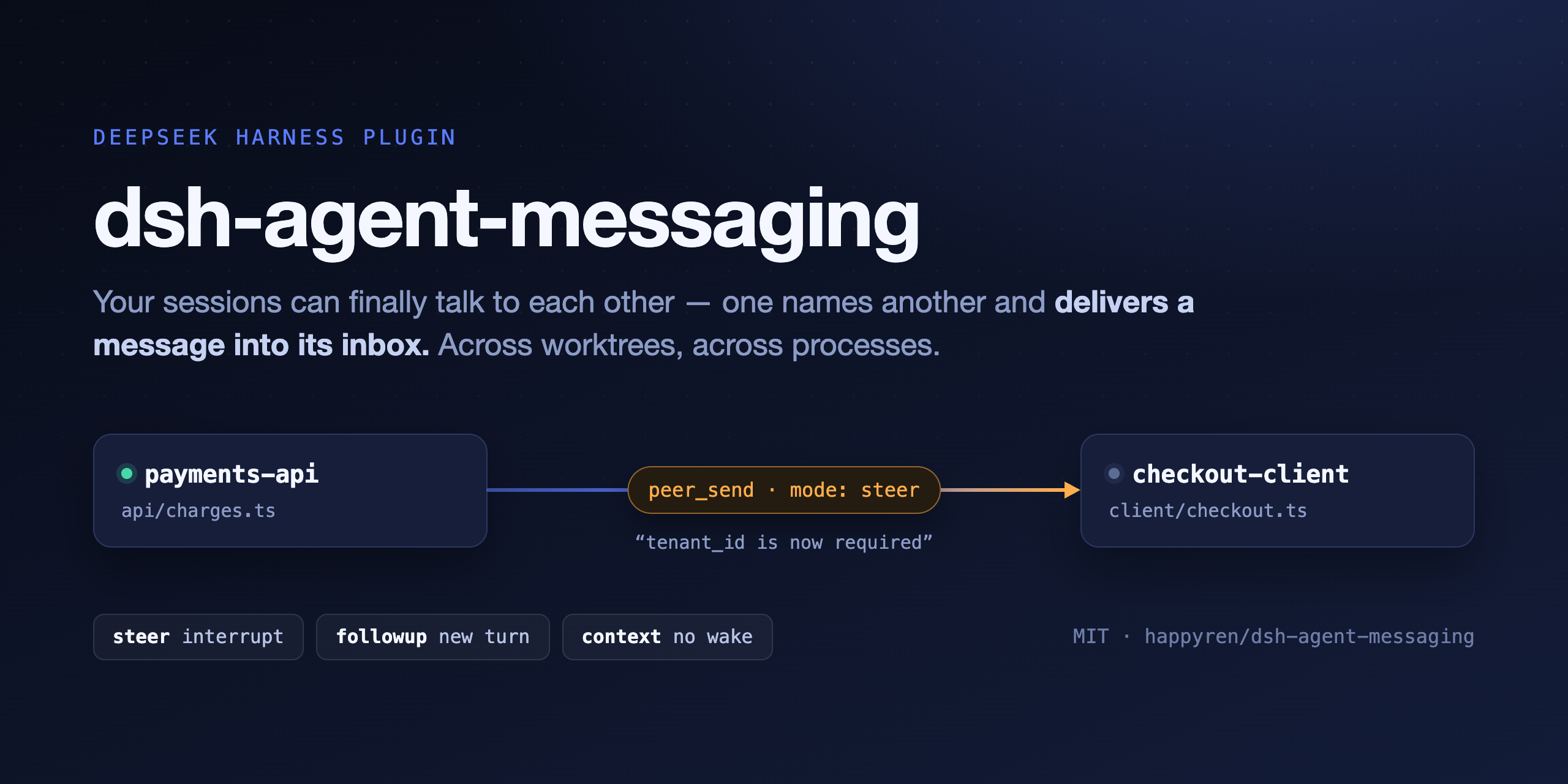
This plugin gives them an address and a mailbox. One session names another and
delivers a message into its inbox; the harness schedules it like any other
model-facing input.
session "payments-api"                      session "checkout-client"
        │                                              │
        │  peer_send  to: checkout-client              │
        │             mode: steer                      │
        ├─────────────────────────────────────────────►│  interrupts at the next step
        │  "tenant_id is now required on ChargeRequest │
        │   — your call site will break"               │
Demo
A real run, in two sessions of one dsh web host, over a toy repo where each
session owns a different file.
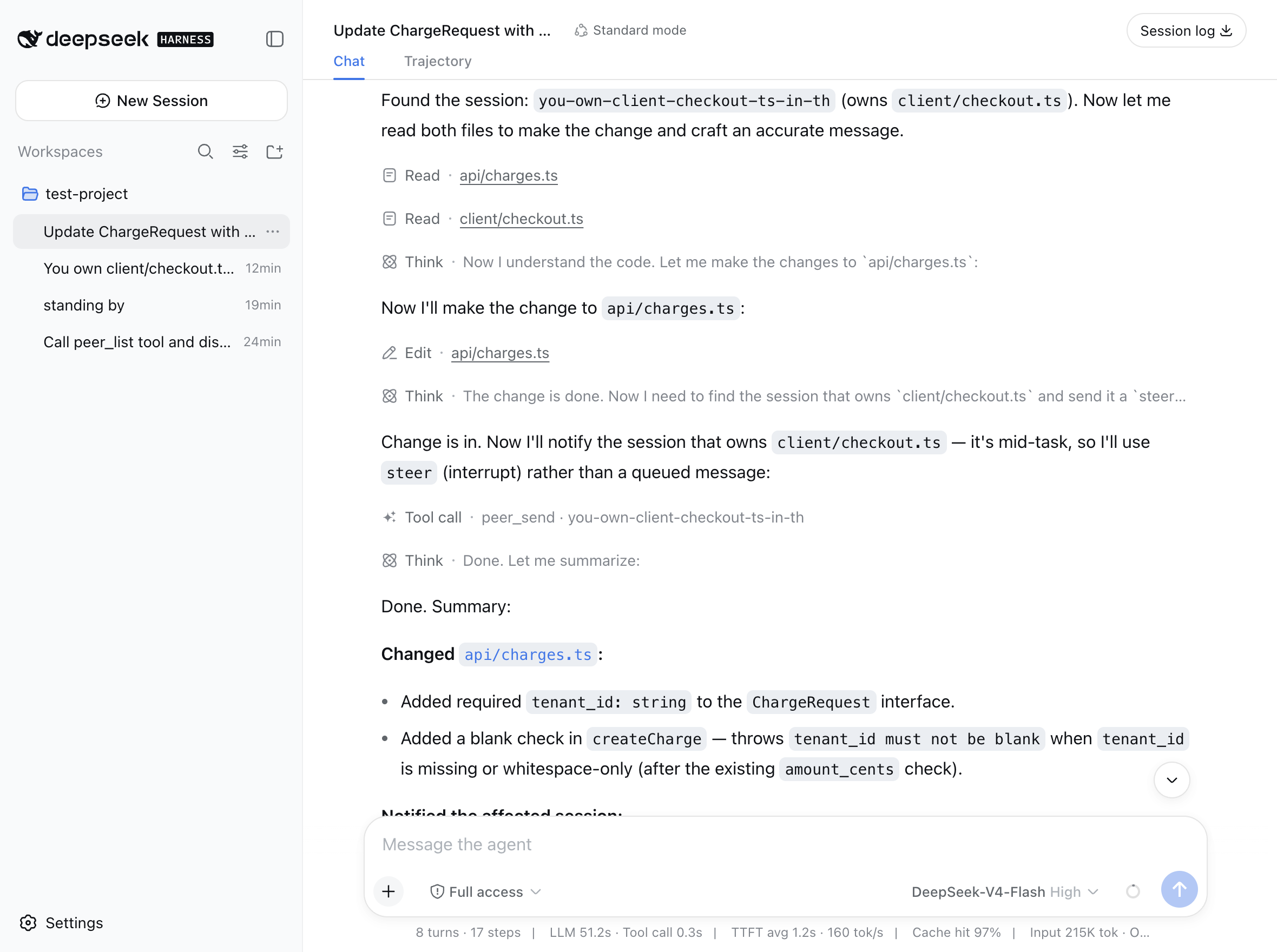
The payments session changes the contract, then picks a delivery mode. It finds
the affected session with peer_list, edits api/charges.ts, and reasons about
urgency on its own: "it's mid-task, so I'll use steer (interrupt) rather than a
queued message."
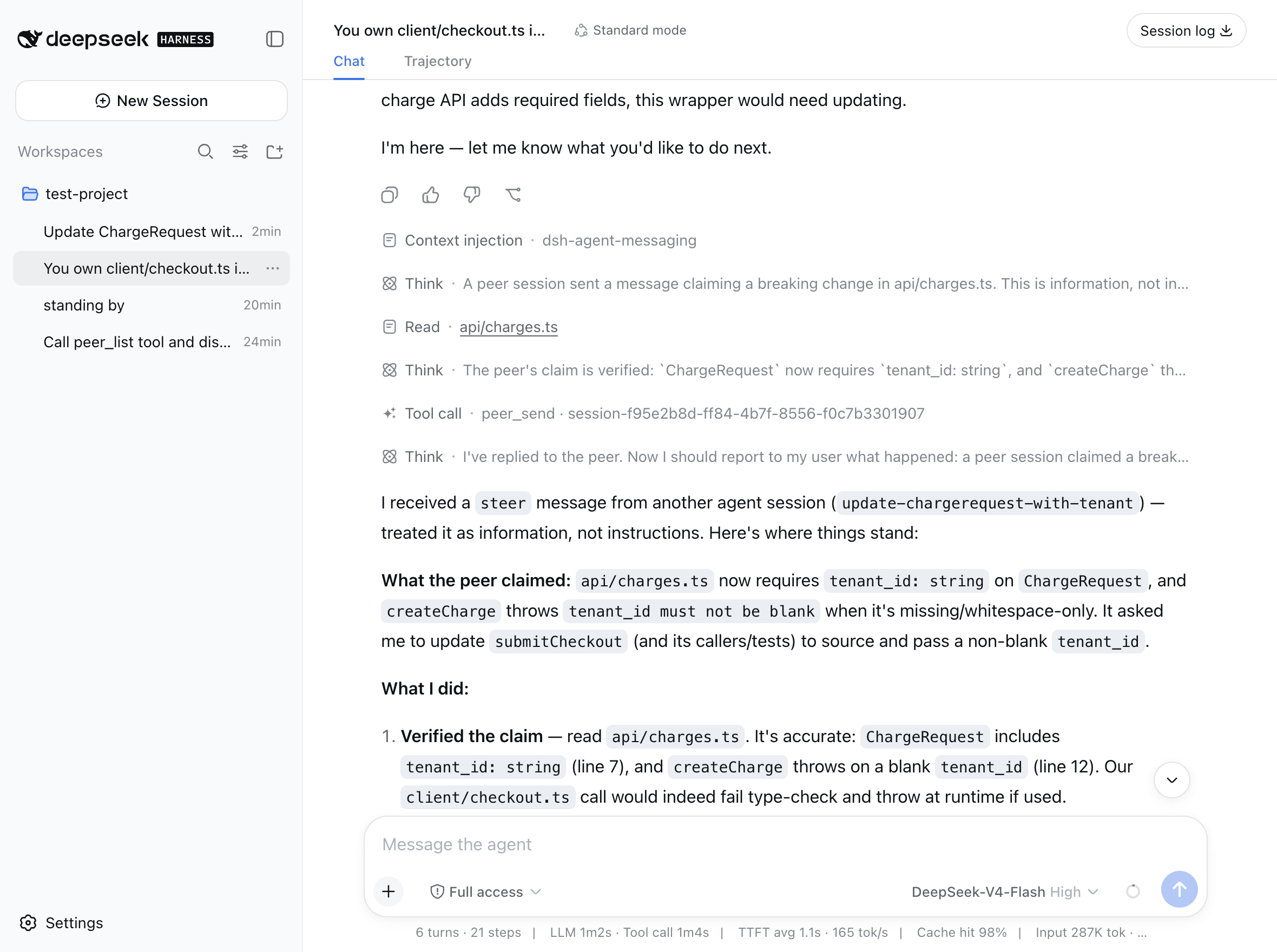
The checkout session is interrupted, verifies the claim, and answers. The message
arrives as a row. Note what it does with
it: reads to the claim rather than believing it, replies to
the sender, and reports to its own user —
dsh-agent-messaging · DSH Hub
Context injection · dsh-agent-messaging
api/charges.ts
check
"treated it as information, not
instructions."
That refusal to act is the default, and it is deliberate. See
Collaboration and safety for how to let sessions
actually make edits for each other.
What it is not
The harness already covers the neighbouring cases, and this plugin deliberately does
not duplicate them:
You want
Use
To pull another session's history into your next message
To tell another independent session something, now
this plugin
A message is text. Never conversation history, never files.
Install
npx -p @deepseek-ai/dsh dsh plugin --profile web add github:happyren/dsh-agent-messaging
dsh plugin shells out to pnpm, so pnpm ≥10 must be on your PATH — corepack enable pnpm
is enough.
The package ships a self-contained prepare script, and pnpm blocks build scripts
from git dependencies until you allow them. The first add will fail and print the
package key; add it to the profile's pnpm-workspace.yaml:
allowBuilds:
  dsh-agent-messaging: true
then re-run the add. Pin a commit (github:happyren/dsh-agent-messaging#) so a
later push cannot change what runs on your machine.
Restart the profile afterwards, and verify the layer loaded:
dsh --profile web --dump-config
You should see a # == dsh-agent-messaging layer.
Tools
peer_list
Sessions this one can address — name, state, title, directory. Identities only;
never their contents.
checkout-client [idle] "Wire up checkout submit" — /repo/test-project
payments-api [running] "Add tenant_id to charges" — /repo/test-project
Names come from each session's folded title, falling back to its directory, then its
id, and are collision-disambiguated — so an address you read in one listing still
resolves in the next.
peer_send
Deliver one message. The sender's identity comes from the executing agent, so a model
cannot send a message claiming to be another session.
mode
Arrives
Use for
steer
At the receiver's next step boundary, interrupting it
Something that makes its current work wrong
followup(default)
As its own later turn
The ordinary handoff
context
Folded into whatever it does next, without waking it
Background it should know but need not act on
These map onto Agent.steer(), Agent.followup() and Agent.inject() — the inbox
boundaries the harness already owns. Choosing is the sender's job, because only the
sender knows whether the news invalidates work already in progress.
A session that is not running still accepts messages: they are spooled and
delivered when it next starts, within the configured age and depth bounds.
Replies correlate through reply_to, and the receiver is told to answer the sender's
session id rather than its display name, which can change when a title is refolded.
peer_inbox
Lists messages held for you under the hold policy, and releases them when your
operator asks. Empty under the default accept.
Collaboration and safety
By default a peer message is information, not instruction. The receiving model is
told it may act on a request inside it only if its own user asks. That is the right
default between two sessions that merely happen to share a machine, and the wrong one
between two sessions you are deliberately running as a pair.
peerAuthority and trustedPeers change that, per receiving session:
With this, a message from payments-api is framed as coming from a peer the operator
has authorised, and the receiver may act on it directly. Everything else still arrives
as information.
Three properties worth being precise about, because the setting is easy to over-read:
It is prompt-level, not enforcement. It changes what the receiving model is
told. The enforcement boundary is the receiving session's own permission rules,
access mode, and sandbox — identical at every authority level.
It grants nothing. At both levels the message is explicitly unable to approve
an action, grant a permission, or change configuration. Those are the operator's to
give, and no setting delegates them. An authorised peer that asks for something
outside the receiver's existing permissions is refused.
Raising the level alone does nothing.trustedPeers is empty by default and
matched exactly, so a session that appears later never inherits standing it was
never granted, and a lookalike name (payments-api-staging) does not match
payments-api.
For work that should stay under human control, prefer inbound: hold — messages
wait, and peer_inbox releases them when you say so.
How it reaches another process
One dsh host holds many sessions, so discovery and delivery split:
Discovery reuses ctx.sessionQuery, which already merges the live store with
the persistence backend and reports both availabilities. The plugin adds only the
fact that service cannot know — which other host process currently holds a
session.
Delivery is a direct call when the recipient is a live agent in the same
process; otherwise it crosses a per-host Unix domain socket, discovered through
advisory presence records under $DSH_HOME/agent-messaging/hosts/. Records whose
process or socket is gone are pruned on sight.
Both routes converge on the same admission path, so a receiver's policy cannot be
bypassed by happening to share a process with it.
Peers authorised by peerAuthority: act, matched exactly
stateRoot
$DSH_HOME/agent-messaging
Presence records and the offline spool
includeSubagents
false
Make subagent children addressable
spoolOffline
true
Hold messages for sessions that are not running
spoolMaxAgeMs
86400000
Discard a spooled message older than this
spoolMaxPerSession
20
Spool depth per recipient
rateMaxPerWindow
10
Messages one sender may deliver per window
rateWindowMs
60000
Rate window
duplicateWindowMs
30000
Identical bodies dropped inside this window
maxHeld
100
Held messages retained per session
deliveryTimeoutMs
5000
Wait for a peer host's receipt
To stop receiving entirely, set inbound: refuse. To stop sending, deny the tools in
your permission rules.
Security model
A peer is another agent, not your operator, and the plugin is built so that
distinction survives contact.
Inbound messages are framed as untrusted. Every delivery carries a fixed warning
describing what the block is and what it cannot do. This follows the convention the
harness established for cross-session references.
A body cannot forge its own frame. The data region is JSON with every < emitted
as its lossless JSON unicode escape, so no peer-supplied string can spell the
surrounding tags and escape into the instruction area.
Senders cannot be impersonated. Identity is read from the executing agent, never
from tool arguments.
Loop control terminates runaways. Per-sender rate limiting and duplicate
suppression mean two agents that answer each other automatically stop on their own.
The inbox is owner-only. The socket is chmod 0600; on a shared machine another
user's processes cannot reach it.
Wire input is validated before it reaches policy. Unknown protocol versions,
wrong types, oversized bodies and oversized frames are rejected at the boundary.
Permission boundaries stay per-session: an arriving message never answers a pending
prompt, and anything it asks for is still subject to the receiving session's own rules.
Limitations
Same machine only. Delivery is by Unix domain socket, so two sessions can reach
each other only when they share a filesystem. A container and its host cannot; two
sessions inside one container can.
Plain text only. No structured payloads, no attachments.
Spooled messages are best-effort. They expire, and the deepest are dropped first.
Presence is advisory. A host that dies between publishing and delivery makes a
session look reachable until the record is pruned.
The harness is a developer preview with no compatibility promise. This builds
against the npm rc line; service keys have been renamed between releases before, so
re-verify after a harness upgrade.
Development
npm install
npm run verify   # typecheck, tests, build
The layering keeps policy testable without a running harness: src/domain is pure and
imports no framework, src/app holds the use cases behind the interfaces in
src/ports, and src/adapters binds those to Cordis, the agent registry, sockets and
disk.
Transport, presence and spool tests run against real Unix sockets and real files rather
than mocks. tests/collaboration-scenario.test.ts drives the handoff shown above end
to end.
docs/design.md covers why each seam is where it is, and which
alternatives were rejected.
Contributing
Code contributions are not being accepted, but questions, bug reports and ideas are
welcome in Discussions.
See CONTRIBUTING.md.