dsh-switchman
提供多智能体团队分发与上下文控制 适合需要将主模型作为分发器、协调多智能体协同工作的复杂任务。
安装
npx -p @deepseek-ai/dsh dsh plugin --profile web add github:mrzturn/dsh-switchman说明文档
阅读完整 README ↗dsh-switchman
English | 简体中文
The switchman family, same author, same orchestration: opencode-switchman (the OpenCode original) · zcode-switchman (the ZCode port) · dsh-switchman (this repo, for DeepSeek Harness).
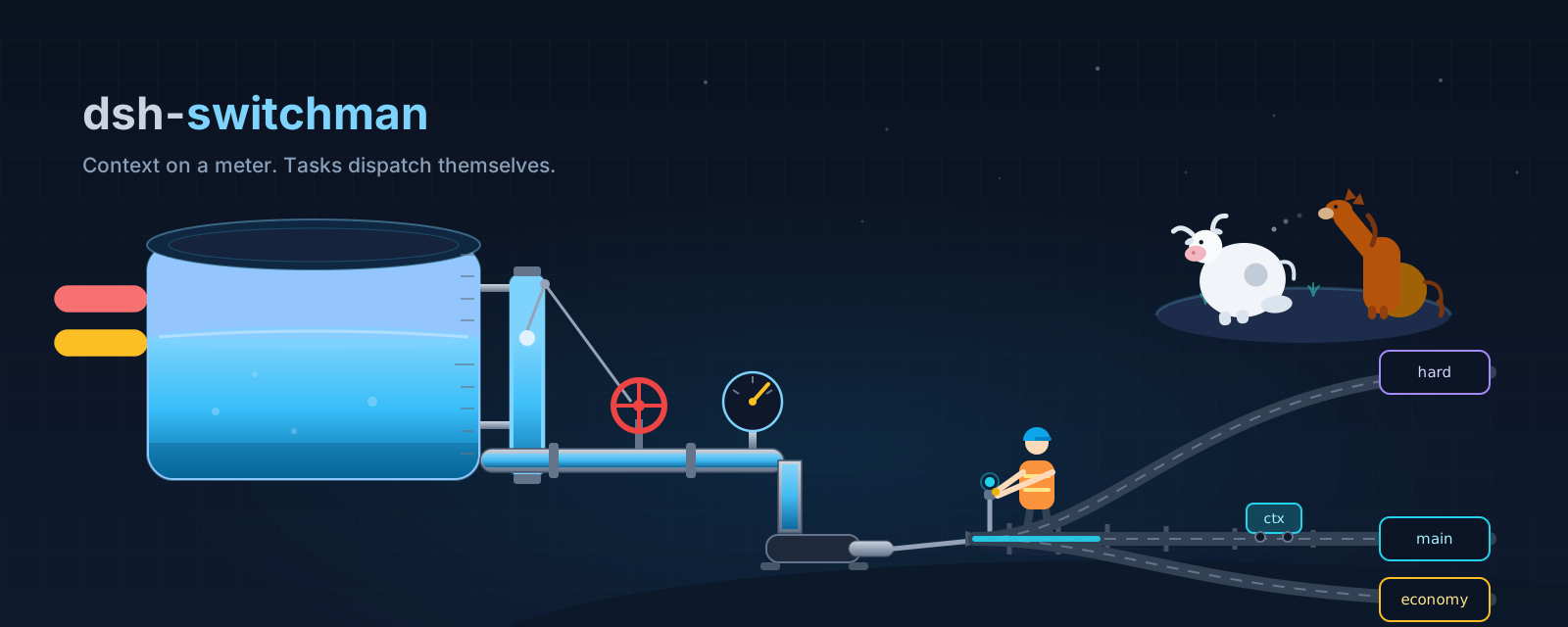
Context on a meter. Tasks dispatch themselves.
A plugin for DeepSeek Harness (DSH). Once installed, your primary model stops doing everything itself and becomes a dispatcher: measure the water level, pick the lane, hand out the task, check the work. Four things:
1. Context water-level control. Every turn measures live session tokens. Soft (default 50k) advises delegating, hard (90k) tightens the per-turn read budget and nudges wrap-up, force (130k) backs the session up and hands it over to compaction — automatically. Run a session all day; your context never drowns in its own history. Every dispatched subagent carries its own hard cap and exits with a HANDOFF summary when it's reached.
2. Six-lane dispatch. economy / mechanical / main / hard / vision / review — six cognitive lanes. Pick candidate models per lane in the settings page, rank them strongest-first (optional S/A/B/C tier anchoring), and pin a reasoning effort per route — the dropdown lists the levels each model actually supports, not a generic three. A [SWITCHMAN:POOLS] table ships with every prompt so the model knows who to call; enforce mode rejects out-of-pool models outright.
3. Language preferences. One dropdown each for replies, code comments, and authored docs. Unset? You get asked once, it's remembered forever, and every later session follows it.
4. Delegate-by-default doctrine. Replaces DSH's shipped conservative team policy ("only create teammates when asked"): trivia stays hands-on (20 lines goes to a tester, >300 lines or core logic goes to a reviewer. Say "don't use teams" and it steps aside instantly.
Only one model? Still worth it — water-level control and the doctrine don't care how many models you have.
Bundled skills
- db-query — read-only MySQL/Redis verification: run SQL to check records, cache keys / TTLs, cross-store consistency. Refuses all writes. One-time setup below.
- git-commit-message — convention-compliant commit text. Text only; never touches git.
- requirement-docs — one spec for requirements / PRD / design docs, archived to
docs/requirements-and-design/.
Quick start
-
Install — from any agent session, or the Web plugin manager:
plugin_manager: install_bundle target=dsh-switchmanor from a local checkout (linked; re-run
remove_bundle+install_bundleafter pulling changes):plugin_manager: install_bundle target=/path/to/dsh-switchman -
Restart DSH — quit the app entirely and reopen (a page reload is not enough) so the client-module table picks up the bundle.
-
Open the settings page — Settings → dsh-switchman. The first screen is language preferences: one dropdown each for replies / comments / docs, each with a live
current: …line. Skip them if you like — you'll be asked once and remembered.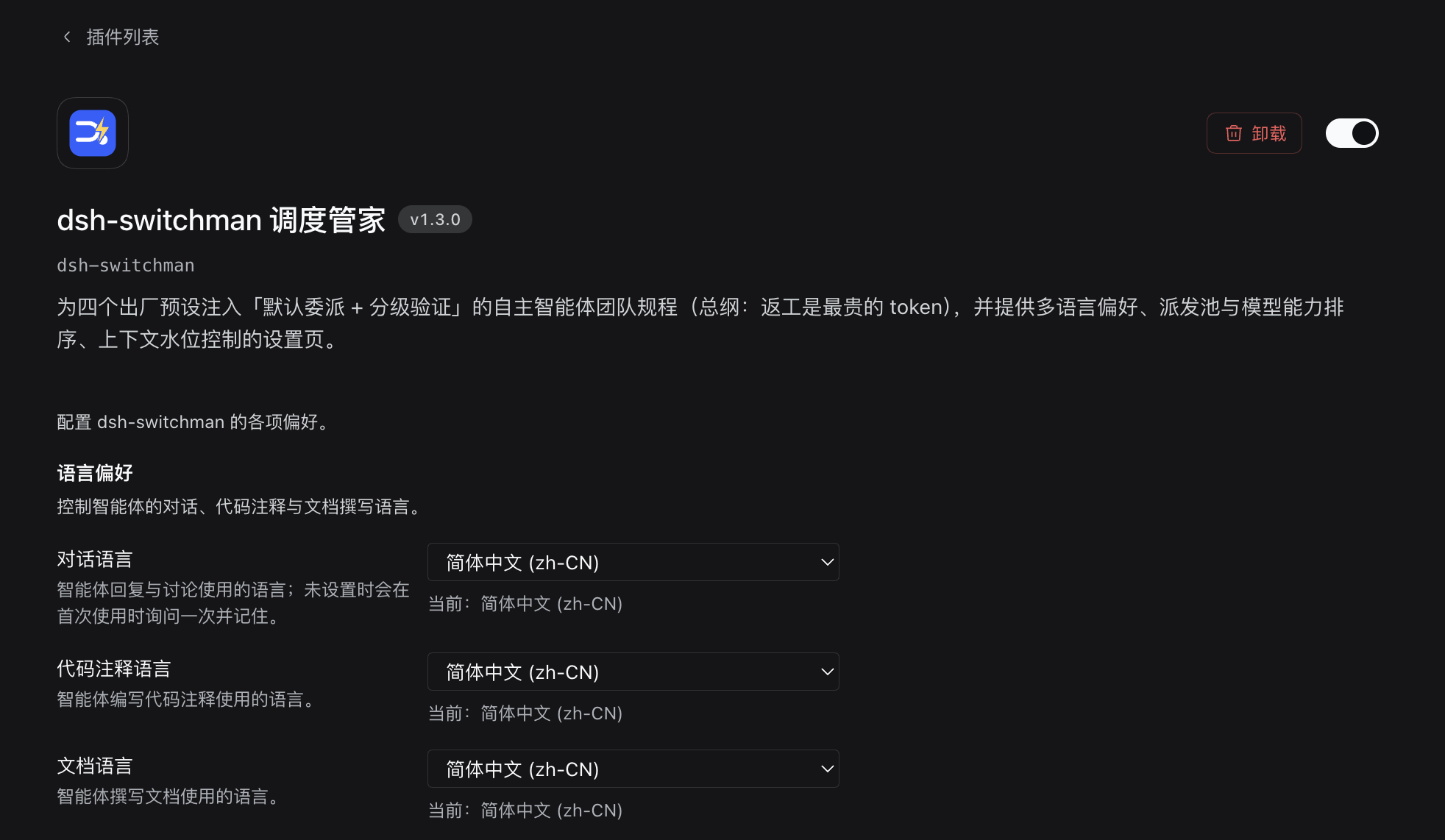
-
Fill the six pools — each pool card lists candidates grouped by provider; tick the ones you want. Tick manual order and the card becomes a numbered priority list with ↑ ↓ × controls. The effort dropdown beside each selected route defaults to follow lane; pinning it lists the levels that model actually supports (Low / High / Max…). A summary line tracks progress live: “6/6 pools set · 3 ranked · mode advice”.
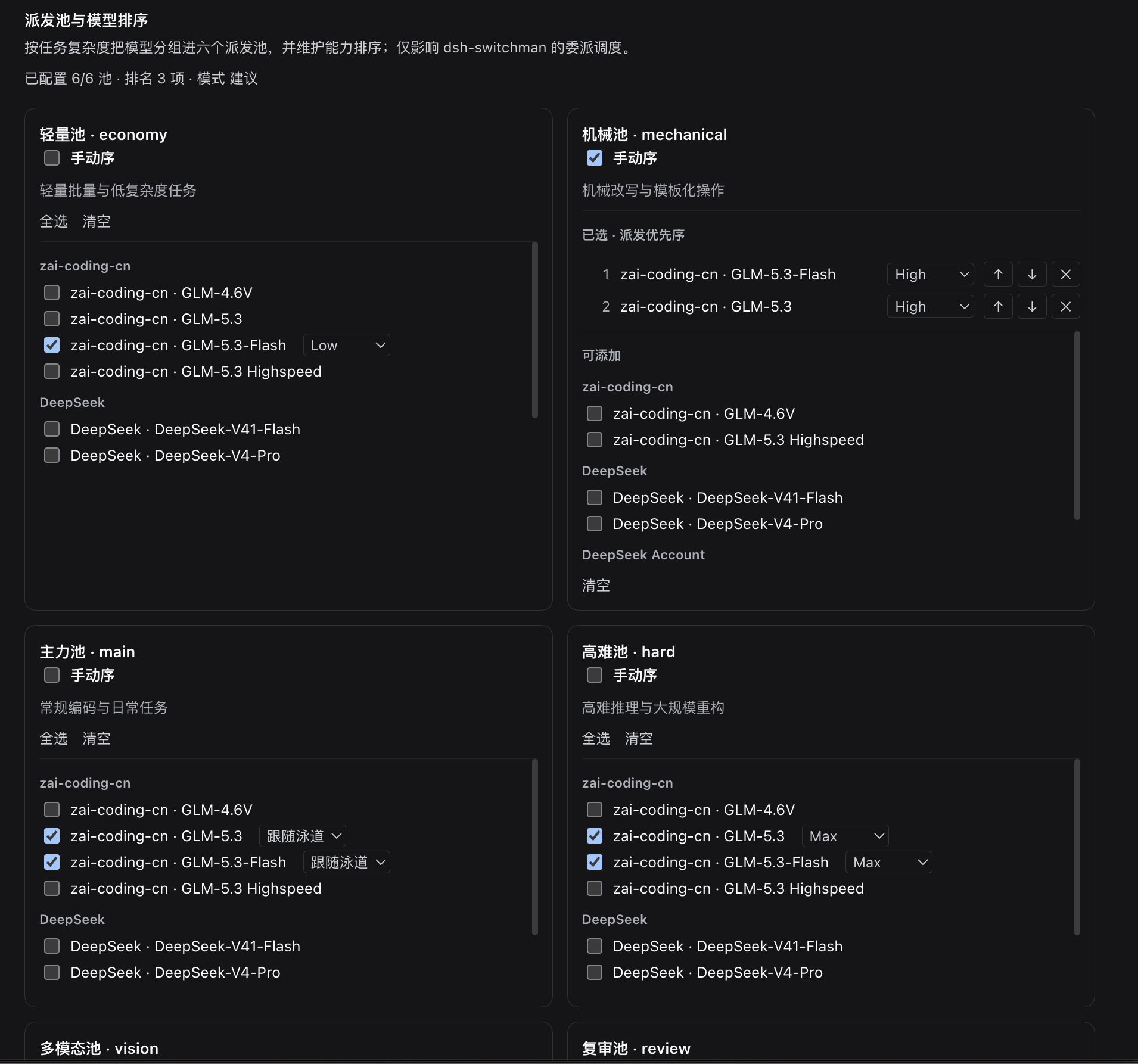
-
Ranking and watermark — the ranking table's order is capability order (strongest first), with optional S/A/B/C tiers; execution mode is
off/ advice / enforce (enforce = out-of-pool models are rejected). Below it, the watermark section tightens behavior by token usage: three thresholds, a per-call read budget, hard-mode behavior (cap / deny), an auto-handover toggle, and a separate cap for subagents. The bottom line carries the commands:/ctx-pauseto stop intervening ·/ctx-resumeto resume ·/ctx-handoverto back up and hand over now.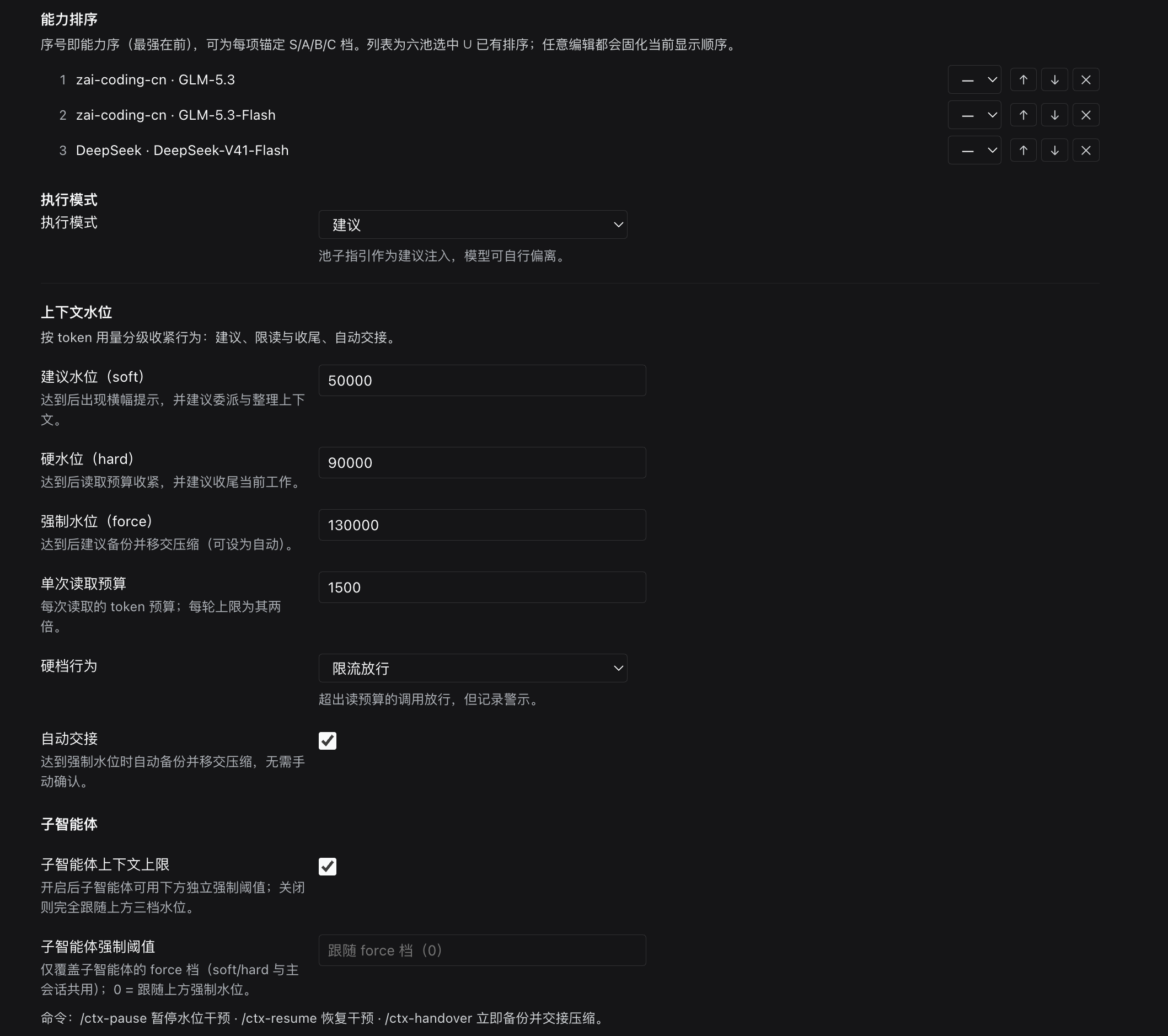
-
Verify — the ⚡ badge appears beside the preset chip in any session header; ask the model “what does the last section of your system prompt say?” — it should mention the dsh-switchman doctrine.
db-query one-time setup (script dependencies live inside the skill directory):
bash /skills/db-query/scripts/setup.sh
How it works
- The Host half (
index.js+host/) injects three dynamic system-prompt sections, the read-budget and enforce gates, automatic answer capture, and three slash commands. All settings are volatile fields — saved changes apply to the next prompt assembly, no restart. - The Client half (
client.js) renders the ⚡ badge beside the preset chip and the settings page, through official settings-form services. cordis.patch.ymlrestates each shipped preset's plugin list verbatim and only extends the persona suffix; the Agent Teams tools themselves still come from the shipped@deepseek-ai/dsh-experimental-agent-team-profile.
Maintenance
- After a DSH upgrade that changes shipped preset plugin lists, re-sync
cordis.patch.ymlfrom the newpresets/*.patch.yml(keep the doctrine suffix), then reinstall. - Model-facing protocol lines (
[SWITCHMAN:LANG|POOLS|WATERMARK]) are deliberately English and byte-stable — do not localize them. npm pack --dry-runmust stay at the audited 34-file / ~111 kB shape (thedocs/screenshots never ship).
License
MIT