songoao25/dsh-bottom-info-bar ↗★ 39
dsh-bottom-info-bar
在输入框下方展示模型、余额及会话开销 适合需要实时监控API余额、计费标准和当前会话花费的用户。
安裝
npx -p @deepseek-ai/dsh dsh plugin --profile web add github:songoao25/dsh-bottom-info-bar說明文件
閱讀完整 README ↗Bottom Info Bar
English | 中文


A DeepSeek Harness plugin that replaces the stats row under the composer with one line: provider and model, real balance or subscription quota, peak/off-peak pricing, and what this session has cost.

What it shows
| Group | Fields |
|---|---|
| Provider | the exact provider and model, mirroring DSH's model switcher |
| Native stats (kept) | turns and steps, model time, tool time, cache hit rate, input/output tokens, context usage |
| Money | real balance, subscription quota windows, or this month's cloud bill |
| Pricing | peak and off-peak prices, the current period, a countdown to the next price change |
| Spend | this session (including subagents), today, last 30 days, all time |
| Extras | main time, world time, custom text |
The bar has two densities — click it to switch. Compact shows only the provider, model, and one essential account detail: balance, the shortest useful quota window, or this billing period's spend. Full shows every enabled detail, including DSH's native stats row. Both follow DSH's light or dark theme.
Compact mode
Four real states — light and dark, balance and subscription quota.
Light · balance

Dark · balance

Light · subscription quota

Dark · subscription quota

Three billing modes
The bar follows the active session and picks the mode from the provider. The three modes are mutually exclusive — there is no manual switch.
Balance
Shows the real balance from the provider's own API. It refetches when the bar opens, the page refreshes or the provider changes, then polls every 60 seconds; a failed refresh keeps the last known figure on screen. Below 20 (in the account's currency) the amount and a Low label turn red.
Subscription quota
Full mode shows each available quota window (5-hour / weekly / monthly) and a countdown to the next reset — both always come from the same window, so they can never disagree. Windows show remaining percent by default and can be switched to used in settings; the low-quota warning always follows the remaining ≤ 20% rule. Compact mode keeps only the shortest available window (5-hour → weekly → monthly), without a reset countdown.
Cloud billing
Shows this month's real spend from the provider's official billing API, for example Together | This month $12.34 or AWS Bedrock | This month $45.60 · Budget 46%. Cloudflare also shows the daily free-quota remainder with a UTC-midnight reset countdown when the API actually reports a free allowance.
Install
Requires DeepSeek Harness with the web interface (dsh web) and pnpm.
From npm (recommended — installs the released version):
dsh plugin --profile web add dsh-bottom-info-bar
From the GitHub repository — github.com/songoao25/dsh-bottom-info-bar (tracks the default branch; lib/ is committed, so no build runs on install):
dsh plugin --profile web add https://github.com/songoao25/dsh-bottom-info-bar
With the local one-click script (clone, build and install in one step):
git clone https://github.com/songoao25/dsh-bottom-info-bar.git
cd dsh-bottom-info-bar
./install.sh
If you installed from a checkout before the package moved to the repository root, your profile points at /plugin. That path still resolves — the repository keeps plugin/ as symlinks to the package root — so nothing needs reinstalling. If it does not resolve (a ZIP download, for instance, delivers those symlinks as plain files), remove the plugin and install again with one of the commands above.
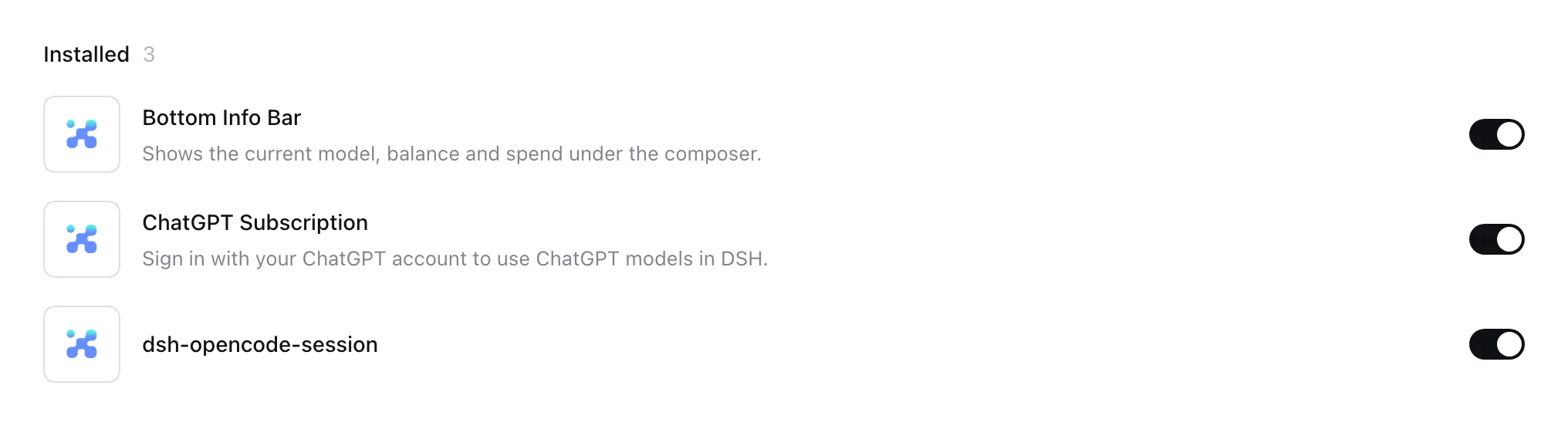
Then restart dsh web — plugins are composed when the host starts, so a page refresh is not enough. The plugin shows up in the Plugins list, enabled:
More detail and troubleshooting: docs/INSTALL.md.
Settings
Everything lives on the plugin page — Plugins → bottom-info-bar. Changes save as you make them.
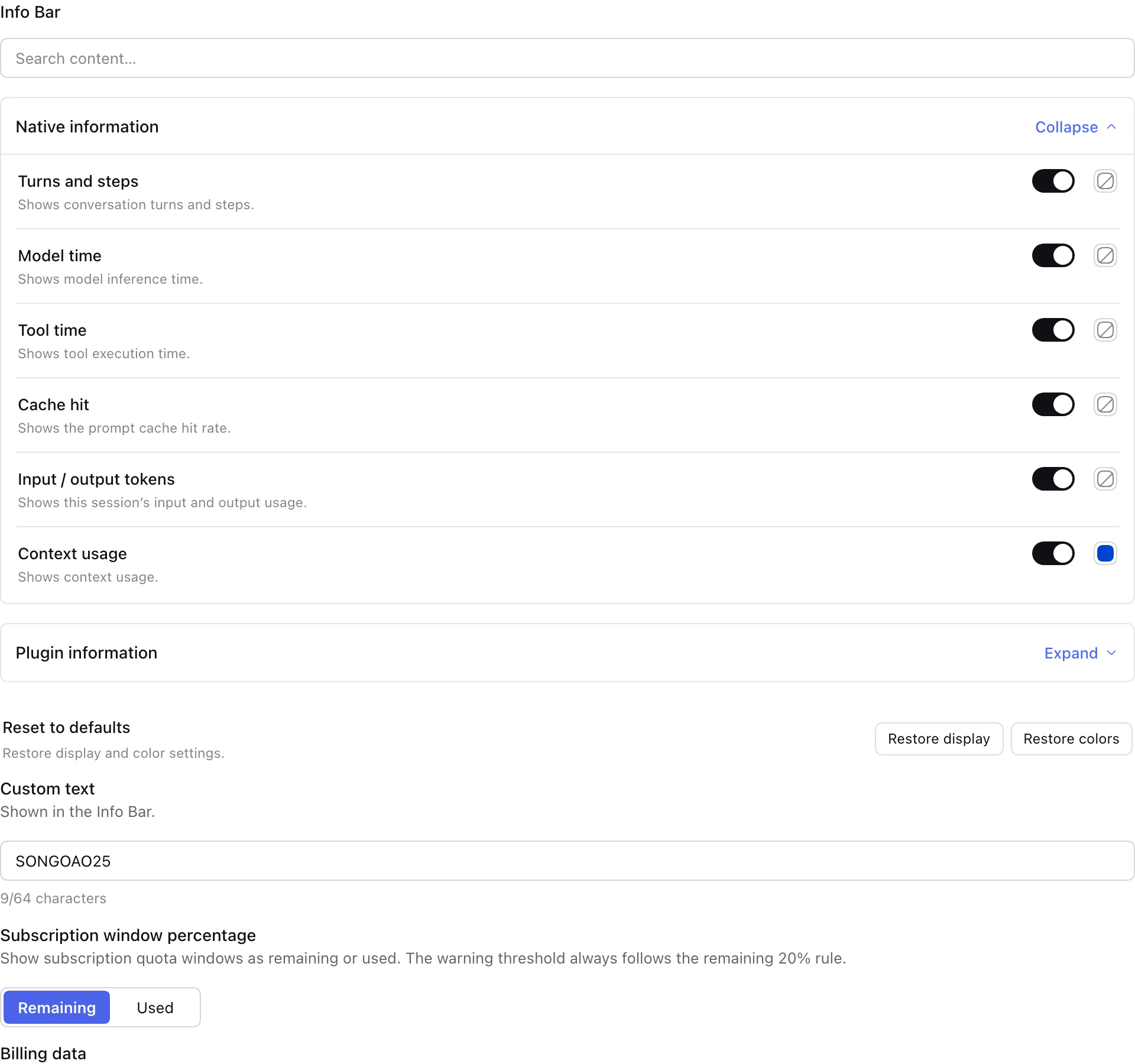
Information display — choose Compact or Full and the choice is saved. Compact does not erase any field choices; switch back to Full whenever you need the extra detail.
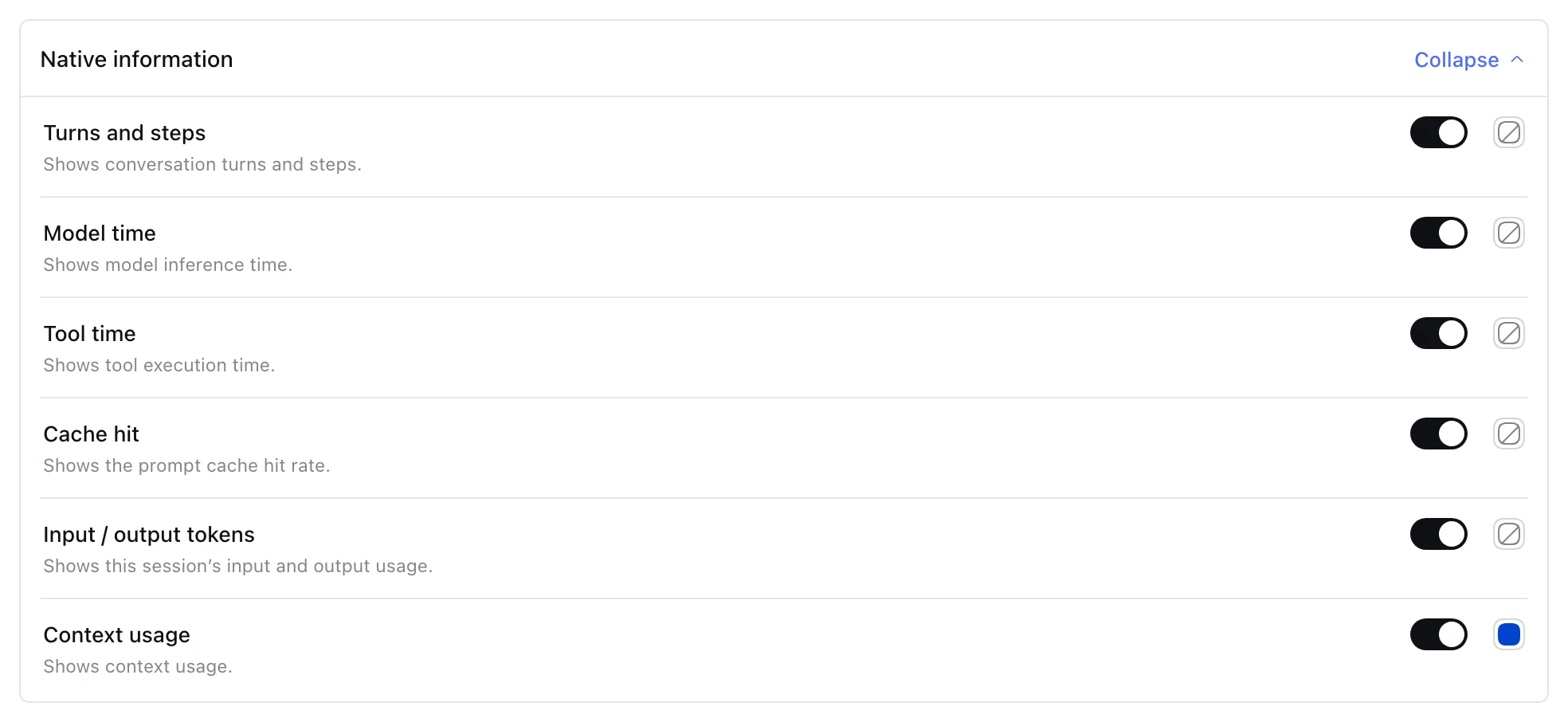
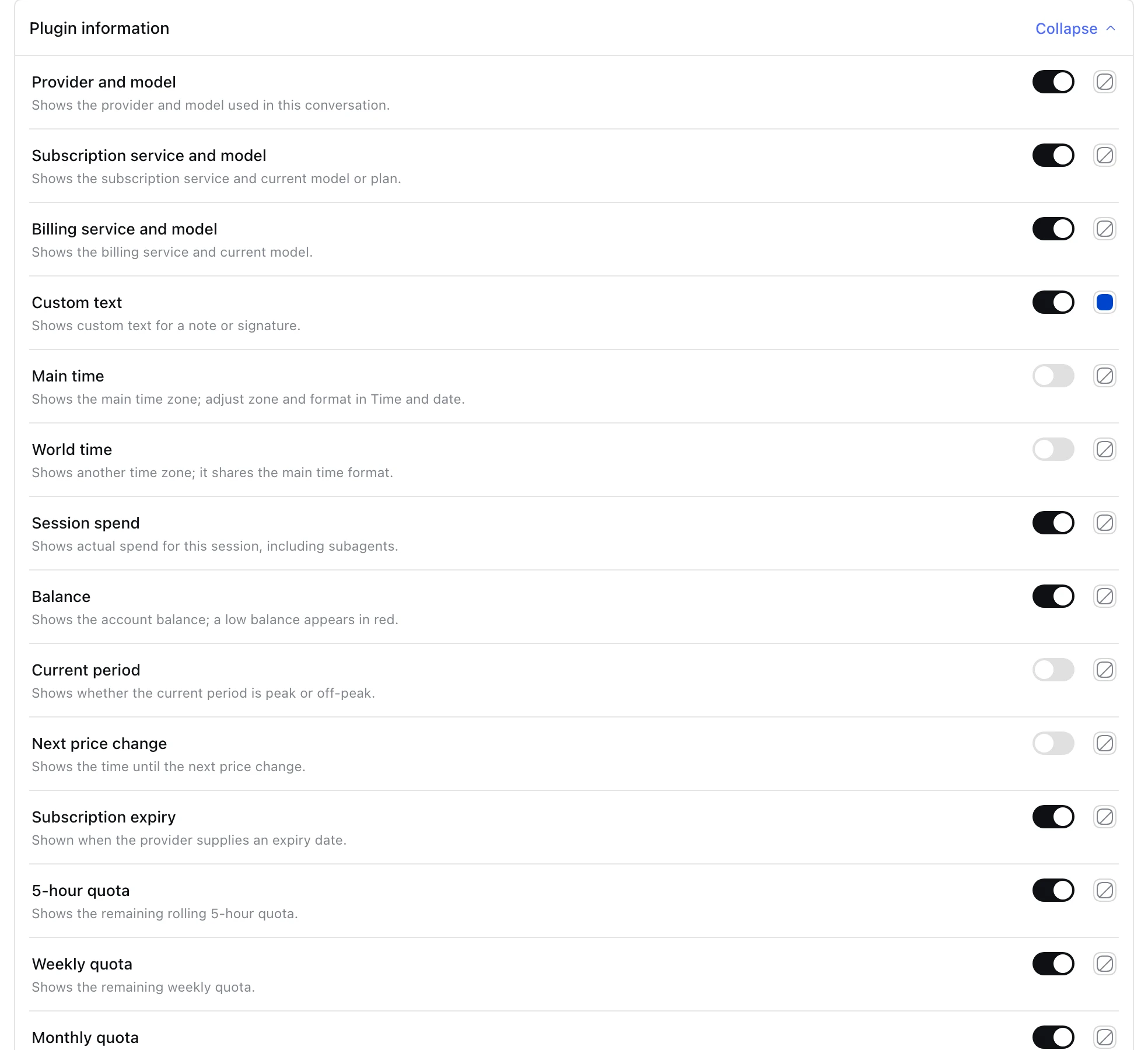
Fields and colors — one switch and one color per field, in two groups. Turn a field off and the bar drops it. The plugin information group opens first; native stats only appear in Full mode.
- Native information — the fields DSH's own stats row already showed.
- Plugin information — everything this bar adds: provider and model, subscriptions, spend, balance, pricing and quota.
Subscription window percentage — show quota windows as remaining (default) or used. The low-quota warning always follows remaining ≤ 20%.


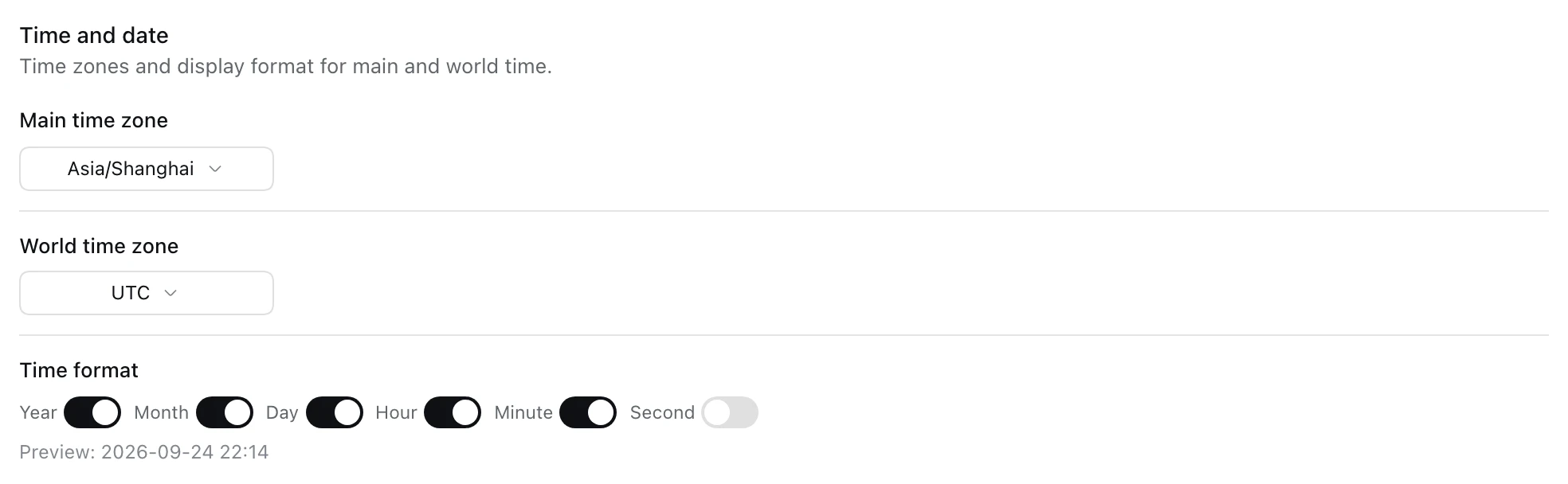
Time and date — main and world time zones, plus which of year / month / day / hour / minute / second to display.
Custom text — up to 64 characters, shown in the bar.

Billing data — export the ledger as CSV or JSON, or clear it after confirmation. Settings and sign-in information stay untouched.
Supported providers
The bar detects the provider from DSH's current model — no configuration. Set the key in DSH under Settings → Models.
Balance
| Provider | Display name | Credential / source |
|---|---|---|
| deepseek / deepseek-official | DeepSeek | DEEPSEEK_API_KEY |
| openai | OpenAI | OPENAI_API_KEY — estimated from your spending rate; there is no public balance API |
| moonshotai / moonshotai-cn / kimi-coding | Kimi | MOONSHOT_API_KEY |
| openrouter | OpenRouter | OPENROUTER_API_KEY |
| stepfun | StepFun | STEPFUN_API_KEY |
| xiaomi | Xiaomi MiMo | XIAOMI_API_KEY |
Subscription quota
| Provider | Display name | Credential / source |
|---|---|---|
| codex / chatgpt / openai-codex | ChatGPT / Codex | ~/.codex/auth.json (read-only, decoded locally) |
| opencode-go / opencode | OpenCode Go | OPENCODE_GO_API_KEY or the opencode CLI login |
| zai / zai-coding-cn | Zhipu | ZAI_CODING_CN_API_KEY (fallback ZAI_API_KEY) |
| xiaomi-token-plan-cn / -sgp / -ams | Xiaomi MiMo | XIAOMI_TOKEN_PLAN_CN/SGP/AMS_API_KEY (fallback XIAOMI_API_KEY) |
| command / command-code | Command Code | COMMAND_CODE_API_KEY or CMD_API_KEY, or ~/.commandcode/auth.json |
| minimax / minimax-cn | MiniMax | MINIMAX_API_KEY (Global) / MINIMAX_CN_API_KEY (CN) — must be a Subscription Key |
Cloud billing
| Provider | Display name | Credential / source |
|---|---|---|
| together | Together | TOGETHER_API_KEY — official Usage API, this month's spend |
| fireworks | Fireworks | FIREWORKS_API_KEY — official Billing API, this period's spend |
| amazon-bedrock | AWS Bedrock | AWS_ACCESS_KEY_ID / AWS_SECRET_ACCESS_KEY — Cost Explorer + Budgets |
| cloudflare-ai-gateway / cloudflare-workers-ai | Cloudflare | CLOUDFLARE_API_KEY + CLOUDFLARE_ACCOUNT_ID (token needs Billing read) |
Anything else shows a Not supported hint instead of borrowing another provider's numbers.
Spend tracking
Every model response is recorded (usage × unit price) and aggregated four ways: this session (including subagents), today, last 30 days and all time. The price is locked the moment a response completes, so later price-table updates never rewrite history. A model with no known price keeps its token counts but is excluded from money totals — no amount is ever invented. Records are written to disk before they count, so a restart loses nothing; if a write fails, the bar says Spend not saved.
Updating
The plugin checks npm for a newer version at startup and re-checks at most every 15 minutes. Pick how it should act in Version and updates on the plugin settings page:
- Automatic (default): download, verify and replace the plugin's own files, then all you do is restart DSH once.
- Manual: it only checks and tells you; nothing is downloaded until you press Check for updates.
Every file is verified before it lands, and a failure rolls the whole batch back, so a bad download never breaks the copy you are running. Roll back to the previous version is one click away in the same section. Only this plugin's own files are touched — never the dependency tree or the profile manifest.
When something needs you, the bar shows two short badges: Restart to apply (a new version is on disk) and Update failed (the last automatic update did not go through). Each one has its own switch under Notices and takes no space otherwise.
Updating itself only runs when the plugin is loaded from a profile (npm, GitHub address and the install script all qualify). A source checkout or a link: install is treated as read-only and left alone — update those by hand:
| Installed via | Command |
|---|---|
| npm | `dsh plugin --profile |
| add dsh-bottom-info-bar@latest` | |
| GitHub address | `dsh plugin --profile |
| add ` | |
| local checkout or install script | git -C fetch origin && git -C checkout main && git -C merge --ff-only origin/main && node /scripts/build.mjs |
The first upgrade to v1.19.0 still needs the table above, because the updater itself only arrives with that version. Later releases need nothing from you.
Privacy and security
- Read-only credentials. API keys stay in DSH;
~/.codex/auth.jsonand~/.commandcode/auth.jsonare read locally and never written back. This plugin does not bind or refresh accounts. - No conversation content. The ledger stores tokens, model, provider, currency and cost — never prompts, messages or keys.
- Local only. Data lives in
~/.dsh/dsh-bottom-info-bar/(directory0700, files0600). Nothing leaves your machine except the provider API requests the bar itself makes. - Uninstalling keeps your data. Export or clear it from the plugin page (Billing data) if you want a clean slate.
Development
- Build:
npm run build - Test:
node tests/run-all.mjs - Contributing: CONTRIBUTING.md
License
MIT © 2026 songoao25
💬 Questions or ideas? Join our WeChat group DeepThinking — QR code.