dsh-snippets
为网页界面管理 CSS 与 JS 代码片段,可启用注入或执行。 适合需自定义界面样式或脚本的用户,仅应启用可信代码。
同名套件的其他儲存庫
安裝
npx -p @deepseek-ai/dsh dsh plugin --profile web add github:zhang24xiao/dsh-snippets說明文件
閱讀完整 README ↗dsh-snippets
CSS and JS code snippets for the DeepSeek Harness web GUI.
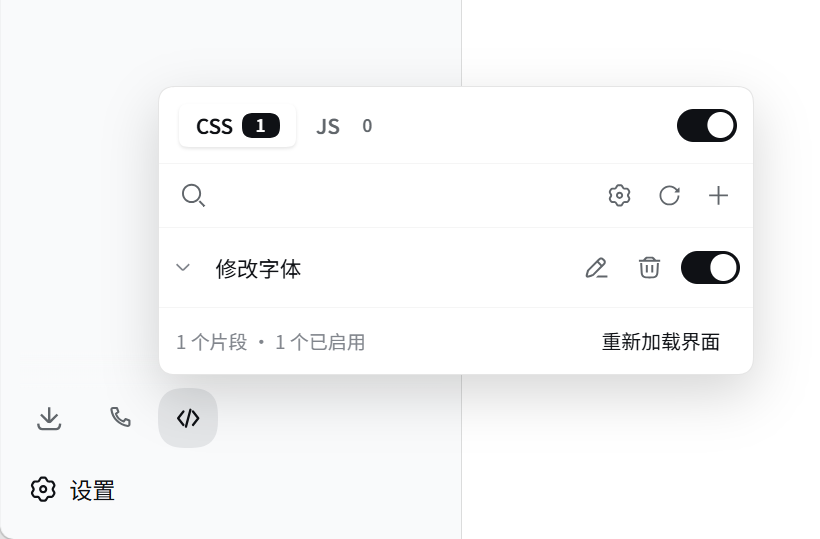
A quick toggle in the sidebar footer beside Settings opens a manager panel —
the same seat @linxin666/dsh-remote-web-ui uses for its phone entry — and
Settings → Code Snippets is an independent page with the full set of
preferences. Enabled CSS is injected into the page immediately; enabled
JS runs after the page loads.
Inspired by TCOTC/snippets, the SiYuan note-taking app's snippet manager, and adapted to the DSH plugin contract.
Screenshots
The quick toggle sits in the sidebar footer, in the same row as Settings, and opens the manager panel:
Settings → Plugins → Plugin configuration carries the card, beside every other plugin's settings:
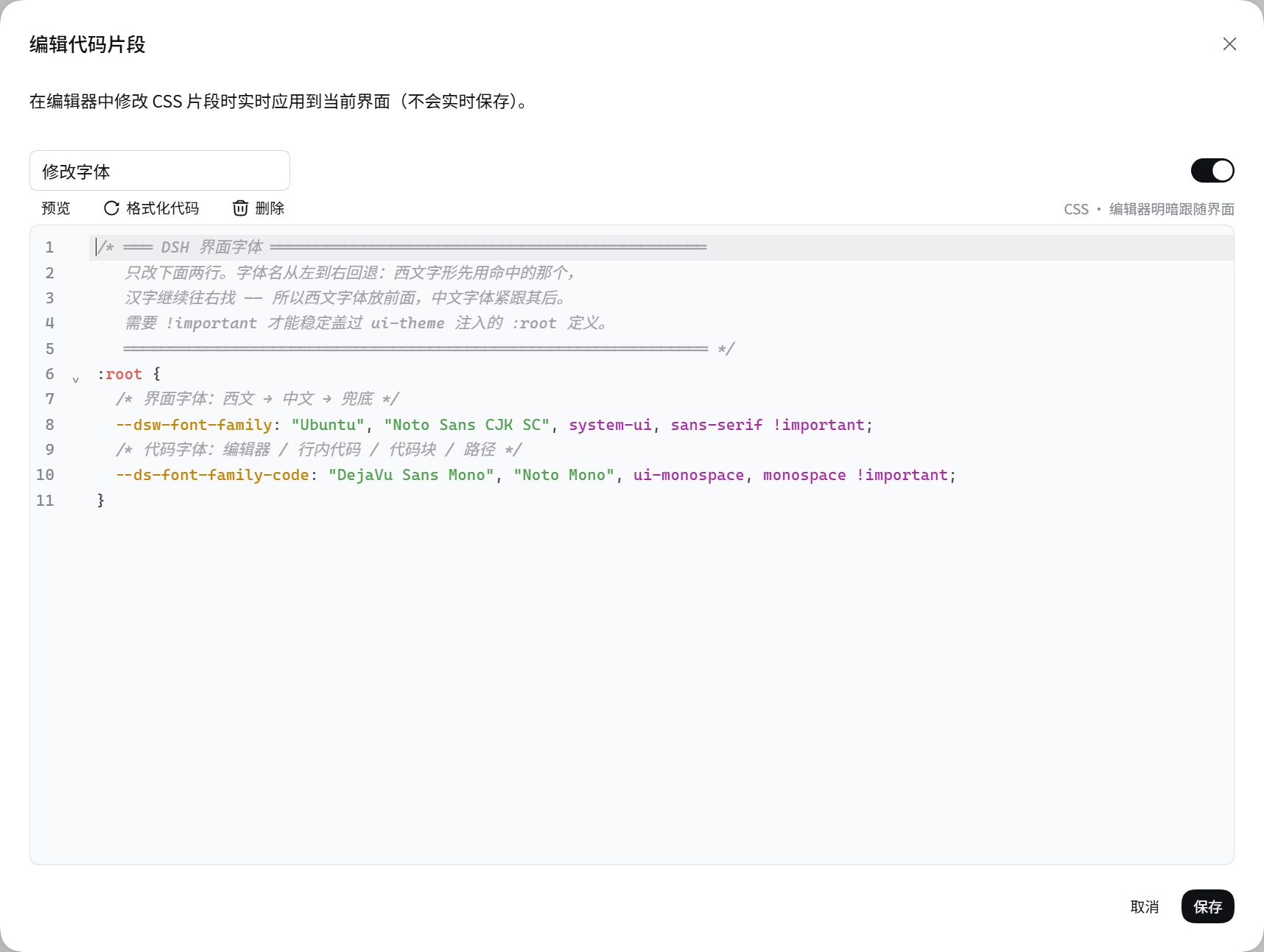
The editor is CodeMirror 6 — line numbers, CSS/JS highlighting, search and replace — sized to the viewport, with live CSS preview:
Features
Managing snippets
- CSS / JS tabs with live counts, one master switch per type, and search across titles, code, or both
- Lives with the other plugin settings, in Settings → Plugins → Plugin configuration
- Add, edit, duplicate, delete, enable/disable, and drag to reorder
- Ten sort orders (custom, enabled-first, title A→Z / natural, oldest/newest)
- Per-row edit / duplicate / delete buttons, each individually hideable
- One-click Reload the interface for changes only a reload can apply
Editing
-
CodeMirror 6: line numbers, CSS/JS syntax highlighting, bracket matching, fold gutter, search & replace, history
-
Configurable indent unit, font size and soft wrap; the theme follows the app, including dark mode
-
Live CSS preview — see the page change while you type, without saving
-
The editor dialog sizes itself to the viewport (up to 1040×760) instead of the shell's 380px form card, and the code area absorbs the leftover height, so a long snippet scrolls inside the card rather than pushing the dialog past the window edge
-
Best-effort re-indent that only ever rewrites leading whitespace
-
Content guards: CSS containing `` button in the SiYuan original. The tooltip carries the name and the live counts; the manager panel's footer carries them permanently.
-
The trigger's box is copied field for field from the neighbouring entry's own trigger, so the two hover surfaces agree:
36×36withborder-radius: 50%in the rail, and in the wide rowpadding: 0 10pxwithborder-radius: 999px. That padding is what makes the wide box 36px around a 16px glyph — without it the box is 16px wide and reads as a narrow vertical pill beside the neighbour's circle. Gaps match too: 6px in the wide row, 4px in the rail. -
The sidebar shell lays the foot out as a column but keeps
sidebar.footer.actiona row even when the column is collapsed to the 56px rail. With one action that is invisible; with two, the icons land side by side and overflow. This plugin therefore injects one narrowly scoped rule that makes the collapsed row a column again:html [class*='_footerActions'] { gap: 6px; } html [class*='_collapsed'] [class*='_footerActions'] { flex-direction: column; gap: 4px; … }The attribute-substring selectors are deliberate: if the shell's class hashes change, the rule simply stops matching and the rail falls back to the shipped layout instead of breaking.
How CSS and JS take effect
- Each enabled CSS snippet becomes one
">element in ``. Toggling one adds or removes exactly that element, so CSS applies and reverts instantly with no reload. - Each enabled JS snippet is compiled with
new Functionand called once per page load. There is no sandbox and no undo — this is deliberately the same trust model as pasting the code into the browser console, which is the point of the feature. Disabling, editing or removing a JS snippet therefore reports that a reload is required, andautoReloadAfterJsEditcan do it for you. window.__dshSnippetsexposes{ version, log, reload }for snippets that want an entry point.- Unloading the plugin removes every `` it injected. Executed JS is not undone; it cannot be.
Security notes
- Snippet data travels only over the official settings wire. The plugin adds no browser-writable snippet endpoint, so on a LAN or tunneled deployment an unpaired visitor cannot reach a route that would inject code into a page.
- The plugin's own endpoints (
/snippets/api/*) do the three things a browser cannot: read the watched folder, call GitHub, and open the backups directory. They answer loopback requests only; over a LAN or tunnel those sections disable themselves and say so. - The GitHub token is stored on the host at
$DSH_HOME/dsh-snippets/gist-token.jsonwith mode0600. It never enters the settings document, never reaches the browser, and the UI only ever learns whether one is configured.
Differences from TCOTC/snippets
Three settings describe SiYuan features that DSH does not have:
| SiYuan | DSH |
|---|---|
| Snippet "publish service" switches | Removed — DSH has no publish concept |
| "Open the native snippet window" | Replaced by "Open the backups folder" |
| Watched folder: relative paths only | Absolute paths and ~ are supported (the DSH host is a plain Node process) |
Development
pnpm install
pnpm run check     # typecheck, build, and both test suites
pnpm run watch     # rebuild on change
npm run test runs two suites:
test/host.test.mjs— namespace registration, the loopback fence on every route, backups, the folder mirror (including id stability across scans), the Gist import plan, and the content guards.test/client.test.mjs— loads the builtclient/client.jsthroughwindow.__ModuleLoader__.loadin jsdom and drives the runtime: an enabled CSS snippet produces exactly one ``, an enabled JS snippet runs exactly once, disabling removes only that element, the type master switch gates injection, and teardown leaves nothing behind. It then server-renders all three registered seats, so a broken render path fails here rather than in the GUI.
License
MIT