dsh-skin
Folder-based skins for DeepSeek Harness Web: image/video backgrounds, token colours, logo, ambient audio.
같은 패키지 이름의 다른 저장소
설치
npx -p @deepseek-ai/dsh dsh plugin --profile web add github:bigm4ngo/dsh-skindsh-skin
English · 简体中文
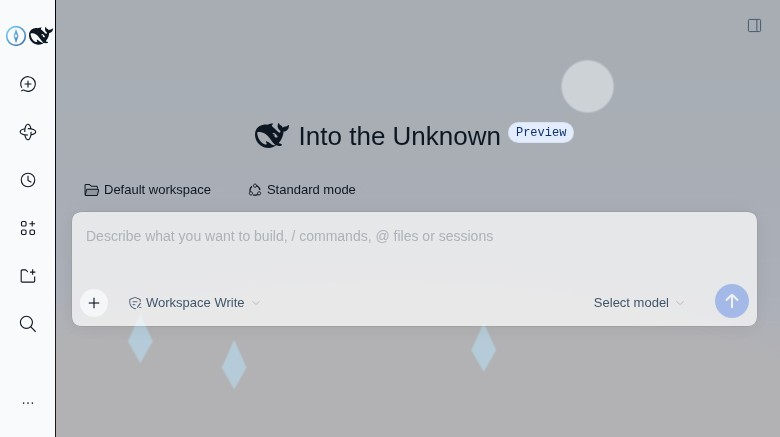
Skins for DeepSeek Harness Web — the kind where you point it at a wallpaper and the whole interface sits on top of it.
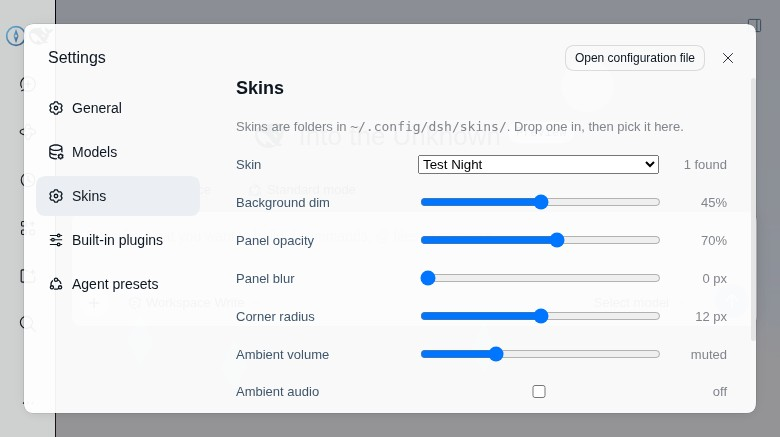
A skin is a folder. Drop it in ~/.config/dsh/skins/, refresh, pick it in Settings → Skins.
Image or video background, translucent panels, your own colours, your own logo and wordmark, optional
ambient audio. No build step, no upload dialog, nothing leaves the machine.
Requirements
- dsh 0.2.2-rc.x. The client peers are pinned to that range; the plugin manager refuses anything outside it rather than half-loading.
- The web profile (
dsh web). The desktop app loads its client differently and is not supported yet.
Install
# from a checkout
dsh plugin --profile web add /path/to/dsh-skin

# or from GitHub
dsh plugin --profile web add github:bigm4ngo/dsh-skin
Restart dsh web and open Settings → Skins.
Nothing is installed system-wide: dsh plugin puts the package in the profile's own node_modules,
and lib/ ships pre-built, so your machine needs no compiler or build step.
Make a skin
The full format — every field, the colour tokens, the rules for drawing a logo — is in SKIN-FORMAT.md. It is written to be handed to a designer, not only to a developer.
The short version:
~/.config/dsh/skins/harbour/
├── skin.json
├── background.jpg      (or .mp4 / .webm)
├── logo.svg            (optional)
└── ambient.mp3         (optional)
{
  "name": "Harbour",
  "background": { "file": "background.jpg", "dim": 0.5 },
  "colors": {
    "dark":  { "bg-layer-1": "#0b1524", "brand-primary": "#7ad1ff" },
    "light": { "bg-layer-1": "#ffffff", "brand-primary": "#1b6f9e" }
  }
}
Reload the page and it appears in the list. If something is wrong — a missing file, a value that isn't a colour, a 300 MB video — the skin is refused and the reason is printed under the dropdown instead of being applied silently.
What you can change
- Background — image or video;
cover/contain/fill/repeat; position; dimming; blur. - Surfaces — panel opacity, backdrop blur, corner radius, the message bubble, the composer field,
the popup menu, and any
--dsw-*colour token, separately for light and dark mode. - Logo and wordmark — your own SVG/PNG/WebP replaces the product mark; a plain string replaces the wordmark.
- Ambient audio — a looping file, or the video's own track; muted by default, with a volume slider.
- Favourites — star the skins you keep coming back to; pinned skins move to the top of the picker and stay in a quick-pick row. Remembered in the browser like the other preferences.
Five of those stay adjustable in the UI (dim, panel opacity, blur, radius, ambient volume) and are
remembered per browser. Everything else comes from skin.json, so a designer can ship a look without
the user having to fiddle.
Notes and limits
- Branding is applied to the existing brand seat, not through the sidebar's brand slots: on 0.2.2-rc.1 those slots do not accept an out-of-tree occupant. The shell's mark is hidden and the skin's logo is painted into the same box, so layout is unchanged.
- Class names in the shell are build-hashed, so the plugin finds the outer containers by geometry and by stable class suffixes rather than exact selectors. A future dsh release may move them; if a wallpaper stops showing through, that is where to look.
How it is put together
Two halves, both small:
- Host (
src/index.ts) registers/dsh-skinon the web server and serves the skins directory — listings at/dsh-skin/index.json, media at/dsh-skin//with HTTP range support so video can stream. It validates each manifest on read. - Browser (
src/client/) fetches the listing, paints the background layer, overrides the design tokens at the element that declares them, and registers the Skins settings page.
A skin is data plus media: no CSS, no scripts, no HTML. Unknown fields are ignored, not executed.
Development
pnpm install
node scripts/build.mjs     # lib/index.js (host) + lib/client.js (browser)
lib/ is committed, so installing from a fresh clone needs no build.
Licence
MIT.