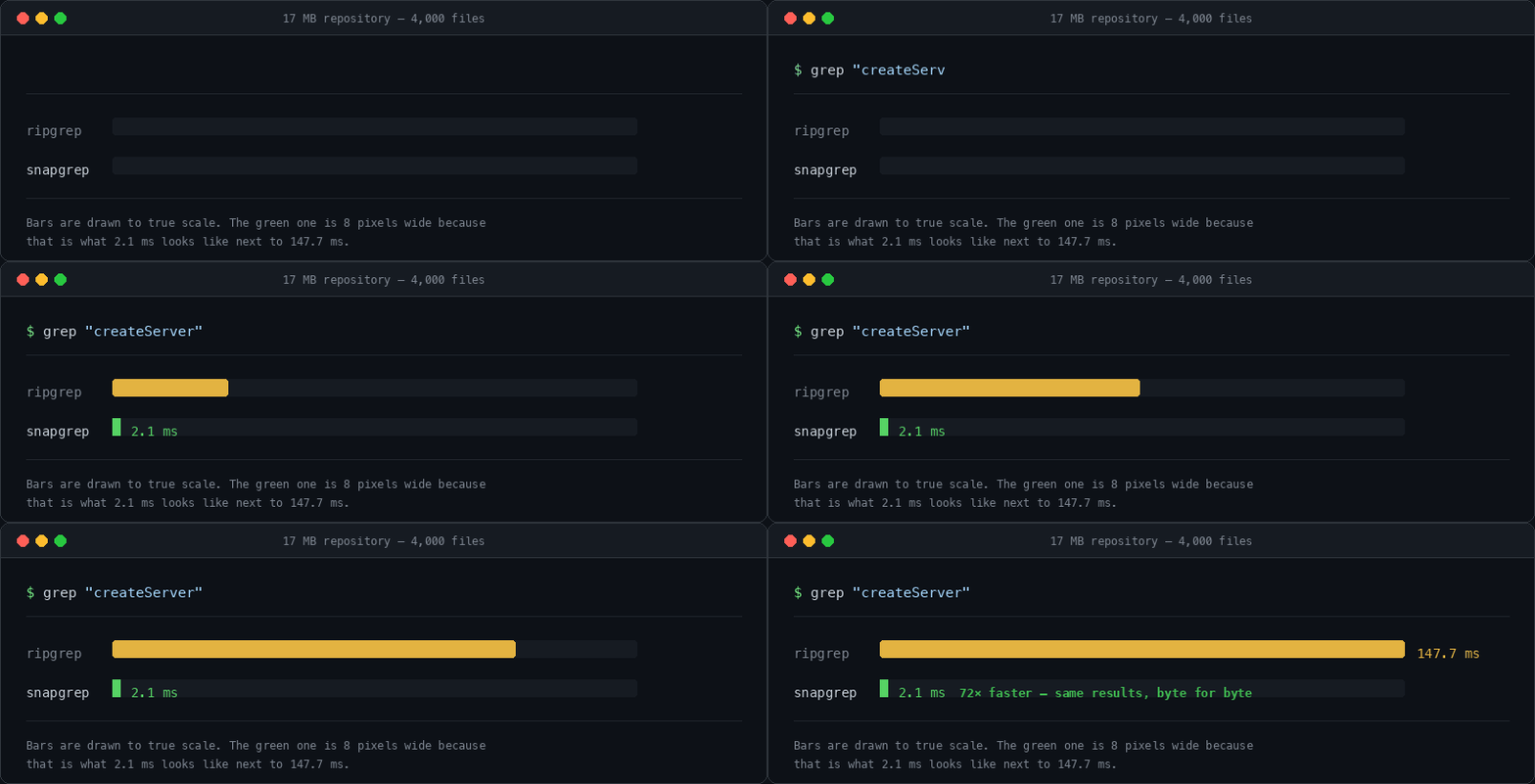
An in-process trigram index that makes code search in Pi
Typically 40–70× faster than ripgrep on a warm index —
and every result is checked against ripgrep, byte for byte.
No sidecar process. No daemon. A single 3.2 MB native addon loaded inside the agent process.
Why this exists
Coding agents search constantly. Every grep call in a large repository means ripgrep reads every byte on disk again — hundreds of milliseconds, several times a minute, forever.
Index-backed search fixes that, but the usual answer is a sidecar daemon (Zoekt, and everything built on it): another process to launch, supervise, keep in sync, and debug when it drifts. For a CLI agent that starts and stops constantly, that is a lot of machinery.
snapgrep puts the whole index in the agent's own process. Rust builds and queries a trigram index over a git snapshot; Node calls it through N-API. Startup to first query is about half a second, and the index is smaller than the code it indexes.
Measured results
All numbers are P50 over 7 measured iterations after 3 warmups, kernel and ripgrep alternating within the same run, on the same repository snapshot with identical query parameters and output limits.
Against ripgrep
Query
snapgrep
ripgrep
Speedup
Rare token, 1 match in 4,000 files
0.120 ms
230.8 ms
1921×
Escaped regex, 1,200 matching files
3.188 ms
220.2 ms
69×
createServer in a 17 MB repo
2.065 ms
147.7 ms
72×
defineConfig, 186 candidate files
2.574 ms
142.9 ms
56×
import\.meta, 538 candidate files
4.179 ms
snapgrep · DSH Hub
156.5 ms
37×
Path-filtered search
0.973 ms
8.0 ms
8×
Where the speedup goes away
Speedup comes from not reading files, so it tracks how many files ripgrep would otherwise have to open. Push that number to its limit and the advantage disappears. From an independent run on Linux, single core, a 20 MB / 5,001-file repository:
Scenario
snapgrep
ripgrep
Speedup
Every file matches (5,001 files)
6.98 ms
18.5 ms
2.6×
300 files match
0.22 ms
14.1 ms
63.5×
One file matches (rare token)
0.006 ms
14.2 ms
2458×
When every file matches, the index has nothing to skip, and 2.6× is all it can win. That is the number to plan around for a query like function in a JavaScript repository. The four-digit figures are the other extreme: ripgrep must scan the whole tree to prove a token appears once, while the index answers from a posting list.
Most real agent searches sit in the middle — a symbol name in a few dozen to a few hundred files.
Against Zoekt
Zoekt is the reference index-backed engine. Every query that snapgrep serves from its index is at least twice as fast, measured against Zoekt in the same run:
Query
snapgrep
Zoekt
Ratio
Glob filter *.yaml, 800 files
1.533 ms
70.4 ms
0.022
Case-insensitive, 500 files
3.003 ms
51.8 ms
0.058
Glob filter *.ts
3.053 ms
14.8 ms
0.206
Case-insensitive defineConfig
4.806 ms
13.8 ms
0.347
Zoekt's per-query cost is dominated by HTTP transport, JSON decoding, and re-verification across a process boundary. Removing the process boundary removes all three.
Footprint
Synthetic 17.0 MB corpus
Real 17.4 MB repository
Index size
6.5 MB (0.38× source)
15.9 MB (0.91× source)
Cold start to first query
662 ms
508 ms
Resident processes
0
0
Why a custom kernel
Not because the trigram algorithm is novel. It isn't — Zoekt has done this well for years, and this project measured itself against Zoekt on every accepted change.
The reason is that buying the index means buying its process boundary, and the boundary costs more than the search. Here is where Zoekt's slowest query on the vite corpus actually spent its 18.32 ms:
Stage
Time
Share
Zoekt's own search
1.24 ms
7%
HTTP transport + JSON decode
3.58 ms
20%
Verification (mostly rg process startup)
8.34 ms
45%
Local merge and classification
5.14 ms
28%
The search itself is 7% of the bill. The other 93% is the cost of the index living somewhere else: serialise the query, cross a socket, decode JSON, then spawn ripgrep to re-read files the index already had in memory. A single ripgrep spawn has a floor of about 6 ms on this machine — that alone outweighs the entire search.
Owning the kernel is what makes that 93% disappear:
The index is mapped into the agent's own memory. No socket, no JSON, no serialisation. A query is a function call.
Verification reads the mmap'd index, not the disk. Candidates are confirmed in-process against bytes that are already resident, so there is no spawn and no second read.
Unsupported queries can fail closed instead of approximating. This one is not a performance argument, and it is the reason a general-purpose library was not enough. An earlier attempt used an off-the-shelf file finder for candidate selection; on the Linux kernel tree it returned 17,767 files where ripgrep found 17,772. Five missing files, from nested .gitignore re-inclusion rules — and a final ripgrep pass can only remove extra results, never recover ones the candidate stage already dropped. When the recall boundary is someone else's implementation detail, you cannot prove it, and you cannot fix it.
The index format is tuned for this shape of data — compressed content blocks, delta-varint gram metadata — which is how the index lands at 0.38–0.91× the size of the source it indexes.
The trade is real and worth stating: one .node per platform to build and ship, and every ripgrep behaviour has to be re-proven rather than inherited. Twenty of the twenty-four benchmark queries are served from the index today; the other four hit ripgrep's binary-file and NUL-byte output semantics, which have not been replicated yet, so they fall back rather than guess.
Correctness comes first
Every result set is checked against ripgrep on the same snapshot with the same flags. The bar is missing = 0 && extra = 0 — and also identical ordering, byte offsets, context lines, and truncation behaviour.
All 24 conformance queries match ripgrep exactly. 20 are answered from the index; the other 4 fall back to ripgrep, and the comparison covers both paths. That has held on every accepted change.
Anything the index cannot serve correctly falls back to a full ripgrep search rather than returning a partial answer. Fallback is reported in the result metadata with a reason, so an unsupported query never looks like an empty result.
Currently falling back:
Binary files where ripgrep's NUL-byte output semantics apply
Regex combined with path or glob filters
Literals shorter than 3 bytes, or spanning line breaks
Case-insensitive search with a non-ASCII pattern
Glob syntax outside the proven subset (!, ?, [], {})
These are correctness boundaries, not missing features. Each one is a case where matching ripgrep's exact behaviour has not been proven yet, so the index refuses to guess.
Install
curl -fsSL https://raw.githubusercontent.com/Owen718/snapgrep/main/install.sh | sh
Detects your platform, downloads only the addon that machine can run (~1.2 MB), and installs into ~/.pi/agent/extensions. Nothing is compiled and no daemon is started.
Then start pi — its built-in grep is replaced automatically, in every project. To confirm it is active, ask Pi to search for a string you know exists: the tool detail will show actualBackend: kernel.
Set PI_EXTENSIONS_DIR to install somewhere else. Prefer to do it by hand, or want one copy that works on every machine? Grab snapgrep-extension-all-platforms.tar.gz from the release — it carries all five addons and picks the right one at load time.
Install into a single project instead
git clone https://github.com/Owen718/snapgrep.git

mkdir -p /path/to/your-project/.pi/extensions
cp -R snapgrep/artifacts/pi-extension/pi-fast-grep /path/to/your-project/.pi/extensions/

cd /path/to/your-project
pi --approve
--approve is only needed the first time, to trust a project-level extension. The artifact carries a .gitignore scoped to its own directory, so installing it will not make your repository dirty.
Prebuilt addons ship for macOS (Apple Silicon and Intel), Linux (x64 and arm64, glibc), and Windows x64. Alpine/musl is not built yet; on any unsupported platform the extension names the exact file it could not find rather than failing silently, and you can build one with npm run build:kernel && npm run package:extension.
DeepSeek Harness ships a grep tool that spawns the packaged ripgrep binary through ctx.subprocess.spawn() on every call — a process launch plus a full scan, each time. This repository includes a Cordis plugin that answers from the index instead.
The harness resolves plugins through pnpm and a profile bundle list, so it installs differently from Pi:
npm i -g pnpm
curl -fsSL https://raw.githubusercontent.com/Owen718/snapgrep/main/install.sh | sh -s -- --dsh
That registers the package and adds it to the profile's bundle list. Installing alone is not enough — a bundle stays inert until it is listed there, and the harness reports it as a plain dependency. Target another profile with DSH_PROFILE.
Verify with dsh --profile headless --dump-config | grep snapgrep.
Verified end to end, not inferred from types: a real DeepSeek V4-Flash session calling both tools returns correct results, and the index file appears under ~/.cache/snapgrep/ — proof the query was served from the index rather than quietly falling back.
Measured on the same 17.4 MB vite repository, against what the harness does today:
Query
Indexed
Harness default
Speedup
createServer
1.74 ms
131.0 ms
75×
defineConfig
2.12 ms
133.3 ms
63×
normalizePath
1.36 ms
130.0 ms
96×
ResolvedConfig
1.89 ms
128.3 ms
68×
Those came off an idle machine. Re-measured under load average 3.9 the same queries land at 50–63× — both sides slow down, but the indexed side is small enough that fixed costs weigh more on it. Expect the lower end on a busy laptop.
Three things this had to get right, each found by running it rather than reading about it:
The registry rejects a duplicate tool name outright — there is no last-one-wins. The plugin's bundle patch disables the built-in tool-fs-search row and supplies both grep and glob in its place. glob runs the identical ripgrep invocation the built-in used: same flags, same modification-time ordering, same VCS exclusions.
The index lives in ~/.cache/snapgrep/, never inside the repository. An index written under the workspace appears as an untracked file, and since the kernel only serves a clean Git snapshot, it would disable itself after one query.
Freshness runs off tools/pre-execute, which fires before a writing tool dispatches, so a search cannot observe a workspace caught mid-write. Rebuild costs about 60 ms; read-only tools do not trigger one.
A workspace that is not a clean Git tree falls back to a full ripgrep run: correct, just not accelerated.
With oh-my-pi (omp)
oh-my-pi ships a compatibility layer that treats @earendil-works/pi-coding-agent as an aliased scope, and its extension loader accepts both .omp and .pi directories. The same package works unmodified:
Every API this extension depends on is present in omp's shim — defineTool, createGrepToolDefinition, registerTool, registerFlag, getFlag, and the session_start / tool_execution_start / user_bash / tool_result / session_shutdown events that drive index invalidation and recovery. This was verified against the published type definitions of @oh-my-pi/pi-coding-agent, not by running it — if something misbehaves, please open an issue.
omp already has a fast grep, and it is fast for a different reason: it links ripgrep into its own process, which removes the fork-exec cost of shelling out. That is a real saving — a single ripgrep spawn costs roughly 6 ms — but the scan itself is unchanged. Linked in or not, ripgrep still reads every byte of every eligible file.
snapgrep removes the scan instead. On the 17 MB corpus above, ripgrep takes 147.7 ms, of which about 6 ms is process startup. An in-process ripgrep lands somewhere near 141 ms; the index answers in 2.1 ms because it never opens the other 99% of the files. The two techniques compose rather than compete — candidate selection by index, exact verification in-process, which is what this project already does internally.
Staying fresh
An index is only useful if it reflects what you just edited.
Before any tool that can modify files runs, in-flight searches are drained and the index is invalidated. After the tool finishes, the index is rebuilt from the current working tree. A search can therefore only ever observe a complete state — never a torn one, mid-edit.
Measured recovery on a 300-file repository: 41–62 ms from edit to searches running on the index again. Two consecutive edit calls and one bash call were each followed by a search that returned to the index and matched ripgrep exactly.
While a rebuild is in flight, searches fall back to ripgrep. Correct, just not accelerated.
How it works
Pi (Node)                         snapgrep (Rust, same process)
┌────────────────┐   N-API     ┌──────────────────────────────┐
│ grep tool      │ ──────────► │ trigram index over a git     │
│                │ ◄────────── │ snapshot, mmap'd             │
└───────┬────────┘             └──────────────┬───────────────┘
        │                                     │ candidates
        │ unsupported query,                  ▼
        │ or index rebuilding      ┌────────────────────────┐
        ▼                          │ in-process exact verify│
   ripgrep (full search)           └────────────────────────┘
Split the pattern into trigrams and intersect their posting lists to get candidate files.
Apply hidden / path / glob / case filters at the candidate level, before any file is read.
Verify exactly, in-process, over the mmap'd index — no subprocess, no re-read from disk.
Materialize only the lines actually needed for the requested limit and context.
The index is a single file per repository, built from a clean git snapshot, with content blocks compressed and gram metadata delta-varint encoded.
Development
./scripts/bootstrap.sh      # pins dependencies, builds, runs the test suite
npm run check               # type check
npm test                    # unit and integration tests
npm run test:kernel         # native tests against the real addon
npm run benchmark           # correctness and performance harness
Requires Node 22.19+, Rust, and ripgrep on PATH.
Benchmark result artifacts from the most recent accepted rounds are in artifacts/results/, including the correctness runs, the same-run A/B no-regression measurements, and the delivery readiness numbers quoted above.
Method notes
Two measurement rules this project learned the hard way, both worth stealing:
Never compare against a P50 recorded in an earlier run. Re-measuring the same unchanged code across sessions drifted by −31% to +9% — enough to manufacture a regression that does not exist, or hide one that does. Every no-regression check runs both versions in the same process batch, alternating ABAB, each with its own warmups.
A 5% threshold is meaningless on a query that does no work. For searches with zero candidate files, 5% is about 4 microseconds — below timing noise. Running two byte-identical builds against each other showed exactly how much noise each class of query carries, and the thresholds were set from that measurement: absolute microsecond bounds for near-zero-work queries, the relative 5% bound for everything else. That calibration immediately caught a real 5 µs regression caused by an added per-instance property changing V8's object layout.